Phosphorus, Your Bones, and Your Kidneys
If you have kidney disease, your care team may have told you to watch your phosphorus. Maybe a blood test came back high, or you were handed a new pill to take with meals and weren't sure why. This page explains what phosphorus is, why it builds up when your kidneys are weak, what it does to your bones, and how to keep it in a safe range. It is written for patients, not for medical staff.
Phosphorus is a mineral in your food that healthy kidneys clear out of your blood. When your kidneys are damaged, phosphorus can build up — and over time that weakens your bones and stiffens your blood vessels. The good news is that you have real control here. Cutting back on processed foods that carry phosphorus additives, choosing lower-phosphorus foods, and taking your binder pills with meals all help keep phosphorus down, which is how we work to protect your bones and your heart.
Visual reference
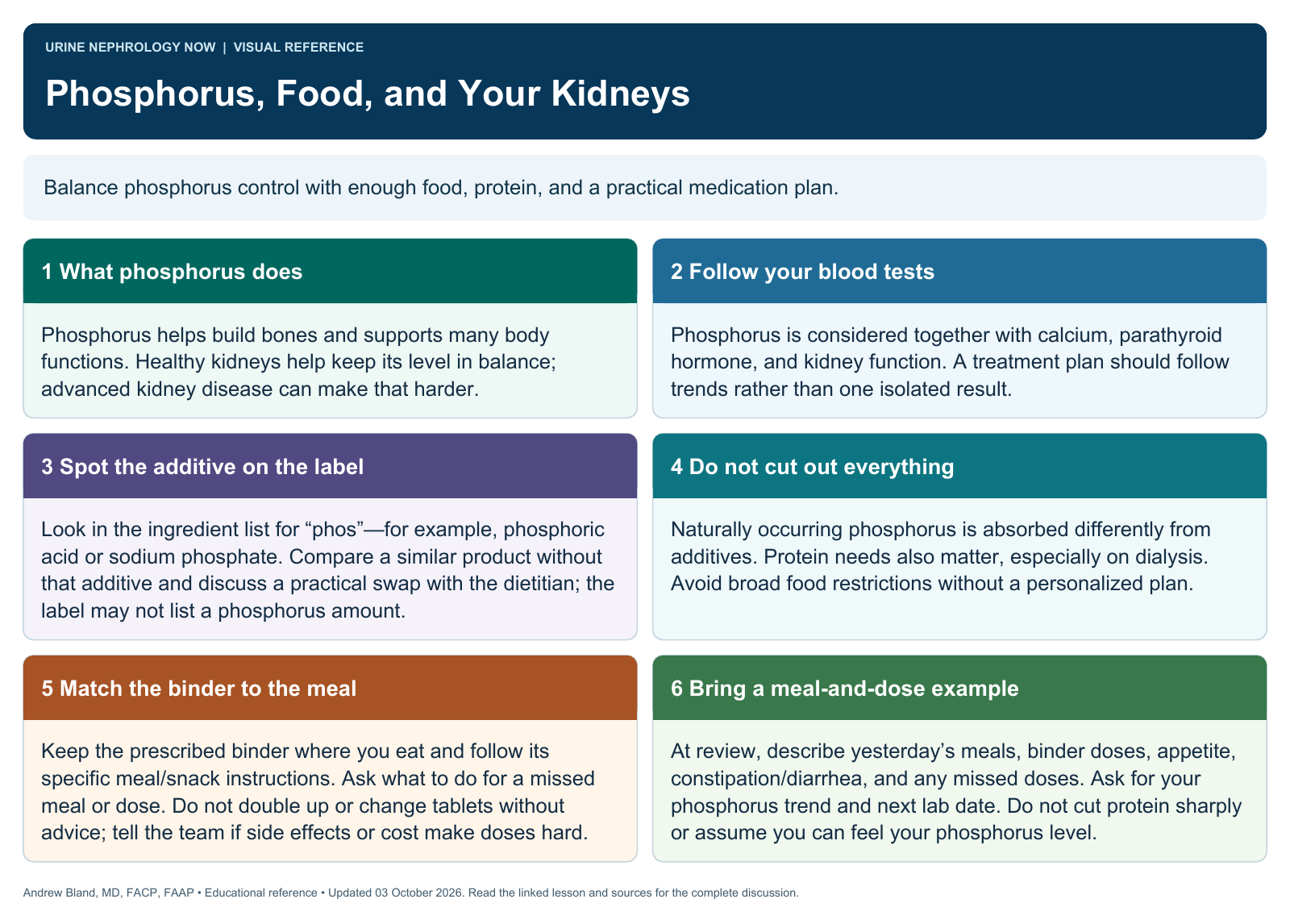
Browse the visual reference library · Download lesson Markdown
What phosphorus does in your body
Phosphorus is a mineral, much like calcium. You get it from food, and your body uses it in nearly every cell — to build bones and teeth, to store energy, and to keep tissues working. Phosphorus and calcium work as a pair, and your body likes to hold them in a steady balance.
Your kidneys are the main organ that manages that balance. A healthy kidney filters your blood and sends any extra phosphorus out in your urine, which keeps the level in your blood inside a narrow range — roughly 2.5 to 4.5 on your lab report. When the kidneys can no longer do that job well, the balance tips.
Why phosphorus builds up in kidney disease
When kidney function drops, your kidneys can't clear phosphorus the way they used to, so it starts to collect in your blood. At first your body pushes back. It makes more of two hormones — FGF23 first, then PTH, which comes from small glands in your neck — and both tell the kidneys to dump more phosphorus. For a while, this keeps your blood level looking normal.
As kidney disease advances, those hormones can't keep up, and phosphorus climbs. Two things make this easy to miss. High phosphorus usually causes nothing you can feel — you won't ache or tire from it directly. And the harm it does happens slowly, over months and years. That is exactly why your team tracks it on your blood tests and treats it before you would ever notice a problem.
The phosphorus–bone connection
Here is why phosphorus matters so much when your kidneys are weak. A high phosphorus level does not stay in one place — it drags your calcium and your bones into the problem.
The extra phosphorus, along with the high PTH hormone, pulls calcium out of your bones. Over years, this weakens them. Kidney doctors call the result renal bone disease. Bones can grow fragile and break more easily, sometimes from only a minor fall.
Renal bone disease is not one single problem. Bone can end up turning over too fast, or too slowly, and the treatment is different for each. That is why your team aims to hold your phosphorus and your PTH in a range rather than push either one as low as it will go.
High phosphorus does something to your blood vessels at the same time. It signals the cells in your artery walls to start acting like bone-building cells, and they lay down calcium in the wall itself, which makes those vessels stiff. This is one reason people with kidney disease face a higher risk of heart problems. Keeping phosphorus in a safe range is how we try to protect your bones and your heart. We know high phosphorus goes along with worse outcomes; we're still learning exactly how much lowering it helps.
You may feel completely fine with a high phosphorus level. The harm — weaker bones and stiffer blood vessels — builds quietly. That is why your kidney team treats phosphorus early, with diet and medicine, long before it would ever make you feel sick.
Phosphorus in everyday foods
Natural phosphorus still counts, so your dietitian may ask you to watch some whole foods too — dairy most of all, because your body absorbs its phosphorus well. This does not mean you can never eat them; it means portion size and balance matter.
| Naturally higher in phosphorus | A lower-phosphorus choice |
|---|---|
| Milk, yogurt, and hard cheese | Smaller portions, or a dietitian-approved non-dairy option |
| Processed and spreadable cheese | A small amount of natural cheese |
Beans, lentils, nuts, seeds, and peanut butter sit near the top of many older phosphorus lists. They do hold a lot of phosphorus, but you absorb little of it, so they count for less here than those lists suggest. Your dietitian may still set a portion size for other reasons, such as potassium.
Your needs depend on your kidney function, whether you are on dialysis, and your other lab values, so the safest plan comes from a kidney dietitian rather than a one-size-fits-all list. If you don't already work with one, ask your team for a referral.
Phosphate binders — the medicine you take with meals
When diet alone isn't enough — and once kidney disease is advanced, it often isn't — your doctor may prescribe a phosphate binder. With this medicine, timing matters more than with almost anything else you take.
A binder works inside your gut. When you take it with food, it grabs onto the phosphorus in that meal and carries it out in your stool, so less of it reaches your blood. That is the whole idea. A binder swallowed on an empty stomach, or an hour after you eat, has little food phosphorus to catch — so most of the dose is wasted.
The rule to remember: take your binder with the first few bites of your meal or snack, every time you eat. If you skip a meal, you usually skip that dose. A larger meal may call for more, a small snack for less — your team will tell you how to match your binder to what and when you eat.
A phosphate binder only works on the phosphorus in the food you eat alongside it. Taken on an empty stomach, it catches about a third as much. And if your binder is a calcium one, taking it between meals means you absorb more of that calcium instead — the opposite of what you want. Take it with the first bites of each meal and snack, and don't save the doses for bedtime.
There are several kinds of binder, and your doctor chooses based on your calcium level and your other needs.
| Type of binder | Examples | Good to know |
|---|---|---|
| Calcium-based | calcium acetate | Common and low-cost; your doctor watches your calcium, since too much calcium is not good either |
| Non-calcium | sevelamer, lanthanum | Often chosen when your calcium is already on the high side |
| Iron-based | ferric citrate | Binds phosphorus and adds iron your body can use, so some people need fewer iron infusions |
| Iron-based | sucroferric oxyhydroxide | Usually fewer tablets than other binders; turns the stool dark, which is expected and harmless |
Your pharmacy label may show a brand name rather than the generic name above. If you aren't sure which type you take or how to time it, your pharmacist or kidney team can walk you through it.
Warning signs — when to call
High phosphorus itself rarely causes symptoms you can feel. The signs below usually point to a different mineral problem — most often a low calcium level — but they are worth a call to your kidney team either way.
• New tingling or numbness around your lips or in your fingers
• Muscle cramps, twitching, or spasms
• Bone pain, or a bone that breaks from a minor fall
• You have run out of your binder, or you're not sure how to take it with meals
• You've started any new medicine or supplement — some contain phosphorus or calcium
Questions worth asking your kidney team
- What is my phosphorus level, and what range are we aiming for?
- Do I need a phosphate binder — and exactly how and when should I take it with meals?
- Can I see a kidney dietitian to build a phosphorus plan around the foods I actually eat?
- Which processed foods should I cut first for the biggest benefit?
- Are any of my other pills or supplements adding phosphorus or calcium?
- How is my phosphorus affecting my bones, and should we check them?
About this guide
This guide follows the KDIGO 2017 international guideline on bone and mineral health in kidney disease, along with the medical literature since. KDIGO does not set one target phosphorus number for everyone — the goal is to bring a high level down toward the normal range, which is why your own target comes from your kidney team.