Potassium and Your Kidneys
If you have kidney disease, someone has probably talked to you about potassium — or handed you a blood result with a number that was too high. This page explains what potassium is, why it can build up when your kidneys are not working well, and what you can do about it. It is written for patients, not for medical staff.
Potassium is a mineral your body needs, but too much of it in your blood is dangerous — it can throw off your heartbeat. When your kidneys are not working well, potassium can build up, because your kidneys are how your body normally gets rid of the extra. The good news is that high potassium can be managed: with smart food choices, by being careful with salt substitutes, sometimes with a medicine called a binder, and by keeping the medicines that protect your kidneys under your team's watch. Below, we walk through each one.
Visual reference
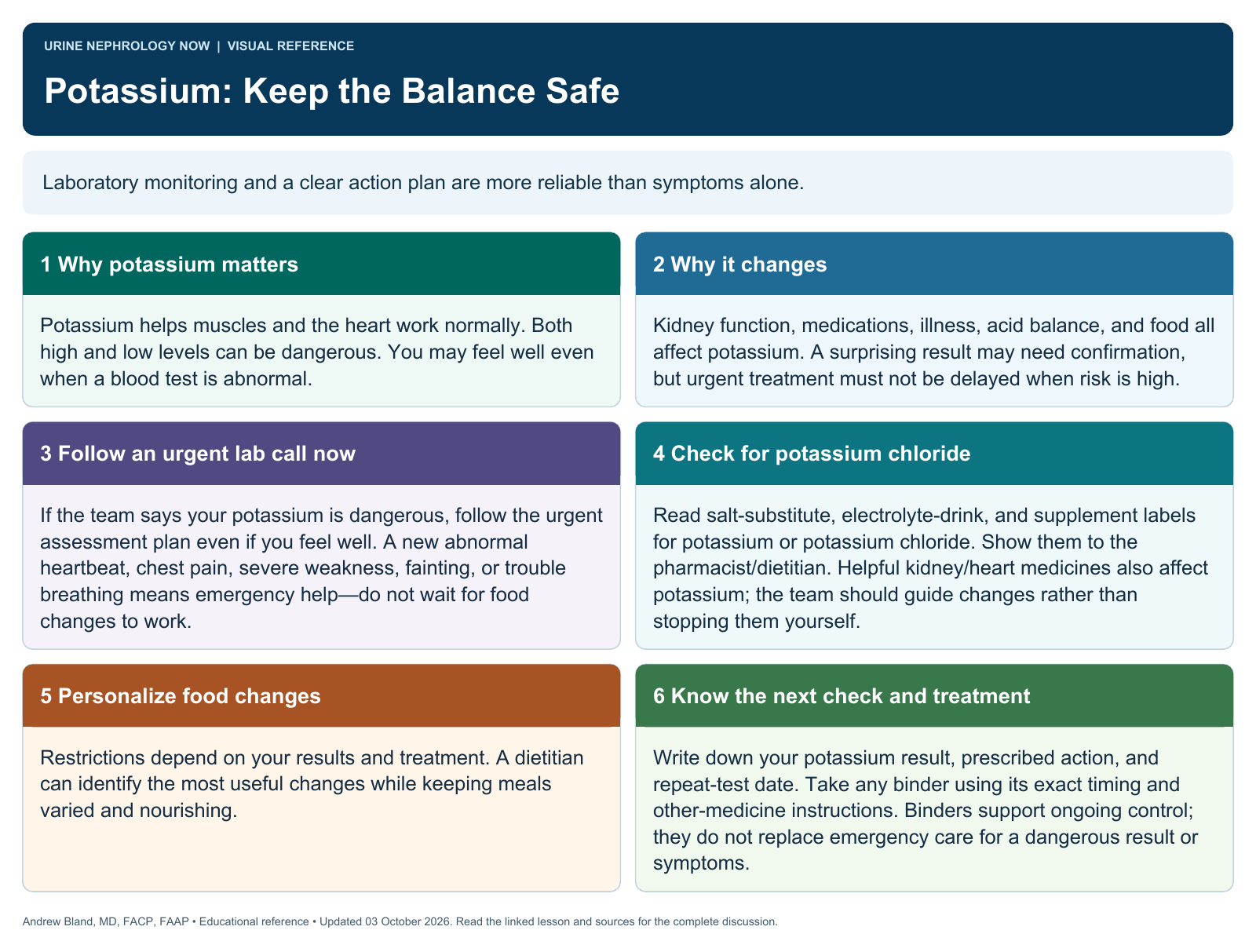
Browse the visual reference library · Download lesson Markdown
What potassium does in your body
Potassium is a mineral found in many everyday foods. Your nerves, your muscles, and — above all — your heart depend on it to work properly. Your body keeps the amount of potassium in your blood inside a narrow range, roughly 3.5 to 5.0 on your lab report.
Healthy kidneys do most of that balancing. When you eat more potassium than you need, they send the extra out in your urine. A blood level above about 5.5 is called high potassium — the medical word is hyperkalemia — and the higher it climbs, the more it matters. A level in the borderline zone between about 5.0 and 5.5 is worth keeping an eye on: your team may recheck it or make a small adjustment before it climbs further. Labs differ on where they draw the line — many flag anything above 5.0 — so a 5.2 can look alarming on the printout and still not worry your kidney team.
Why potassium can build up when your kidneys are struggling
Because your kidneys are the main way your body clears extra potassium, kidney disease is one of the most common reasons it rises. When your kidneys filter less and make less urine, potassium that would normally leave your body stays in your blood instead.
A few other things can add to it:
- Certain medicines — covered further down — slow how quickly your kidneys let go of potassium.
- Potassium added to food during processing, and salt substitutes made with potassium chloride. Your body takes up added potassium almost completely, and the label often does not mention it.
- Getting dehydrated or very sick. When you cannot keep fluids down, less blood reaches your kidneys and they filter less — and the potassium-raising medicines further down this page are usually still being taken. It is the dehydration, not the stomach bug itself, that tips the level up.
- Blood that turns more acidic, which can happen with kidney disease and pushes potassium out of your cells and into your blood.
Often it is a combination — a kidney-protecting blood-pressure pill, plus a salt substitute someone recommended, plus a day of the flu.
When high potassium is an emergency
Here is the part that surprises people: high potassium usually causes no symptoms at all. You can feel completely normal with a level that is dangerous. That is exactly what makes it risky — sometimes the first sign is a serious change in your heart rhythm, which can be life-threatening and can come on suddenly.
When symptoms do show up, they can include muscle weakness, numbness or tingling, or a heartbeat that feels slow, skipping, or irregular. None of these are reliable, though, which is why a blood test is how high potassium is usually caught.
If your kidney team tells you your potassium is very high, take it seriously even if you feel fine. Very high levels are treated in the hospital, where medicines can protect your heart and move potassium out of your blood, and dialysis can remove it quickly when needed. The message for you at home is simple: do not brush off a high result just because you have no symptoms.
Higher- and lower-potassium foods
Nearly every food contains some potassium, but the amount varies a lot. Start here: not everyone with kidney disease needs a strict limit. Whether you need to cut back — and by how much — depends on your blood levels and your other conditions, and fruits and vegetables do a lot of good elsewhere in your body. Cutting them out is not the first move.
If your team has asked you to watch your potassium, the table below is a starting point. Portion size matters as much as the food itself — a small amount of a high-potassium food may be fine, while a large helping of a "lower" one adds up.
| Higher in potassium — watch your portions | Lower in potassium — usually easier on your levels |
|---|---|
| Potatoes and sweet potatoes | Apples, berries, grapes |
| Tomatoes and tomato sauce | Pineapple and canned peaches (drained) |
| Oranges and orange juice | White bread, pasta, and white rice |
| Bananas, avocado, and melon | Green beans, cabbage, cauliflower |
| Beans, lentils, and nuts | Lettuce and cucumber |
| Dried fruit — raisins and dates | Blueberries and cranberries |
| Spinach and other cooked greens | Rice or corn cereal |
| Milk, yogurt, and bran | Cherries and plums |
Three practical points:
- Boiling helps — soaking does not do much. Cut potatoes into small pieces, boil them, and pour the water off. The smaller the pieces, the more potassium ends up in the water instead of on your plate.
- Watch for potassium that was added. Processed and "enhanced" meat, poultry, and fish often have potassium added during packing. That is a better place to look than your fruit bowl.
- Get help building the list. A kidney dietitian can build a food plan around what you actually like to eat. Ask your team for a referral.
The salt substitute trap
This one catches people off guard. Most "salt substitutes" — and many products labeled "lite" or "low-sodium" salt — swap ordinary table salt (sodium) for potassium chloride. That trade can be good for your blood pressure. But if your kidneys cannot clear extra potassium, a salt substitute can push your level into the danger zone quickly.
If you have kidney disease, do not start a salt substitute — including products like "NoSalt" or "Nu-Salt," or any "lite" or "low-sodium" salt — without asking your kidney team first. Coconut water deserves the same caution — a cup carries about as much potassium as a large banana. And read the ingredient list on reduced-sodium broths, soups, and seasoning blends: many of them replace the sodium with potassium chloride.
Medicines that can raise your potassium
Several common medicines make it harder for your body to get rid of potassium. Many of them are the same medicines that protect your kidneys and heart, so the answer is almost never to simply stop them. The ones worth knowing about include:
- Blood-pressure and kidney-protecting medicines called ACE inhibitors and ARBs — names often ending in "-pril" or "-sartan."
- Water pills known as potassium-sparing diuretics, such as spironolactone, eplerenone, and amiloride.
Your team weighs the benefit of these medicines against your potassium level. They might adjust the dose, switch you to something else, or add a potassium binder so that you can stay on the medicine that is protecting you. Do not stop a prescribed medicine on your own because you are worried about potassium. Stopping a kidney- or heart-protecting medicine can cause problems of its own — talk with the clinician who prescribed it first.
Potassium binders — medicines that lower it
When food changes are not enough, your doctor may prescribe a potassium binder. A binder is usually a powder you mix in water and drink. It works inside your gut, grabbing onto potassium so that it leaves your body in your stool instead of building up in your blood. Binders are meant for ongoing, day-to-day control rather than for emergencies.
| Brand name | Generic name | Good to know |
|---|---|---|
| Veltassa | patiromer | Taken once a day; works gradually over several hours |
| Lokelma | sodium zirconium cyclosilicate | Also taken by mouth; tends to start working a little faster |
An older binder, Kayexalate (sodium polystyrene sulfonate), was used for many years but is prescribed less often now, because in rare cases it can injure the bowel. Whichever binder you are on, take it exactly as directed, and ask your pharmacist how to time it around your other pills — binders can change how well your other medicines are absorbed.
Warning signs — when to call
• New muscle weakness, or weakness that is getting worse
• Numbness or tingling, especially in your legs
• A heartbeat that feels slow, skipping, fluttering, or irregular
• Feeling faint, very lightheaded, or like you might pass out
• Vomiting or diarrhea you cannot control, or not being able to keep fluids down
• A recent blood test showing high potassium — even if you feel fine
If your heart is racing or pounding irregularly and you also have chest pain, fainting, or trouble breathing, treat it as an emergency and call 911. Do not wait to see if it passes.
Questions to ask your kidney team
- What was my most recent potassium level, and what number do you want me to stay under?
- Do I need to limit potassium in my diet — and can I see a kidney dietitian to build a plan?
- Are any of my medicines raising my potassium, and is that a trade-off worth making?
- Is a salt substitute safe for me, or should I avoid it?
- Would a potassium binder help me, and how would I take it?
- What is my sick-day plan if I get a stomach bug and cannot eat or drink normally?
About this guide
This guide follows the KDIGO 2024 clinical practice guideline for chronic kidney disease — the international kidney-care standard — and the research behind it. On potassium in particular, KDIGO offers practice guidance rather than formal graded recommendations, so kidney teams differ on some of the details. Yours knows your numbers. Follow their advice over anything on this page.