SGLT2 Inhibitors and Your Kidneys
If your doctor has started you on one of these medicines — or is thinking about it — you may wonder why a "diabetes pill" is being used to protect your kidneys. This page answers the common questions in plain language. It is written for patients, not for medical staff.
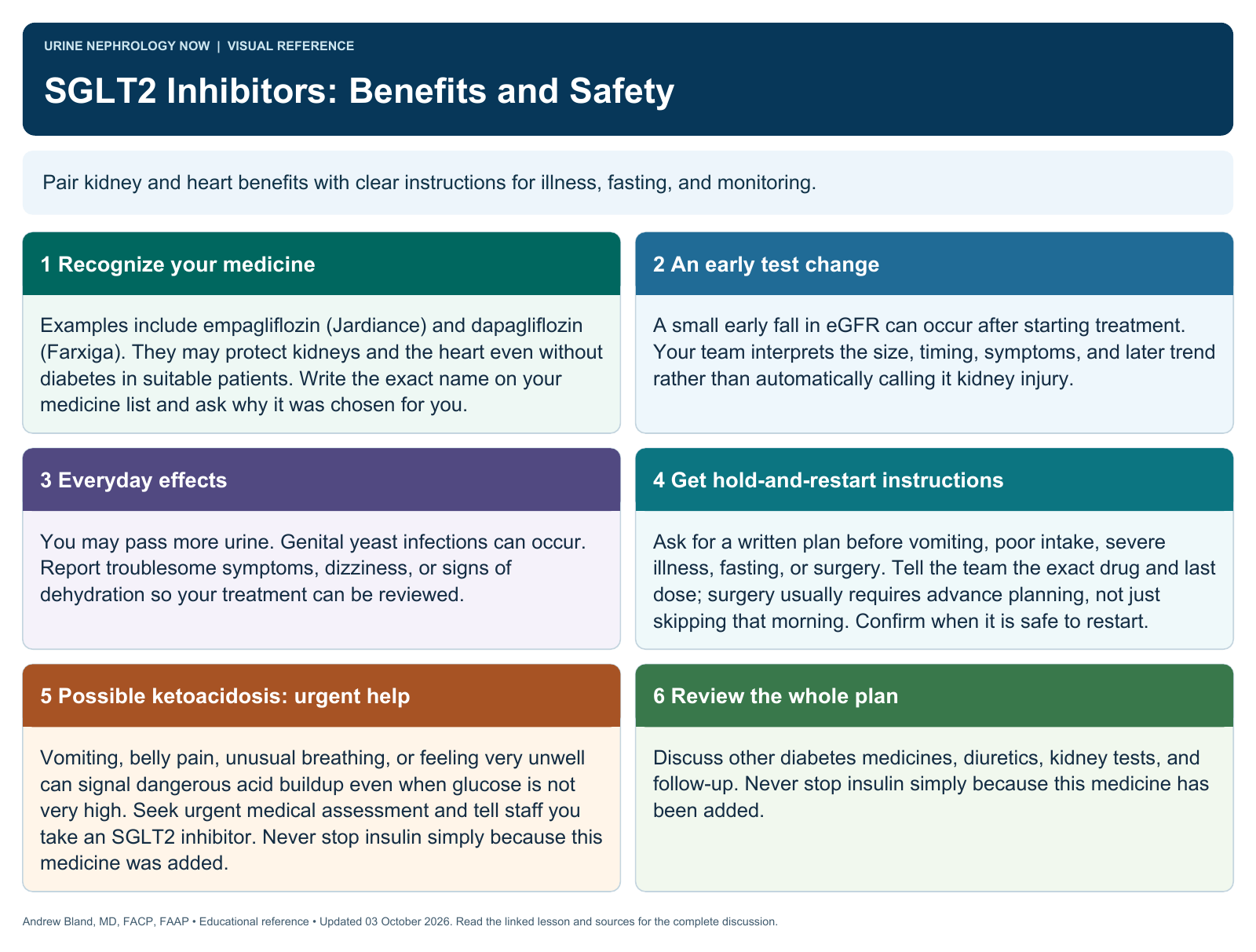
SGLT2 inhibitors were first used for type 2 diabetes. Large, high-quality studies then showed they also protect the kidneys and the heart — even in people without diabetes. If you have kidney disease, that is good news. There are a few things to know: a small dip in one kidney blood test at the start is normal and not harmful, you may need to pause the medicine on sick days, and gentle hygiene may help with genital symptoms, but yeast infections can still occur and need appropriate assessment and treatment. Each one is explained below.
Visual reference
Browse the visual reference library · Download lesson Markdown
What are these medicines?
SGLT2 inhibitors are a family of once-daily pills. The name describes what they do: they block a doorway in the kidney (called SGLT2) that normally pulls sugar back into your blood. With that doorway blocked, some sugar leaves your body in your urine instead — and a little extra salt and water go with it.
You may know them by their brand names:
| Brand name | Generic name | How it is taken |
|---|---|---|
| Jardiance | empagliflozin | Daily pill |
| Farxiga | dapagliflozin | Daily pill |
| Invokana | canagliflozin | Daily pill |
Doctors now prescribe them for several reasons at once: to slow down kidney disease, to protect the heart, to treat heart failure, and to help with blood sugar in type 2 diabetes. One medicine, several jobs.
How they protect your kidneys and heart
The word "diuretic" — a water pill — makes some people nervous, because the older water pills can be hard on the kidneys and can drop your potassium. These medicines are different. They cause only a mild, gentle loss of salt and water, and they do it without stirring up the stress hormones that older water pills trigger. Your potassium usually stays right where it should be.
The bigger reason they help is what happens inside the kidney's filters. Your kidneys clean your blood through millions of tiny filters, and in kidney disease those filters often run under too much pressure — which wears them out over the years. These medicines ease that pressure, a little like taking your foot off the gas. They also lower blood pressure slightly and calm inflammation in the kidney tissue itself.
In two large kidney studies — one with dapagliflozin (Farxiga) and one with empagliflozin (Jardiance) — people taking these medicines were far less likely to reach kidney failure or lose kidney function quickly, and were less likely to be hospitalized for heart failure. Separate heart studies found fewer deaths and fewer hospital stays in people with heart failure, including a type of heart failure that had almost no proven treatment before. The benefit held up whether or not the person had diabetes.
The normal early dip in your kidney number
When you first start one of these medicines, your kidney number (called eGFR) may drop a little — usually just a few points — in the first week or two. If no one warns you, this can be alarming. It looks like the medicine is hurting your kidneys.
It is not. That small early dip is the filter pressure easing off — the same helpful change described above. Think of it like turning down the pressure to protect the plumbing for the long run. Your doctor will usually recheck the number in about two to four weeks, and in most people it settles and then stays steadier than it would have without the medicine.
A small early change in your kidney blood test is not a reason to quit the medicine. If the number worries you, call the clinician who prescribed it before making any change. A larger or later drop is different and should be checked — see the warning signs below.
What to expect day to day
Most people tolerate these medicines well. A few things are worth knowing about up front.
- You may urinate a bit more. Because the medicine sends extra sugar and water into your urine, you may go more often, especially in the first weeks. This usually settles. Keep drinking normally so you do not get dehydrated.
- Your blood pressure may come down a little. This is often a good thing, but if you feel lightheaded when you stand up, tell your care team — another blood-pressure medicine may need adjusting.
- Genital yeast infections are the most common side effect. The extra sugar in your urine can feed yeast around the genitals. The section below explains symptoms, hygiene, and when to ask for treatment.
These medicines rarely cause low blood sugar on their own. If you also take insulin or a sulfonylurea pill (such as glipizide or glyburide), that other medicine — not the SGLT2 inhibitor — is the one that can drop your sugar too low, and its dose may need review.
Preventing genital yeast infections
These medicines increase the chance of genital yeast infections, especially in people who have had them before. Gentle hygiene may help, but infections can still occur. Most can be treated; new or repeated symptoms need the right diagnosis and treatment.
Practical care steps:
- Keep the area clean and dry. Pat dry after showering and after using the bathroom.
- Change out of wet or sweaty clothing — swimsuits, workout clothes — instead of staying in it.
- Avoid harsh soaps, sprays, and douches, which irritate the skin.
- Contact your care team for new itching, rash, or discharge so they can confirm the cause and recommend treatment.
If symptoms keep coming back, ask your care team to confirm the diagnosis and review treatment. The prescriber can weigh recurrent or severe infections against the benefits of continuing the medicine. Vaginal estrogen is an option for recurrent urinary tract infections in selected people around or after menopause; that is a different condition from genital yeast infection. Do not use it as a yeast-prevention treatment without discussing the actual diagnosis and plan.
Sick days — when to pause the medicine
This is the most important safety rule with these medicines, so it is worth getting clear ahead of time.
When you are sick enough that you cannot eat or drink normally — a bad stomach bug, vomiting, diarrhea, or any illness where you are not keeping fluids down — pause the medicine until you are well and eating and drinking again. During those illnesses the medicine can add to dehydration, which is hard on the kidneys, and in rare cases it can contribute to a serious problem called diabetic ketoacidosis (explained just below).
You should also hold the medicine before a planned surgery or procedure. Your surgical team will tell you exactly how many days ahead. Restart once you are back to normal eating and drinking, unless your team tells you otherwise.
Ask your kidney team which of your medicines to pause when you are ill and not eating or drinking normally — this usually includes the SGLT2 inhibitor along with a few others. Having the list written down means you are not guessing in the middle of a bad day.
Rare but serious problems to know about
These are uncommon. They are listed so you can recognize them early, not to scare you off a medicine that helps most people a great deal.
Diabetic ketoacidosis (DKA). This is a dangerous buildup of acid in the blood. With these medicines it can happen even when your blood sugar looks normal or only mildly high, which is why it can be missed. Warning signs are nausea, vomiting, belly pain, trouble breathing, and feeling very unwell. The risk is higher during illness, fasting, very low-carb diets, and around surgery — which is exactly why the sick-day rule matters. It is more of a concern in type 1 diabetes, where these medicines are generally not used.
A severe deep infection of the genital area (Fournier's gangrene). This is extremely rare, but it is an emergency. Get care right away for severe pain, swelling, redness, or fever in the genital or groin area — this is very different from an ordinary itch or yeast infection.
If you already have kidney disease
These medicines were studied specifically in people with reduced kidney function, and they are often continued well into more advanced kidney disease. A few points apply:
- They still work when kidney function is low. The protection continues even in people whose kidney numbers are well below normal, and your prescriber will tell you the point at which to stop.
- They are often paired with other kidney-protecting medicines — such as an ACE inhibitor or ARB for blood pressure. Used together, they protect the kidneys more than any one of them alone.
- Watch fluids when you are ill. Dehydration is harder on kidneys that are already working with less reserve, which is why the sick-day rule is especially important for you.
When to call your doctor
• Nausea, vomiting, belly pain, or trouble breathing — especially if you feel very unwell (possible DKA), even if your blood sugar looks normal
• Severe pain, swelling, redness, or fever in the genital or groin area
• Vomiting or diarrhea and you cannot keep fluids down
• Signs of dehydration — dry mouth, little or very dark urine, weakness or dizziness
• Lightheadedness when you stand up, or a fall
• A genital itch, rash, or discharge that does not clear with treatment
• A surgery or procedure scheduled, with no plan discussed for holding the medicine
Questions worth asking your kidney team
- Is this medicine meant to help my kidneys, my heart, my blood sugar — or several of these?
- My kidney number may dip a little at the start — when will you recheck it?
- What is my sick-day plan — which medicines should I pause when I cannot eat or drink normally?
- How many days before a surgery or procedure should I hold this?
- What should I do if I keep getting yeast infections?
- I also take insulin or a sulfonylurea — does that dose need to change?
Safety sources: FDA empagliflozin labeling (genital yeast infection); AUA/CUA/SUFU 2025 recurrent UTI guideline (vaginal estrogen).
References
These are the main peer-reviewed studies behind this page. They are written for clinicians; your own doctor can help you interpret them.
- Heerspink HJL, Stefánsson BV, Correa-Rotter R, et al. Dapagliflozin in Patients with Chronic Kidney Disease (DAPA-CKD). N Engl J Med. 2020;383(15):1436–1446. doi:10.1056/NEJMoa2024816. PMID: 32970396
- The EMPA-KIDNEY Collaborative Group; Herrington WG, Staplin N, et al. Empagliflozin in Patients with Chronic Kidney Disease (EMPA-KIDNEY). N Engl J Med. 2023;388(2):117–127. doi:10.1056/NEJMoa2204233. PMID: 36331190
- McMurray JJV, Solomon SD, Inzucchi SE, et al. Dapagliflozin in Patients with Heart Failure and Reduced Ejection Fraction (DAPA-HF). N Engl J Med. 2019;381(21):1995–2008. doi:10.1056/NEJMoa1911303. PMID: 31535829
- Packer M, Anker SD, Butler J, et al. Cardiovascular and Renal Outcomes with Empagliflozin in Heart Failure (EMPEROR-Reduced). N Engl J Med. 2020;383(15):1413–1424. doi:10.1056/NEJMoa2022190. PMID: 32865377
- Anker SD, Butler J, Filippatos G, et al. Empagliflozin in Heart Failure with a Preserved Ejection Fraction (EMPEROR-Preserved). N Engl J Med. 2021;385(16):1451–1461. doi:10.1056/NEJMoa2107038. PMID: 34449189