Preventing Urinary Tract Infections
If you keep getting urinary tract infections — one clears up, and a few weeks or months later another one starts — you are not doing something wrong, and you are not alone. Recurring UTIs are common, especially in women, and there are real steps, tested in good studies, that lower how often they come back. This page walks through what actually works, what is oversold, and when a UTI is a reason to call your doctor. It is written for patients, not for medical staff.
Most recurring UTIs come from the same gut bacteria finding their way back to the bladder. You can lower your odds with a few simple habits: drink enough water, do not hold your urine, and empty your bladder after sex. After menopause, a low-dose vaginal estrogen is one of the most effective prevention tools we have. Cranberry helps a little. D-mannose, once widely recommended, did not beat a dummy pill in a large 2024 study. If UTIs are frequent or severe, your doctor can add a prescription plan. Blood in your urine, fever, or back pain means call — that is more than a simple bladder infection.
Visual reference
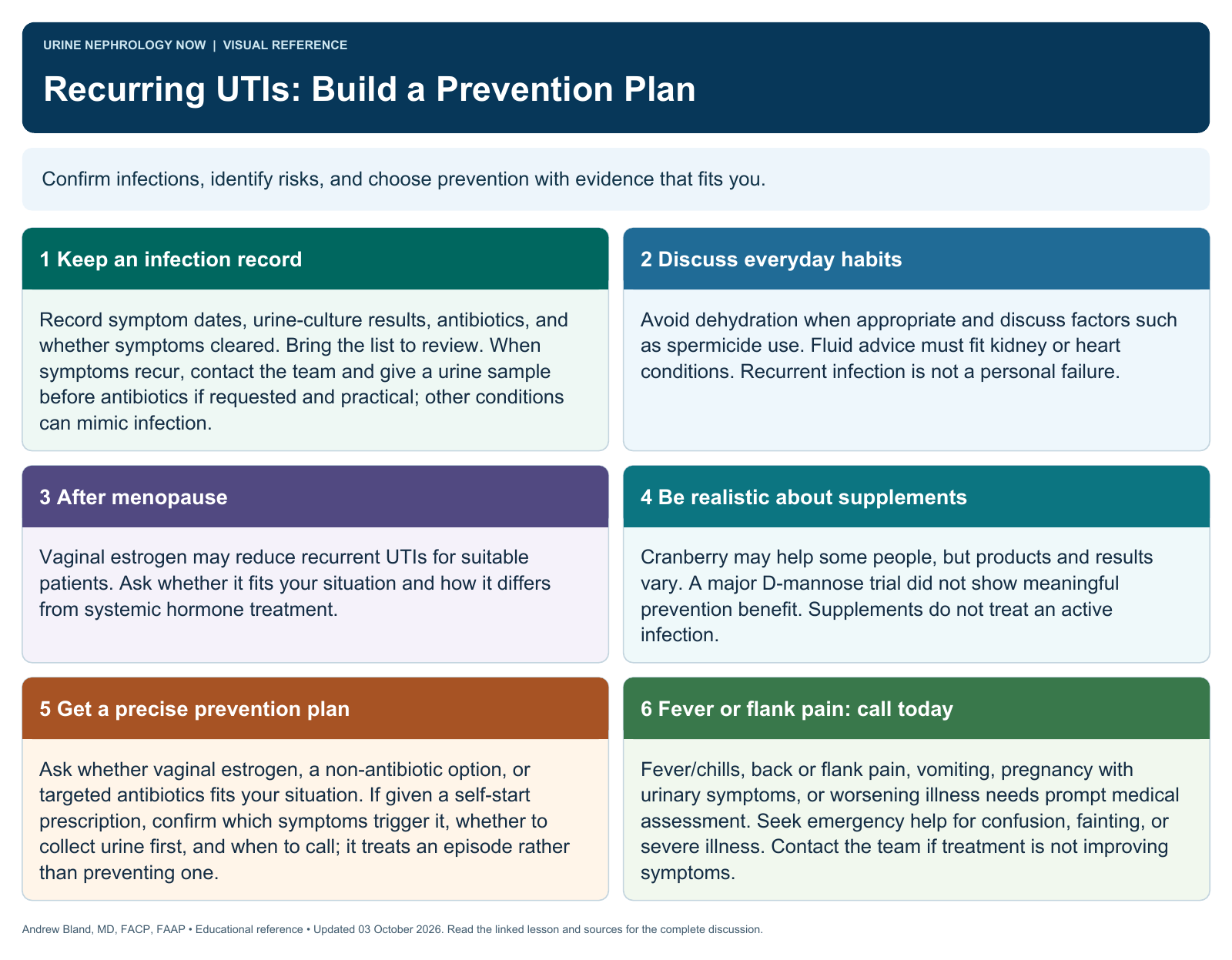
Browse the visual reference library · Download lesson Markdown
What counts as a recurring UTI?
Doctors call UTIs "recurrent" when you have three or more in a year, or two or more in six months. If that sounds like you, it is worth building a prevention plan rather than just treating each infection as it comes.
Recurring UTIs are far more common than most people realize. More than half of women have at least one UTI in their lifetime, and roughly one in five keeps getting them again and again. This is not a sign of poor hygiene or of doing anything wrong. Part of the reason is simply how your body is built: in some women, the cells lining the bladder and urethra are "stickier" for the bacteria that cause UTIs, and that tendency runs in families. Careful, clean people get recurring UTIs all the time.
Why UTIs keep coming back
Most UTIs — around 8 in 10 — are caused by E. coli, a bacteria that normally lives in your gut without causing trouble. The problem starts when it travels the short distance to the urethra and up into the bladder. E. coli has tiny hair-like grippers on its surface that let it latch onto the bladder wall, so a stream of urine cannot simply wash it away.
When a UTI comes back, it is usually the very same strain that was living nearby and climbed up again, rather than a brand-new infection. That single fact explains why prevention comes down to two goals: keep bacteria from reaching the bladder in the first place, and rinse out any that do get in before they can take hold.
Everyday habits that lower your risk
These are the least glamorous prevention steps and, for many people, the most useful. None of them require a prescription.
| Habit | Why it helps | How strong the evidence is |
|---|---|---|
| Drink enough water | Dilutes your urine and makes you go more often, which flushes bacteria out | Strong |
| Go when you need to — do not hold it | Holding urine gives bacteria time to multiply in a still bladder | Strong |
| Empty your bladder after sex | Flushes out bacteria that get pushed toward the urethra during intercourse | Moderate |
| Wipe front to back | Keeps gut bacteria away from the urethra | Strong |
| Skip douches and scented sprays | They disturb the natural balance that normally protects you | Strong |
| Choose cotton underwear; avoid very tight clothing | Keeps the area drier and less welcoming to bacteria | Moderate |
Two of these are worth a little more detail. For water, aim for urine that is pale yellow rather than dark — for most women that works out to roughly six to eight glasses of fluid a day, more in hot weather. For sex, try to urinate within about half an hour afterward; you do not have to jump up immediately, but do not put it off until morning.
Vaginal estrogen after menopause
After menopause, your body makes much less estrogen. The tissue around the vagina and urethra becomes thinner and drier, and the natural acid balance shifts. That change lets unfriendly bacteria move in and crowds out the protective ones that normally keep the area healthy. It is one of the biggest reasons UTIs pick up again in your fifties, sixties, and beyond.
A low-dose estrogen that you place in the vagina — a cream, a small tablet, or a soft flexible ring — rebuilds that healthy tissue and restores the protective balance. In studies, it cut recurring UTIs by about half in women past menopause, and it works best for those who also notice vaginal dryness or irritation. A cream or tablet is usually used nightly for the first couple of weeks, then two or three times a week; the ring is simply changed every three months. Give it two to three months to reach its full effect.
Vaginal estrogen only helps when low estrogen is part of the problem, so it is aimed at women who are past menopause — it is not the right choice before menopause. The good news is that very little of it is absorbed into the bloodstream, so it is generally considered safe even for many women who cannot take estrogen pills. Still, this is a decision to make with your own doctor.
What about cranberry?
Cranberry is the classic home remedy, and it does have a kernel of truth behind it. Cranberries contain compounds that make it a little harder for bacteria to grip the bladder wall — the same basic idea behind some other prevention approaches. So the mechanism is real, but the payoff is modest.
Across studies, cranberry lowers UTI risk by roughly 15 to 30 percent, and the results swing quite a bit from one study to the next. Put in plain terms: if you would normally get about three UTIs a year, cranberry might bring that down to two. That is worth something, but it is not a cure. Two practical points make it more useful. First, cranberry juice is loaded with sugar, so a concentrated cranberry supplement is a better choice than drinking juice every day. Second, cranberry works best alongside the everyday habits above, not in place of them.
D-mannose: what the research actually shows
D-mannose is a simple sugar sold as a supplement, and for years it was one of the most recommended natural ways to prevent UTIs. The idea sounded good — like cranberry, it was thought to stop E. coli from gripping the bladder wall so the bacteria would rinse away. Then a large, careful study put that idea to the test, and the results were not what many expected.
In 2024, a team led by Hayward published a trial in JAMA Internal Medicine that followed about 600 women with recurring UTIs across primary-care clinics in the United Kingdom. Half took 2 grams of D-mannose powder every day, and half took a look-alike powder with no active ingredient. After six months, the two groups had almost the same number of UTIs — about 51 percent of the D-mannose group had at least one, compared with 56 percent of the placebo group, a gap small enough to be chance. In short, daily D-mannose did not prevent UTIs any better than a dummy powder.
Because of that study, D-mannose is no longer a reliable recommendation for preventing UTIs. It is generally safe and easy to tolerate, so trying it is not dangerous — but do not count on it to keep infections away. If you have diabetes, mention it to your doctor before using it, since it is a sugar. And if D-mannose is the only thing standing between you and an option that actually works, that is a good reason to talk with your care team about switching.
When prevention needs a prescription
If UTIs are frequent or really disrupt your life, your doctor can add a medicine-based plan. There are two common approaches, and both are designed to use antibiotics carefully so they keep working over time.
- Self-start treatment. You and your doctor agree on a short antibiotic course that you keep on hand and start at the very first sign of a UTI. This treats a new episode promptly; it is not a proven way to prevent future episodes or reduce their number by a fixed percentage. Your plan should say when to collect urine, which symptoms qualify, and when to call instead of self-treating.
- Low-dose daily prevention. A small dose of antibiotic taken every day, usually at bedtime, for several months. It is effective while you are on it — cutting recurrences by roughly half to three-quarters — but UTIs often return once you stop, and taking antibiotics daily raises the risk of side effects and of bacteria becoming resistant. For those reasons, doctors usually save this option for women with very frequent infections who have already tried other measures.
Which path fits you depends on how often you get UTIs and what you have tried before. This is a decision to make together with your clinician.
If you are pregnant or have diabetes
Two situations change the prevention plan and are worth calling out.
- Pregnancy. Several usual options are off the table. Cranberry supplements and D-mannose do not have enough safety information in pregnancy, and some UTI antibiotics are not safe for the baby. At the same time, UTIs in pregnancy do need attention — even a UTI with no symptoms is usually treated, because in pregnancy it can lead to problems. If you are pregnant and getting UTIs, your doctor will choose a pregnancy-safe plan. Do not start supplements on your own.
- Diabetes. Higher blood sugar makes UTIs more likely and can make them harder to clear. Keeping your blood sugar well controlled is part of preventing them.
One more point that surprises people: a UTI found only on a urine test, with no symptoms at all, is usually left alone in most adults. Treating those "silent" bacteria does not help and mainly breeds resistance. The main exception, again, is pregnancy.
Warning signs — when to call
Most bladder infections are annoying but not dangerous. A few signs mean something more serious, or mean the problem needs a closer look.
• Blood in your urine — pink, red, or the color of cola
• Fever, chills, or pain in your side or back — the infection may have reached a kidney
• Nausea or vomiting along with UTI symptoms
• Symptoms that are not improving after a day or two of treatment
• Any UTI symptoms while you are pregnant
• UTIs that keep returning despite a prevention plan
Blood in the urine, kidney infections, UTIs in men, and infections that do not respond to the usual antibiotics all deserve a closer look — sometimes with a urologist and, occasionally, an imaging test — to make sure nothing else is going on.
Questions worth asking your care team
- Do my UTIs count as "recurrent," and should that change how we prevent them?
- I am past menopause — would vaginal estrogen be a good fit for me?
- Could I use a self-start antibiotic plan, so I can treat early without taking a pill every day?
- Are the supplements I am taking, like cranberry or D-mannose, actually helping — or should I put that effort somewhere else?
- Should I have any testing to make sure nothing else is causing the infections?
- Which symptoms mean I should be seen right away instead of waiting?
This guide is based on current clinical guidelines and the peer-reviewed medical literature, including the 2024 Hayward trial of D-mannose for recurrent UTI prevention. It is general information, not medical advice for your own situation — your doctor can help you apply it to you.