Water Pills (Diuretics): What They Do and How to Take Them
If your doctor has put you on a "water pill," you probably have questions about what it does and how to take it well. This page answers the common ones in plain language. It is written for patients, not for medical staff. Water pill is just the everyday name for a diuretic — a medicine that helps your kidneys pass extra salt and water out as urine.
Water pills help your body get rid of extra salt and water. Doctors use them for swelling, high blood pressure, and fluid buildup from heart, kidney, or liver problems. There are two main kinds — loop and thiazide — and they work in different ways. Most of the care is in the small daily habits: taking your dose early so you are not up all night, weighing yourself every morning, watching for signs you have lost too much fluid, and getting your blood checked so your minerals stay in balance. Each one is explained below.
Visual reference
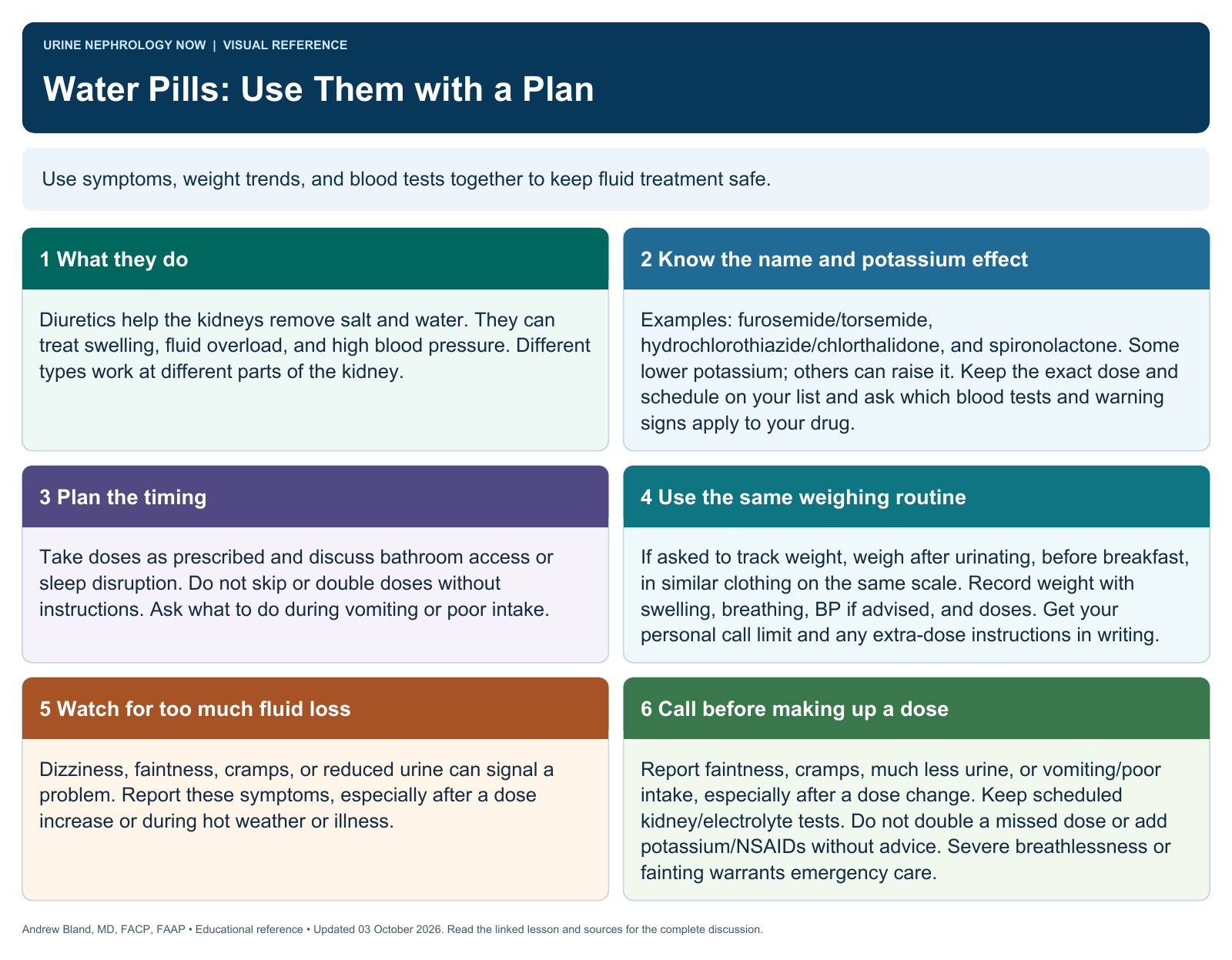
Browse the visual reference library · Download lesson Markdown
What water pills do
Your kidneys are always deciding how much salt and water to keep and how much to send out as urine. When too much fluid builds up — in your legs, your belly, or your lungs — it can cause swelling, weight gain, and shortness of breath. A water pill tells your kidneys to let more salt go. Water follows the salt, so you make more urine and the extra fluid comes off.
Losing that fluid does two things: it eases swelling and breathing, and it lowers blood pressure. That is why the same medicines show up for very different problems — heart failure, kidney disease, high blood pressure, and fluid from liver disease.
The two main kinds: loop and thiazide
Not all water pills are the same. The two main families work at different points inside the kidney, so they have different strengths and different jobs. Your doctor may even use both together when one alone is not enough.
| Family | Common names | Generic name | Mostly used for |
|---|---|---|---|
| Loop | Lasix, Bumex, Demadex | furosemide, bumetanide, torsemide | Swelling and fluid overload; works even when kidneys are weak |
| Thiazide | Microzide, Thalitone, Lozol | hydrochlorothiazide, chlorthalidone, indapamide | Mostly high blood pressure; milder fluid effect |
| Potassium-sparing | Aldactone, Inspra, Midamor | spironolactone, eplerenone, amiloride | Often added to protect potassium; also used in heart failure |
Loop water pills — the strong, fast ones
Loop water pills, such as furosemide (Lasix), bumetanide (Bumex), and torsemide (Demadex), are the strongest. They act fast and pull off a lot of fluid, so they are the go-to choice for real fluid overload — swollen legs or fluid on the lungs.
Because they are fast and strong, they send you to the bathroom often for a few hours after each dose, then wear off. That short, sharp action is exactly why timing matters, which is covered below. The three loop pills are close cousins; the main difference is how well your gut absorbs each one, so if one is not working well your doctor may switch you to another.
Thiazide water pills — the steady ones for blood pressure
Thiazide water pills, such as hydrochlorothiazide, chlorthalidone, and indapamide, are milder. They take extra salt off slowly and steadily, which makes them a mainstay for high blood pressure rather than for heavy swelling. Chlorthalidone is long-acting and is taken once a day.
You may hear that thiazides stop working once kidney function drops. That was the long-standing teaching, but it has not held up. In a randomised trial in people with stage 4 CKD — quite advanced kidney disease — a thiazide-type pill called chlorthalidone still lowered blood pressure substantially compared with a dummy pill, and also reduced the amount of protein leaking into the urine. So these pills can still be worth using when kidney function is low. A related pill, metolazone (Zaroxolyn), is sometimes added to a loop pill to break through stubborn swelling. That is a powerful combination and needs close blood-test monitoring, because it can drop your potassium quickly.
Potassium-sparing water pills
Most water pills make you lose potassium in your urine. Potassium-sparing pills — spironolactone (Aldactone), eplerenone (Inspra), amiloride, and triamterene — do the opposite: they help your body hold on to potassium. They are weak on their own, so they are usually added to a loop or thiazide pill to keep your potassium from falling too low. Spironolactone also has its own role in treating heart failure.
The trade-off is the opposite problem — potassium that climbs too high. That risk goes up if you also take a blood-pressure medicine called an ACE inhibitor or ARB, or if your kidneys are weak. Spironolactone can also cause breast tenderness or swelling in some people; if that happens, tell your doctor, because a related pill (eplerenone) usually does not.
Timing your doses around your day
A loop water pill usually starts working within an hour or two and keeps you going to the bathroom for a few hours after that. Take it too late and you will be up all night. The simple fix is to take your dose early.
If you take it once a day, take it in the morning. If you take it twice a day, take the first dose in the morning and the second by early afternoon — not at bedtime. If you will be away from home, it is fine to shift a dose an hour or two so you are near a bathroom when it kicks in — ask your doctor first. The goal is steady fluid control and a full night's sleep.
Think of a water pill like a strong cup of coffee for your kidneys: take it early so the effect is finished long before bedtime. Morning for a once-a-day dose; morning and early afternoon for a twice-a-day dose.
Weigh yourself every day
Your weight is the best home signal of how much fluid you are holding. A pound of weight is roughly a pint of fluid, so the scale often changes before you notice swelling or shortness of breath.
Weigh yourself at the same time each day — first thing in the morning, after you use the bathroom and before you eat or dress. Write the number down. A steady number is useful, but it does not prove fluid balance is right; swelling, breathing, appetite, and other changes still matter. A quick rise of several pounds over two or three days usually means fluid is building up, and a fast drop can mean you are losing too much. Your care team will give you a number to watch and a point at which to call.
Salt matters as much as the pill
A water pill and salt pull in opposite directions. The pill sends salt out; the food you eat puts it back. Eat a salty meal and your body holds the water that comes with it, and the scale climbs — even though you took your pill. This is why people sometimes feel their water pill has "stopped working" when the real problem is the salt.
You do not have to eat bland food. Cutting back on the biggest sources — canned soups, deli meats, frozen dinners, and restaurant portions — does far more than putting away the salt shaker. Ask your team for a daily salt target — for many people it is about 2,000 milligrams a day. Stricter is not automatically better, so stick with the number you are given.
Too much of a good thing
A water pill is doing its job when it takes off extra fluid — but it can take off too much. Losing more fluid than you need can leave you dehydrated, drop your blood pressure, and make you dizzy, especially when you stand up. Over time, heavy fluid loss is also hard on the kidneys.
Signs of losing too much fluid include a dry mouth, strong thirst, passing only small amounts of dark urine, feeling lightheaded when you stand, muscle cramps, and unusual tiredness. This matters most when something else is already drying you out — a stomach bug with vomiting or diarrhea, a hot day, or a stretch when you are not eating or drinking normally.
When you are sick and cannot keep fluids down, a water pill can dry you out fast, and many people are told to hold it on days like that. Ask your care team ahead of time for a sick-day plan — which medicines to pause when you cannot eat or drink normally, and when to start them again.
Keeping your minerals in balance
Along with salt and water, water pills change the levels of the minerals your body runs on — mainly potassium, sodium, and magnesium. That is why your doctor checks a blood test after you start or change a dose. Potassium gets the most attention, because both too little and too much can affect your heartbeat.
| Mineral | What can go wrong | What you might feel |
|---|---|---|
| Potassium — too low | Loop and thiazide pills can lower it | Muscle weakness, cramps, a skipping or racing heartbeat |
| Potassium — too high | Potassium-sparing pills can raise it | Often nothing until it is dangerous — one reason for blood tests |
| Sodium — too low | Thiazides can lower it, mostly in older adults | Headache, confusion, feeling unsteady or "not yourself" |
| Magnesium — too low | Water pills can lower it | Cramps; can make low potassium harder to fix |
Do not start a potassium supplement or a salt substitute on your own. Many salt substitutes are made of potassium, which can be risky if you take a potassium-sparing pill. Let your team adjust these.
A few other things to know
A water pill will send you to the bathroom more, especially just after a dose — that is expected. Two other points are worth knowing:
- Over-the-counter pain relievers such as ibuprofen and naproxen (Advil, Aleve) can work against a water pill and can be hard on the kidneys. The risk is highest when you take one alongside an ACE inhibitor or ARB for blood pressure, especially in the first month. Check with your team before using them regularly. Acetaminophen (Tylenol) is usually a safer choice for everyday aches.
- Thiazide pills can nudge up your uric acid and blood sugar, which can set off a gout flare or matter if you have diabetes. Your doctor keeps an eye on both.
If you have kidney disease
Water pills are common and useful when your kidneys are weak — they help control the swelling and blood pressure that come with kidney disease. A few points apply to you in particular:
- Loop pills keep working with weak kidneys, but usually need a higher dose to do it. Thiazides still lower blood pressure even when kidney function is low, so your doctor may use one as well.
- Your blood needs checking more often, because both your kidney number and your potassium can shift when the dose changes.
- The sick-day plan matters even more. Dehydration is harder on kidneys that are already struggling, so know which medicines to pause when you are ill.
Warning signs — when to call
• Weight gain past the number your care team gave you — often more than two to three pounds in a day, or about five pounds in a week
• New or worsening swelling in your legs, belly, or face, or new shortness of breath
• Signs of losing too much fluid — dizziness when you stand, a dry mouth, or only small amounts of dark urine
• Muscle weakness or cramps, or a heartbeat that races or skips (a possible mineral problem)
• Confusion, a bad headache, or feeling "not yourself" (a possible drop in sodium)
• Vomiting or diarrhea that keeps you from drinking normally, with no sick-day plan in place
• A fall, or feeling faint
Questions to ask your kidney team
- Which problem is this water pill treating — swelling, blood pressure, or fluid from my heart or kidneys?
- What time of day should I take each dose?
- What weight change should make me call you?
- What is my daily salt target?
- How often will you check my potassium and other blood tests?
- What is my sick-day plan — which medicines do I pause when I cannot eat or drink normally?
- Are any of my over-the-counter medicines or salt substitutes a problem with this pill?
About this guide
This guide is based on published clinical trials and on current kidney and heart guidelines, including the KDIGO 2024 chronic kidney disease guideline.