What Is Chronic Kidney Disease?
If a blood or urine test has shown a sign of kidney trouble — or your doctor has used the words "chronic kidney disease" or "CKD" — you probably have questions. This page explains what CKD is, what your numbers mean, and what actually slows it down. It is written for patients, not for medical staff.
Chronic kidney disease means your kidneys have been working below normal, or showing a sign of damage, for at least three months. It is tracked with two numbers — one from a blood test (eGFR) and one from a urine test (albumin). Most people with early CKD feel completely fine, which is why it is usually found on routine labs rather than from symptoms. CKD is common, and when it is caught early there is a lot you and your team can do to slow it down.
Visual reference
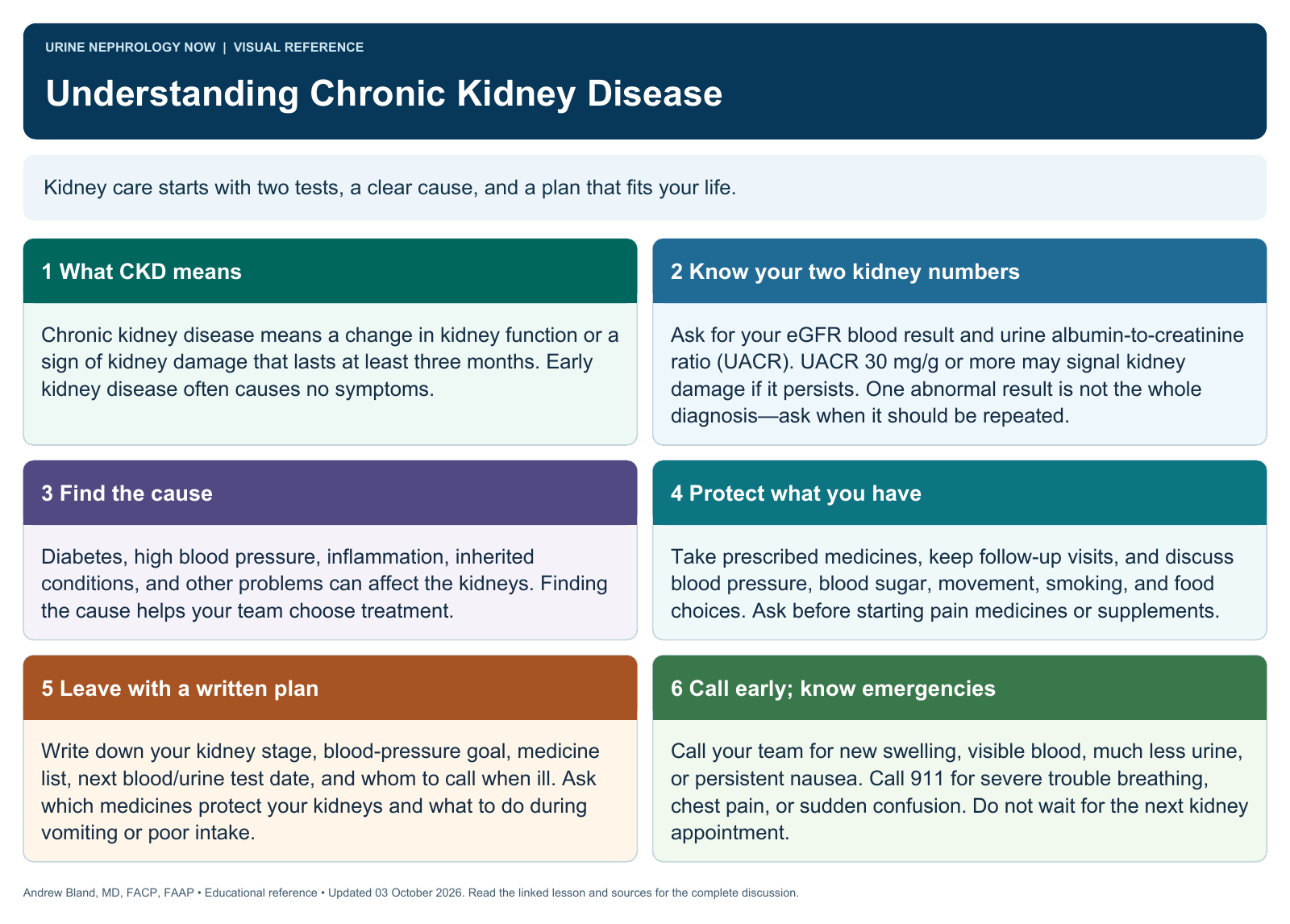
Browse the visual reference library · Download lesson Markdown
What "chronic kidney disease" actually means
Your kidneys clean your blood, removing waste and extra fluid and keeping salts and water in balance. Chronic kidney disease is the medical term for kidneys that have been damaged, or working below normal, for a while.
Doctors say you have CKD when at least one of these has been true for three months or longer:
- Your kidney function, measured as eGFR, is below normal, or
- Your urine shows a steady leak of protein (albumin), a sign of damage, or
- An imaging test shows the kidneys are damaged or built differently.
The word "chronic" is doing real work here. It means the change has lasted, not that it appeared for a day or two and recovered. That three-month rule is what separates CKD from a short-term dip in kidney function that can bounce back.
One point matters more than any other: CKD is not a single disease. It is an umbrella term for many different conditions that damage the kidneys. Knowing which one you have changes what your team recommends.
Your two important numbers
Almost everything about your CKD is described with two test results. It helps to know what each one is.
eGFR — your kidney function number
eGFR stands for estimated glomerular filtration rate. Your lab calculates it from a simple blood test (creatinine) together with your age and sex. The easiest way to picture it: eGFR is a rough measure of how much filtering capacity you still have. An eGFR near 100 is full function. As kidney function falls, the number falls with it.
One low reading on its own does not settle the question. Kidney function can dip for short-term reasons and recover, so your doctor usually repeats the test before calling it CKD.
Urine albumin — your kidney damage number
Albumin is a protein that belongs in your blood, not your urine. Healthy filters keep it in. When the filters are injured, small amounts of albumin start slipping through into the urine — often well before your eGFR changes at all. That is what makes it such an early warning sign.
The result is usually reported as a urine albumin-to-creatinine ratio, or UACR, in mg/g. Here is what the ranges mean:
| Urine albumin (UACR) | What it means |
|---|---|
| Under 30 mg/g | Normal, or only mildly raised |
| 30 to 300 mg/g | Moderately raised — an early sign of damage |
| Over 300 mg/g | Severely raised — more protein is leaking |
Foamy or bubbly urine can be a visible hint that protein is leaking, though plenty of people with albumin in the urine notice nothing at all.
Why your team reads both together
Neither number tells the whole story alone. Picture a chart with kidney function running down one side and urine albumin across the top, shaded from green for the lowest risk through yellow and orange to red for the highest. Where your two numbers meet is what tells your team how closely to watch your kidneys and how hard to work at protecting them.
The stages, in plain language
CKD is sorted into stages based mainly on your eGFR. They run from stage 1, where function is still normal but there is a sign of damage, down to stage 5, where the kidneys have largely failed.
| Stage | eGFR (kidney function) | What it usually means |
|---|---|---|
| Stage 1 | 90 or higher | Normal function, but a urine or imaging test shows kidney damage |
| Stage 2 | 60 to 89 | Mildly reduced function — counts as CKD only with a sign of damage |
| Stage 3a | 45 to 59 | Mild-to-moderate loss; your team starts watching for complications |
| Stage 3b | 30 to 44 | Moderate-to-severe loss; some medicine doses may need adjusting |
| Stage 4 | 15 to 29 | Severely reduced; the time to plan for future treatment options |
| Stage 5 | Under 15 | Kidney failure; dialysis or a transplant may be needed |
Stage 3 is often split into 3a and 3b, so the five stages are sometimes listed as six numbers. And there is a wrinkle worth knowing: at stages 1 and 2 your function is normal or nearly so, so those count as CKD only when there is also a sign of damage, such as albumin in the urine.
Why most people feel fine at first
Your kidneys carry a large reserve. You can lose a real share of their working capacity and still feel completely normal, because the filters that remain quietly take up the slack. That cuts both ways. The good news is that early CKD rarely makes you sick. The catch is that it gives no warning — no pain, no obvious symptom — so it is easy to miss.
This is why CKD is nearly always caught on routine blood and urine tests rather than because someone feels unwell. Symptoms such as swelling, tiredness, or a poor appetite tend to appear only in the later stages, once function is well below normal. Finding it early, while you still feel fine, is exactly when there is the most to gain.
What causes CKD
Because CKD is an umbrella term, the list of possible causes is long. Getting the right one matters, since the treatment can differ. Common causes include:
- Diabetes — high blood sugar over many years is one of the most frequent causes.
- High blood pressure — though, as below, it is sometimes blamed when another cause is really at work.
- Inflammation of the kidney's filters, a group of conditions doctors call glomerulonephritis.
- Inherited conditions such as polycystic kidney disease, where fluid-filled cysts grow in the kidneys and run in families.
- Other genetic causes that can be identified with genetic testing on a blood sample.
High blood pressure deserves a special note. It is often written down as the reason for someone's CKD when the true cause is something else — sometimes a genetic condition that testing can pin down. Different causes respond to different treatments, so your kidney team may look closely at your history, your urine, and in some cases your genes before settling on an answer. Pushing for a real cause, rather than a convenient label, is part of good kidney care.
What slows kidney disease down
Here is the encouraging part. For most people, CKD can be slowed, sometimes a great deal. The steps that work best are not exotic:
- Control your blood pressure. Keeping it in the range your team sets takes steady strain off the filters. You may hear two different targets. The kidney guideline (KDIGO 2021) aims for a top number under 120 when the pressure is measured carefully; the heart and diabetes guidelines (2025 AHA/ACC and the ADA) use under 130/80. Much of that difference comes down to how the reading is taken. Pregnancy, dialysis, and transplant have their own targets, so ask your team which number is yours.
- Take the kidney-protecting medicines if they are prescribed. Two families stand out. ACE inhibitors and ARBs lower the pressure inside the filters and reduce the albumin leak. SGLT2 inhibitors — such as Jardiance or Farxiga — protect the kidneys even in people who do not have diabetes.
- Manage your blood sugar if you have diabetes. Newer diabetes medicines, the GLP-1 group, can protect the kidneys as well.
- Keep up with monitoring. Simple, repeated blood and urine tests let your team follow your eGFR over time and catch a change early. Doses of some medicines are adjusted as your kidney function shifts.
A slow, gentle decline in kidney function is common with age and usually nothing to fear. A fast drop is the thing to catch, because it often points to a specific problem that can be treated. That is one more reason regular testing matters — it shows your team the trend, not just a single snapshot.
Warning signs and when to call your team
Because early CKD is silent, the single most useful step is getting tested if you are at higher risk — for example if you have diabetes, high blood pressure, or a family history of kidney disease.
• New or worsening swelling in your legs, ankles, or around your eyes
• Foamy urine, or blood in your urine
• A clear change in how much you are urinating
• Unusual tiredness, poor appetite, or new nausea
• A blood pressure running much higher than your usual
None of these automatically means something is wrong. But each is worth a phone call, so your team can decide whether to check your numbers sooner rather than waiting for the next visit.
Questions worth asking your kidney team
- What is my eGFR and my urine albumin number, and what stage do those put me at?
- Do you know what is causing my kidney disease, or do we need more tests to find out?
- Is my kidney function stable, or has it been changing over time?
- Am I on the medicines that protect the kidneys, such as an ACE inhibitor, an ARB, or an SGLT2 inhibitor?
- What blood pressure and, if I am diabetic, what blood sugar targets should I aim for?
- How often will you recheck my kidney numbers?
About this guide
This guide is based on the KDIGO 2024 guideline for chronic kidney disease, the KDIGO 2021 guideline for blood pressure in kidney disease, and the medical literature.
Also on this topic
The same subject at other levels of depth.
- Primer chapter: Chapter 11: Chronic Kidney Disease (CKD)
- Clinical Mastery deep dive: Metformin in Chronic Kidney Disease