🏋️ Creatine Supplementation
Why creatine raises serum creatinine without raising the risk of kidney disease — and how to read a patient's labs without stopping a supplement that helps them.
Visual reference
Browse the visual reference library · Download lesson Markdown
🎯 Learning Objectives
1. Why Creatine Matters
Your patients take creatine. The 19yo on the bench press. The 72yo hip-fracture survivor trying to rebuild quad strength. The cardiac-rehab patient whose cardiologist mentioned sarcopenia last visit. The teenage soccer player whose mom read something on Reddit. You meet all of them. You don't prescribe supplements — and that's exactly why the questions land on your clipboard.
Creatine is the most-studied ergogenic supplement in sports medicine. ISSN 2017 calls it "the most effective ergogenic nutritional supplement currently available to athletes" and documents safety up to 30 g/day for 5 years.[1] ISSN 2021 addresses the kidney question directly: the evidence does not support kidney damage at recommended doses in healthy adults.[2]
💡 The DPT/PA Clinician's Three Jobs on Creatine
- Decode the lab. A rising serum creatinine on a patient taking creatine is most often the assay artifact, not kidney injury. Reality-check with the patient and ordering clinician.
- Counsel safely. Monohydrate is the form with evidence. Loading is optional. Third-party certification matters more than brand.
- Recognize the rare. New flank pain, rash, fever, or real GFR drop changes the story — stop, escalate, do not reassure through it.
2. Creatine Biology
Your body makes its own creatine — liver, pancreas, and kidneys synthesize approximately 1 g/day from arginine, glycine, methionine. You eat another 1–2 g/day from meat and fish. Ninety-five percent of whole-body creatine sits in skeletal muscle as phosphocreatine — the rapid-regeneration tank that keeps ATP topped off during short bursts of high-intensity work.[1]
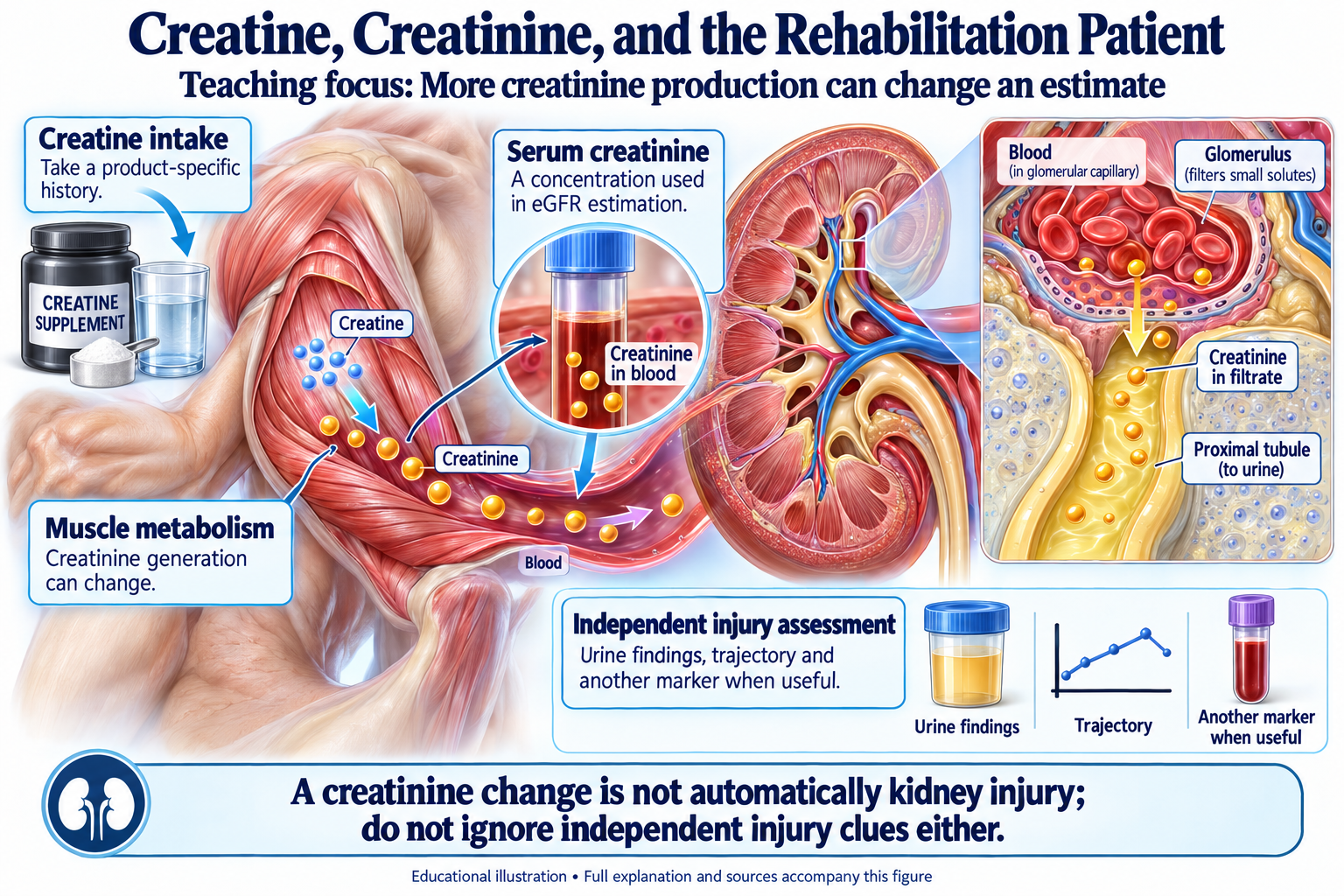
Creatine turns over. About 1–2% of the total muscle pool degrades daily — non-enzymatically, spontaneously — into a single waste product: creatinine. The kidney filters creatinine and dumps it in urine. That is why serum creatinine is used as a surrogate for GFR. It is also why feeding somebody extra creatine changes their serum creatinine reading.
The Supplement — What Actually Works
More than 90% of the research uses creatine monohydrate. Kre-alkalyn, ethyl ester, HCl, buffered forms are marketed as superior. Evidence does not support the claim.[1]
| Protocol | Dose | Effect |
|---|---|---|
| Loading + maintenance | 20 g/day × 5–7 days, then 3–5 g/day | Faster saturation (approximately 1 wk vs 3–4 wk). |
| Maintenance only | 3–5 g/day from day one | Same endpoint at approximately 3–4 weeks. Fewer GI side effects. Most evidence-based for non-athletes. |
⚠️ 3. The Creatinine-Measurement Artifact — the Single Thing to Own
Serum creatinine can rise on creatine without the kidney being hurt. Creatine → creatinine is a one-way metabolic reaction. More creatine in → more creatinine produced → mildly higher steady-state blood level. The kidney filters exactly as it always did. This is production, not clearance.
The Gualano 2010 Proof
Single-kidney patient, 35 days of creatine (20 g/day × 5 loading, then 5 g/day × 30), GFR measured by 51Cr-EDTA clearance — the nuclear-medicine gold standard, independent of creatine metabolism.[3]
(mL/min/1.73 m²)
rose (mg/dL)
in kidney function
Same person. Same kidney. Same GFR. Different creatinine. The rise was the artifact.
Meta-Analytic Verdict
Longobardi 2023 ("Is It Time for a Requiem for Creatine Supplementation-Induced Kidney Failure?") synthesizes clinical trials — GFR preserved by reliable methods (51Cr-EDTA, inulin, cystatin C); serum creatinine may rise modestly.[4] Naeini 2025 (21 studies, meta of 12, 177 creatine + 263 control) confirms: modest Cr rise, no GFR change, "preserved kidney function."[5]
💡 Lab Strategy — the "Creatinine Went Up" Call
- Proactive disclosure. Patient tells PCP and any ordering clinician they supplement creatine — put it on the med list.
- Expect approximately 0.1–0.3 mg/dL rise. Documented across Gualano 2010 and Naeini 2025 meta-analysis.
- If the rise triggers concern:
- Hold creatine 5–7 days and recheck — should return to baseline.
- Order cystatin-C-based eGFR — unaffected by creatine or muscle mass.
- Measure urine albumin-to-creatinine ratio — injury marker independent of the shift.
- Do NOT let a single 0.1–0.3 mg/dL rise automatically discontinue creatine in a patient benefiting functionally — unless symptoms or other injury markers present. Coordinate with PCP.
4. Is Creatine Safe for the Kidneys?
ISSN 2017 reviews doses up to 30 g/day for 5 years with no evidence of renal dysfunction.[1] ISSN 2021 addresses the kidney question directly: no harm at recommended doses (3–5 g/day) in healthy adults.[2] Poortmans & Francaux: cohorts on creatine up to 5 years with clearance-based monitoring show "no evidence for deleterious effects in healthy individuals."[6]
Myths Patients Bring
| Myth | Evidence |
|---|---|
| "Creatine damages the kidneys." | No evidence of harm at recommended doses. Serum Cr may rise — measurement artifact, not injury. Cystatin-C eGFR clarifies.[2] |
| "Creatine is an anabolic steroid." | No. Not a steroid; doesn't act on the androgen receptor. |
| "Creatine causes cramping/dehydration." | Meta-analyses show opposite signal — creatine users cramp less, not more. |
| "Creatine causes hair loss." | Single small trial, not replicated. Unproven. |
| "Only works for young male athletes." | Benefit documented in women, older adults, disease populations.[8] |
| "You have to load to see effects." | No. 3–5 g/day saturates muscle in approximately 4 weeks. |
Special Populations
| Population | Evidence | Stance |
|---|---|---|
| Type 2 diabetes | RCTs show preserved GFR by clearance methods | Reasonable with prescriber awareness |
| Single kidney | Case-level (Gualano 2010): preserved GFR at 35 days[3] | Defer to nephrology |
| Known CKD (any stage) | Insufficient controlled data; theoretical solute-load concern | Defer to nephrology. Do NOT counsel initiation. |
| Adolescents | ISSN 2021 supports safety at recommended doses with adult supervision | Pediatrician + parent decision. |
| Older adults (sarcopenia) | Best rehab-relevant evidence base[8] | Active recommendation paired with RT. |
| Narrow-index drug dosed by eGFR (DOACs, chemotherapy) | Creatine-Cr rise can falsely lower calculated eGFR, drop doses | Coordinate labs; consider cystatin-C eGFR. |
5. Sarcopenia — the Strongest Rehab Evidence
Chilibeck 2017 pooled 22 RCTs, 721 participants. Creatine + resistance training added 1.37 kg lean tissue mass over RT alone (95% CI 0.97–1.76, P < 0.00001) in older adults.[8]
(creatine + RT)
The Older-Adult Sarcopenia Bundle
- Resistance training — lower body (leg press, squats, step-ups), upper body (chest press, rows), 2–3/week, progressive. Foundation. Creatine without it doesn't work.
- Protein — 1.2–1.5 g/kg/day distributed (see Module 3).
- Creatine monohydrate 3–5 g/day — no loading. Any time. With food for GI tolerance.
- Functional benchmarks — 30-s chair stand, TUG, 4-m gait speed at baseline and every 6–8 weeks.
- Coordination — "patient plans to add creatine, any concerns?" message to prescriber.
⚠️ 6. The Rare-But-Real AIN Edge Case
Koshy 1999 NEJM: biopsy-proven AIN approximately 4 weeks after starting creatine 5 g/day. Kidney function recovered after stopping.[9] A handful of similar reports over two decades — classic idiosyncratic hypersensitivity AIN, not dose-related. Same pattern as penicillins, PPIs, NSAIDs.
🚩 The AIN Pattern
- New onset days to weeks after starting
- Nausea, vomiting, malaise, low-grade fever
- Flank pain (sometimes)
- Rash (sometimes — minority of cases)
- Lab findings: eosinophilia, pyuria, WBC casts
DPT/PA move: any of the above → stop the session, have the patient stop creatine and call the prescriber that day. Do NOT diagnose AIN yourself. Do NOT reassure "it's just the artifact" when these symptoms are present.
7. Decision Algorithm
Patient considering or taking creatine
        │
        ▼
Any "pause is reasonable" condition?
  (AKI; advanced unmonitored CKD; narrow-index drug dosed by eGFR;
   PCP unaware; known intolerance; AIN-pattern symptoms now)
        ├── YES → Counsel hold; coordinate with prescriber.
        └── NO  → Continue.
        ▼
Older / frail / losing lean mass (GLP-1 RA / rehab)?
        ├── YES → Creatine + RT is highest-value use. 3–5 g/day
        │         monohydrate. Pair with protein (Module 3).
        └── NO  → Reasonable across healthy adults at 3–5 g/day.
                  Advise telling PCP before next renal panel.
        ▼
Creatinine rise on labs?
        ├── YES → (1) Size up delta. 0.1–0.3 mg/dL = likely artifact.
        │         (2) Symptoms? No → reassure; Yes → STOP, escalate.
        │         (3) Offer PCP cystatin-C eGFR + urine ACR.
        └── NO  → Encourage proactive disclosure; document.
8. Product Quality
| Certification | What it tells you |
|---|---|
| NSF Certified for Sport | Banned substances, contaminants, label accuracy. Strongest athlete badge. |
| Informed Sport / Informed Choice | Batch-level banned-substance testing. |
| Creapure® | Specific German-manufactured creatine monohydrate raw material. |
| USP Verified | Quality-manufacturing mark. |
9. Five Patient-Teaching Scripts
💬 "Creatinine went up"
"Your creatinine went up a little — we expected that. Creatine on the supplement bottle turns into creatinine in your body. It's the waste product your kidney normally filters. More creatinine coming in, same clearing going out, so the number reads a touch higher. Your kidney isn't working any differently. If your doctor wants to confirm, ask about pausing creatine for a week and rechecking, or a cystatin-C kidney test not affected by this supplement."
💬 Loading vs maintenance
"You don't have to load. 3 to 5 grams a day from day one gets you to the same place in about a month. Loading gets there faster but is harder on the gut. For most people, especially older adults, skip the loading."
💬 Monohydrate + certification
"Buy monohydrate. Look for NSF Certified for Sport, Informed Sport, or a Creapure logo. Skip 'advanced,' 'buffered,' or 'HCl' — more expensive, no better. 3 to 5 grams a day maintenance. Loading is optional."
💬 Tell your PCP
"Add creatine to your medication list at every appointment. If your PCP doesn't know you take it and runs labs, a small creatinine rise can look like a kidney problem when it's not. A 30-second disclosure at check-in saves you a workup you don't need."
💬 Sarcopenia toolkit
"For you, three things build strength back: resistance training two to three times a week, enough protein (1.2 to 1.5 g/kg/day), and creatine 3 to 5 g/day. Missing any one piece weakens the other two. This combo has more evidence behind it than almost anything else we do in rehab."
🩺 10. Case Vignettes
Case 1 · "Is Creatine Damaging My Kidneys?"
Setting: Sarcopenia-focused rehab + creatine 5 g/day × 4 months. Mrs. Peterson, 68, retired teacher. PCP called — annual labs show Cr 1.1 → 1.3. PCP advised stopping creatine.
Presentation: No symptoms. 30-s chair-stand count rose from 8 to 14; walking her dog again.
Kidney injury?
Almost certainly not. 0.2 mg/dL rise is the expected artifact magnitude. Asymptomatic. GFR by clearance-based method or cystatin C would almost certainly be unchanged.[3],[5]
Action
- Do NOT override the PCP — coordinate.
- Equip her with language: ask PCP about (a) pausing creatine 5–7 days and rechecking, or (b) cystatin-C eGFR + urine ACR.
- Document functional gains — strong evidence the toolkit is working.
- If recheck confirms the artifact, resume with PCP blessing; add creatine to med list permanently.
- If AIN-pattern symptoms appear → pivot immediately.
Case 2 · 71yo HFpEF Asking About Creatine
Setting: Cardiac rehab. Mrs. Chen, 71, HFpEF, T2DM, on empagliflozin, losartan, metformin, loop diuretic.
Presentation: Gym friend told her creatine helps older adults. Asks if she should start.
Evidence for indication
Sarcopenia evidence in her age range is compelling — Chilibeck 2017 approximately 1.37 kg lean mass.[8]
Why not "yes, start it"
Full cardiorenal team: cardiology, endocrinology, likely nephrology given SGLT2i + ARB. Empagliflozin shifts creatinine via tubular effects. Loop diuretic shifts volume and Cr acutely. Adding a creatine-driven Cr rise into that complexity without coordination creates diagnostic noise.
Action
- Do NOT counsel initiation as a rehab clinician in this cardiorenal profile.
- Message cardiology: "Patient asking about creatine monohydrate 3–5 g/day. Any concerns?"
- If green-lit, start 3–5 g/day, no loading. Document coordination.
- If Cr rise happens later, the team knows why.
Case 3 · 19yo Athlete Worried About Kidneys
Setting: Sports rehab, rotator-cuff strain. Alex, 19yo college wrestler, 82 kg, on creatine monohydrate 5 g/day × 4 weeks. Healthy.
Presentation: Mother saw a TikTok about creatine damaging kidneys. Considering stopping.
Evidence
ISSN 2017 + 2021 document safety at recommended doses in healthy young adults, including up to 30 g/day for 5 years in research cohorts.[1],[2] Meta-analyses show modest Cr rises without GFR decline.[4],[5]
Action
- Reassure with specifics — cite ISSN 2021 and Naeini 2025.
- Recommend proactive PCP disclosure before any sports physical or labs.
- Confirm monohydrate + third-party certification.
- Expect approximately 0.1–0.2 mg/dL Cr rise; baseline cystatin-C eGFR if he wants certainty.
- Distinguish "serum creatinine rises" (true) from "GFR falls" (not shown in healthy adults).
Case 4 · 52yo on Creatine 3 Weeks, Now with New Nausea/Rash
Setting: Outpatient rehab, deconditioning post-influenza. Mr. Tran, 52, started creatine monohydrate 5 g/day 3 weeks ago.
Presentation: Today: new nausea, malaise, low-grade fever × 3 days, new subtle rash on forearms. Assumes it's "still the flu."
Framework
AIN-pattern rules out routine reassurance. Koshy 1999 documented biopsy-proven AIN approximately 4 weeks after starting 5 g/day creatine.[9] Nausea + malaise + new rash + low-grade fever days to weeks after starting a supplement is the pattern that matters.
Action
- Stop the rehab session.
- Instruct him to stop creatine today. Be explicit.
- Call his PCP — labs today (BMP, CBC with differential for eosinophilia, UA for pyuria + WBC casts).
- Do NOT reassure this is the creatinine artifact — artifact doesn't come with fever, rash, malaise.
- Document symptoms, call, instructions.
✍️ 11. Check Your Understanding
Q1. Creatine raises serum creatinine primarily because:
- Creatine decreases kidney filtration
- Creatine is a nephrotoxin in healthy adults
- Creatine degrades to creatinine, increasing production rather than decreasing clearance
- Creatine binds the creatinine assay and falsely elevates it
Q2. Gualano 2010 single-kidney case demonstrated:
- GFR fell 81 → 40 mL/min
- 51Cr-EDTA clearance unchanged (81.6 → 82.0) while serum Cr rose 1.03 → 1.27
- Creatine caused AIN
- Contraindicated in single-kidney patients
Q3. Asymptomatic 68yo with Cr 1.1 → 1.3 on creatine 5 g/day. PCP wants to stop. Best:
- Stop immediately, don't resume
- Tell her to ignore the PCP — just the artifact
- Equip her to ask PCP about pausing 5–7 days and rechecking, or cystatin-C eGFR + urine ACR
- Double the dose
Q4. Chilibeck 2017 meta showed creatine + RT added how much lean mass over RT alone in older adults?
- 0.1 kg
- 1.37 kg
- 5.0 kg
- No significant difference
Q5. Most useful test when a creatine-related Cr rise triggers concern:
- A second serum creatinine the same day
- Cystatin-C-based eGFR — unaffected by creatine or muscle mass
- Serum urea alone
- 24-hour urine for volume
Q6. Patient warranting IMMEDIATE stop + escalation:
- Healthy 19yo with asymptomatic 0.2 Cr rise
- 68yo rehab with 0.2 rise + great functional gains, no symptoms
- 52yo 3 weeks into creatine with new nausea, malaise, low-grade fever, new rash
- 22yo with a TikTok-anxious mother
Q7. Evidence-based creatine dosing for a 70yo starting for sarcopenia:
- Load 20 g/day × 5 days, then 5 g/day
- 3–5 g/day monohydrate from day one, no loading, pair with RT
- 10 g/day, no training
- Only Kre-alkalyn
Q8. STRONGEST rehab-relevant evidence base for creatine:
- Advanced CKD
- Pregnancy
- Older adults with sarcopenia / rehab needs
- Pediatric under age 10
Q9. Strongest third-party protection label:
- "All-natural" on the bottle
- NSF Certified for Sport, Informed Sport, or Creapure
- "Made in USA"
- "Fast-acting formula"
Q10. Most important prevention of "creatine looks like a kidney problem":
- Stop creatine before every lab draw
- Proactive disclosure — patient tells PCP they take creatine before labs
- Avoid all future labs
- Switch to a non-creatine supplement
📌 Take-Home Points
- Creatine → creatinine: supplementation raises serum Cr through production, not decreased clearance. Expect approximately 0.1–0.3 mg/dL.
- Gualano 2010: 51Cr-EDTA unchanged, serum Cr rose. The cleanest single-subject proof of the artifact.[3]
- On a Cr rise: (a) hold 5–7 days + recheck, (b) cystatin-C eGFR, (c) urine ACR.
- Chilibeck 2017: creatine + RT = approximately +1.37 kg lean mass over RT alone in older adults.[8]
- Dose: 3–5 g/day monohydrate, no loading required for non-athletes.
- AIN is rare but real. Fever + rash + malaise days–weeks after starting → stop, escalate.[9]
- Proactive PCP disclosure is the single highest-yield prevention of misinterpreted labs.
📚 References
- Kreider RB, Kalman DS, Antonio J, et al. ISSN position stand: safety and efficacy of creatine supplementation. J Int Soc Sports Nutr 2017;14:18. PMID: 28615996. PubMed
- Antonio J, Candow DG, Forbes SC, et al. Common questions and misconceptions about creatine supplementation. J Int Soc Sports Nutr 2021;18(1):13. PMID: 33557850. PubMed
- Gualano B, Ferreira DC, Sapienza MT, Seguro AC, Lancha AH Jr. Effect of short-term high-dose creatine supplementation on measured GFR in a young man with a single kidney. Am J Kidney Dis 2010;55(3):e7–9. PMID: 20060630. PubMed
- Longobardi I, Gualano B, Seguro AC, Roschel H. Is It Time for a Requiem for Creatine Supplementation-Induced Kidney Failure? A Narrative Review. Nutrients 2023;15(6):1466. PMID: 36986197. PubMed
- Naeini F, Fazeli S, Sadeghi A, et al. Impact of creatine supplementation on renal function — systematic review and meta-analysis. BMC Nephrol 2025. PMID: 41199218. PubMed
- Poortmans JR, Francaux M. Adverse effects of creatine supplementation: fact or fiction? Sports Med 2000;30(3):155–70. PMID: 10999421. PubMed
- Chilibeck PD, Kaviani M, Candow DG, Zello GA. Creatine + resistance training lean mass in older adults meta-analysis. Open Access J Sports Med 2017;8:213–226. PMID: 29138605. PubMed
- Koshy KM, Griswold E, Schneeberger EE. Interstitial nephritis in a patient taking creatine. N Engl J Med 1999;340(10):814–5. PMID: 10075534. PubMed