🧂 High-Salt Foods & the Tonicity-Decoupling Framework
Why sports drinks fail the ICU test — and how to pick sodium and water separately so the ratio matches the deficit.
Visual reference
Browse the visual reference library · Download lesson Markdown
🎯 Learning Objectives
By the end of this lecture, you will be able to:
1. Why This Matters
"Grab a Gatorade" is the reflexive clinical answer to "I feel a little off." It is often wrong. A sports drink locks tonicity at a fixed ratio of water to sodium — approximately 10–20 mEq Na per liter, which is severely hypotonic compared with plasma (140 mEq/L). For the patient whose deficit is pure sweat volume with a minor sodium gap, that ratio is fine. For every other scenario — older adult on a thiazide, cardiac-rehab patient at Week 4 on a hot day, POTS patient, post-op geriatric, endurance athlete drinking every mile — it is either too little sodium or the wrong ratio, and occasionally it is lethal.
The physiology sits underneath every decision: the kidney excretes at most approximately 0.8–1.0 L/hr of free water. Exceed that rate with any hypotonic beverage and serum sodium drops. Thirst, ADH, and appetite usually keep people on the right side of that ceiling. What breaks the system: endurance exertion with scheduled drinking, SIADH triggers (stress, anesthesia, certain drugs), thiazide-induced impairment of renal free-water handling, chronic SSRIs, post-op ADH surges, and contest-level drinking.
💡 The Tonicity-Decoupling Principle
Instead of locking the water-to-sodium ratio in a bottle, pick the two separately:
- Sodium load — salty food, broth, pickle juice, salt tab, or prescribed NaCl tablet.
- Free-water load — plain water, drunk to thirst, titrated to the deficit.
This is how the ICU replaces volume: normal saline (154 mEq Na/L) plus free water separately, not pre-mixed. For outpatient DPT/PA use: "broth + water," "pretzels + water," "salt tab + water." It gives clinician and patient control over tonicity. Sports drinks give it away.
2. Tonicity Physiology — Minimal But Complete
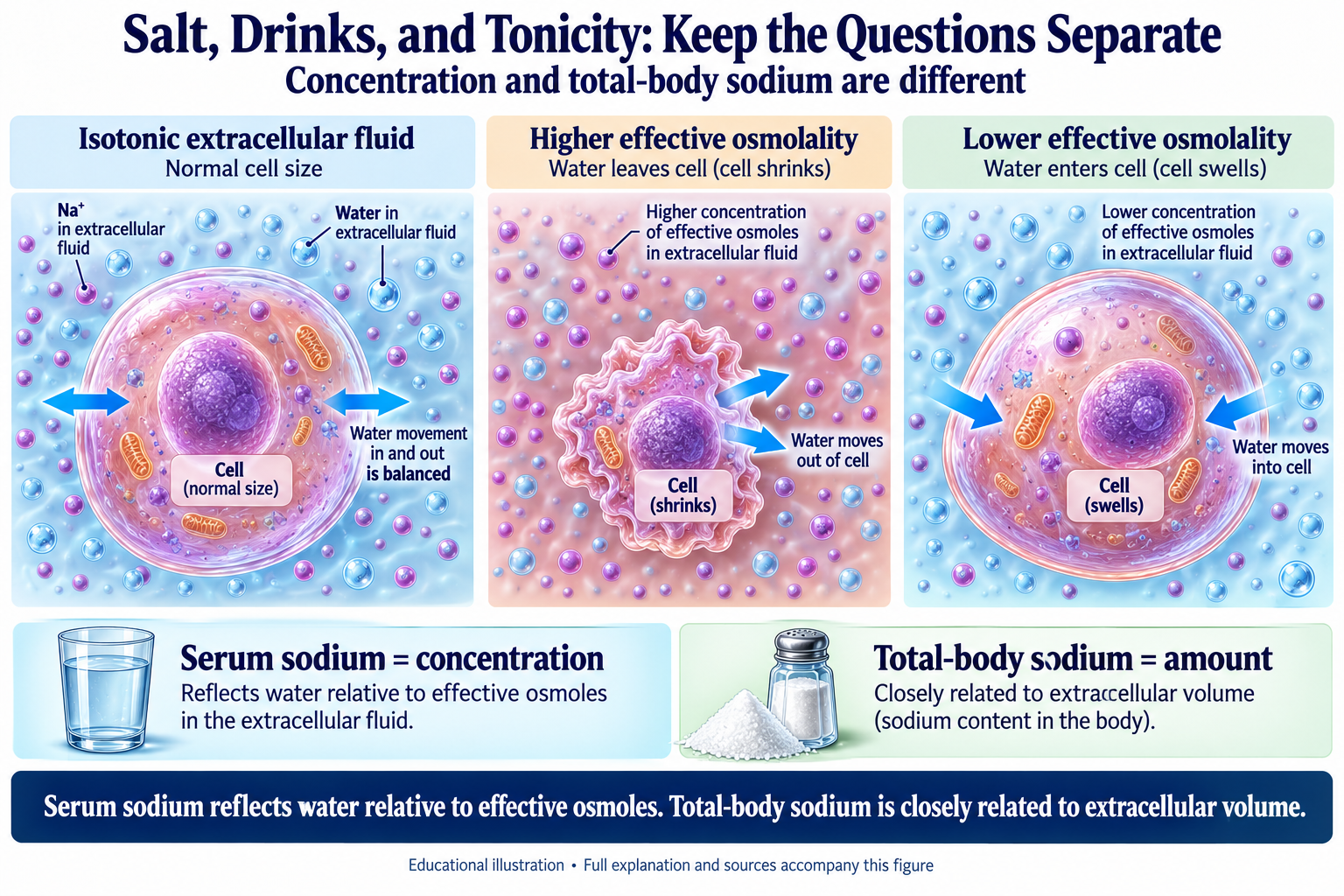
Osmolality vs Tonicity
Osmolality is total solute concentration (plasma approximately 280–295 mOsm/kg). Tonicity is effective osmolality — only solutes that do not freely cross cell membranes. Sodium counts. Glucose counts partly. Urea does not count.
A sports drink with 10 mEq Na/L has osmolality approximately 200–330 mOsm/kg (from the sugar) — close to plasma on paper — but is hypotonic because the tonically effective solute (sodium) is vastly below plasma. Drink enough of it and net free water enters cells. The brain is especially unforgiving when this happens fast.
The Free-Water Excretion Ceiling
Healthy kidneys excrete at most approximately 0.8–1.0 L/hr of free water. Several states lower the ceiling:
- Stress / exertion / pain / anesthesia raise ADH non-osmotically.
- Thiazide diuretics impair urine-diluting capacity (unlike loops).
- SSRIs can produce SIADH.
- HFrEF, advanced cirrhosis, advanced CKD — volume-confused kidneys cannot dilute urine effectively.
ceiling (L/hr)
(mEq/L)
(hypotonic)
(isotonic)
⚠️ The Jennifer Strange Case (2007)
28-year-old contestant in a Sacramento radio contest ("Hold Your Wee for a Wii") drank approximately 2 gallons of water over 3 hours without urinating. Died that day of cerebral edema from acute dilutional hyponatremia.
Mechanism: free-water intake exceeded renal excretion capacity by several-fold; serum sodium dropped precipitously; cerebral edema → seizure → herniation. Plain water can kill when ingested faster than the kidneys can excrete. Sports drinks do not rescue this — they are still hypotonic.
3. Sweat Math — What Exertion Actually Loses
- Typical exertional sweat rate: 0.5–1 L/hr; hot humid conditions can push this to 2 L/hr.
- Sweat sodium concentration: 20–60 mEq/L (approximately 460–1,400 mg Na/L).
- Net: 2 L/hr of moderately salty sweat → approximately 50–120 mEq Na (approximately 1,200–2,800 mg) per hour.
- A typical sports drink (approximately 20 mEq Na/L) provides 20 mEq Na per liter — roughly 0.5 L of the sweat's worth per liter consumed. The math is always behind.
💡 The Intuition
Short exertion with whole-food meals before and after? Sports drinks are fine — the math catches up at the next meal. Multi-hour endurance without salty food? The sports drink alone never catches up. Drinking more of it moves the patient further from tonicity, not toward it. Decoupling — plain water to thirst plus salt-dense solid food — is the mechanistically correct fix.
4. Intake Options — Master Table
| Option | Na content | Tonicity vs plasma | DPT/PA use |
|---|---|---|---|
| Plain water | 0 mEq/L | Severely hypotonic | Everyday hydration. Dangerous in excess during endurance exertion or in SIADH-prone patients. |
| Sports drink (Gatorade / Powerade) | 10–20 mEq/L | Severely hypotonic | OK for short/moderate exertion in Na-normal patients. Suboptimal for most DPT/PA scenarios. |
| Pedialyte | approximately 45 mEq/L | Hypotonic but closer to target | Pediatric mild gastroenteritis; adult sick-day. |
| WHO ORS (reduced-osmolarity) | 75 mEq/L Na + 75 mEq/L glucose | Hypotonic, glucose-cotransport optimized | Acute diarrheal illness.[8] |
| LMNT / Liquid IV / DripDrop | approximately 500–1,000 mg Na per packet | Adjustable (mix smaller volume for higher tonicity) | POTS, endurance athletes, hot-weather cardiac rehab. |
| Pickle juice / olive brine | approximately 150–200 mEq/L | Mildly HYPERtonic | Muscle cramps (Miller 2010[3]); ambulatory salt bolus. Small volumes (2–3 oz). |
| Broth / bouillon / miso / stock | approximately 800–1,200 mg Na per cup | Hypotonic by volume, meaningful Na delivery | Sick-day staple. Tolerable with nausea. Decouples Na from free-water beautifully. |
| Pretzels / saltines / salted nuts | approximately 200–400 mg Na per serving | Solid, paired with water | Classic ambulatory salt source. Long hikes, bike rides, long sessions. |
| V8 / tomato juice | approximately 650 mg Na per cup | Close to isotonic | Older-adult rehab; HFrEF caution with Na limit. |
| Canned soup | approximately 800–1,200 mg Na per cup | Sick-day friendly | Easy vehicle when appetite is poor. Avoid "low-sodium" for this purpose. |
| NaCl salt tablet (1 g) | 393 mg Na / 17 mEq per tablet | Pharmacologic adjunct | POTS under MD guidance.[1] Chronic SIADH per specialist. Not a freelance tool. |
5. Decision Algorithm
Patient needs volume + Na replacement?
        │
        ▼
Step 1 — Is patient in a LESS-salt population?
  (decompensated HFrEF, cirrhosis + ascites, dialysis,
   Na-restricted advanced CKD, resistant HTN, chronic SIADH)
        ├── YES → Do NOT apply this framework.
        │        Follow the prescribed Na/fluid target.
        └── NO  → Continue.
        ▼
Step 2 — Scenario type?
  A. Exertion in Na-normal patient, solid food impractical
     → Sports drink acceptable. Better: water + pretzels + packet.
  B. Pediatric mild gastroenteritis → Pedialyte.
  C. Acute diarrheal illness → WHO-ORS formulation.
  D. POTS / orthostatic intolerance → salt tabs + water + high-Na food
     under MD direction.
  E. Cardiac rehab heat day → decouple: broth + water before,
     pretzels + water during, canned-soup meal after.
  F. Thiazide or SSRI patient with fatigue/confusion → suspect
     hyponatremia. Do NOT give sports drinks. Escalate for Na check.
  G. Post-op older adult → decouple: protein + salt snacks, water
     to thirst.
  H. Muscle cramps during exertion → pickle juice / olive brine
     (Miller 2010). Not the same mechanism as Na repletion.
🚩 6. Who Needs LESS Salt, Not More — the Override
These six populations override the framework. Do NOT recommend salt.
- Decompensated HFrEF / volume-overloaded HF — 2–3 g/day Na prescription[7]
- Advanced cirrhosis with ascites — Na restriction (often <2 g/day) + fluid restriction
- Hemodialysis patients — Na drives interdialytic weight gain and BP swings
- Advanced CKD on Na-restricted diet — follow nephrology target
- Severe resistant hypertension — Na restriction is part of management
- Chronic SIADH — fluid restriction + specialist-directed salt tabs if any
For these patients, the decoupling concept still applies — but the sodium set-point is chosen by the prescribing team. Follow that target.
7. Salt Tablets — the Prescribing-Coordinated Tool
NaCl 1-g tablets (393 mg Na, 17 mEq) are useful in three populations, always coordinated with the prescriber:
- POTS / orthostatic intolerance — often 3–10 g/day total Na (food + tabs) per Freeman 2011.[1]
- Salty-sweater endurance athletes — individual sweat-rate calculation.
- Chronic SIADH — specialist-directed, often with fluid restriction.
DPT/PA role: recognize the fit, relay to the prescriber, do not freelance. Pair with water-to-thirst. If patient feels worse on tabs, call the prescriber.
8. Five Patient-Teaching Scripts
💬 Why pickle juice beats Gatorade
"Two or three ounces of pickle juice gets you about as much sodium as four Gatorades — without the sugar and without the volume. For cramping or a hot session where you need a quick sodium hit, it is faster and cheaper. Broth works. Salty pretzels with water work. Pick your salt, pick your water, don't drink them pre-mixed at the wrong ratio."
💬 Salt tab (when prescribed)
"The salt tablet gives you a measured sodium dose so your blood volume holds up when you stand and when you move. It is not a substitute for water. Take the tab, drink water to thirst, and the two together keep you where your doctor wants you. Never double it on your own."
💬 Sick-day: broth, not Gatorade alone
"For a day you're not feeling great — flu, stomach bug, run-down — warm broth plus water, sipped slowly, beats Gatorade alone. Broth gives real sodium; water hydrates separately. Canned chicken noodle counts. Miso counts. Pho counts. Low-sodium versions don't — you want the real thing."
💬 HFrEF less-salt
"Everything I just said about adding salt is for most people. For you it's the opposite. Your heart can't handle extra salt, and your cardiologist has you on a specific limit. Stick to that target. Read labels, avoid canned soup, skip restaurant pho, weigh yourself every morning."
💬 When sports drinks ARE right
"I'm not against Gatorade. For a long hot session, a soccer tournament, or mid-event endurance when you can't eat real food, it's fine. What I don't want is reaching for it every time something feels 'off' at home. 'Off' can be low blood sugar, low sodium, dehydration, or a medication effect — sports drinks don't fix all of those and for some they make it worse."
🩺 9. Case Vignettes — Four Clinical Scenarios
Case 1 · POTS Patient Starting Salt Tabs
Setting: Outpatient rehab. Ms. Park, 28, 6 months of POTS after a viral illness. Autonomic specialist started NaCl 1-g tabs, 2 tabs TID (approximately 2,400 mg Na/day added), plus salty food encouragement.
Presentation: Asks if she should "drink extra water too" and whether sports drinks would substitute. Also trying to lose 10 pounds; has cut back on "salty junk food."
What framework applies?
POTS is the canonical decoupling scenario. Salt tabs deliver measured sodium; water comes separately to thirst. Sports drinks do neither well.
What to say
- Yes, drink water — to thirst, not schedule.
- No, sports drinks are not a substitute — they lock a hypotonic ratio.
- Reverse the weight-loss advice — dropping dietary sodium undoes her specialist's plan (target 3–10 g/day total Na).[1]
- Coordinate with specialist; if she feels worse on tabs, specialist adjusts.
Case 2 · HFrEF Patient Offered Gatorade
Setting: Cardiac rehab, July. Mr. Hayes, 68, HFrEF (EF 30%), on full GDMT + furosemide 40 mg BID. Cardiologist: 2 L/day fluid target, 2 g/day Na cap.
Presentation: His daughter brings a 32-oz Gatorade "because he is sweating so much today." Shirt damp. Asymptomatic. BP 124/76, weight stable.
Framework?
Less-salt override. 32 oz Gatorade delivers approximately 600 mg Na plus approximately 950 mL free water — blowing through both his caps in one drink.[7]
What to do
- Decline the Gatorade, politely redirect.
- Teach the daughter — for Dad, the usual "sports drinks on hot days" advice is reversed.
- Offer water to thirst within the 2 L cap.
- Modify session — cool-down, shorter interval, monitor for dyspnea/chest pain.
- Document.
Case 3 · Cardiac Rehab, Hot Day, Decoupling in Action
Setting: Cardiac rehab week 4, late August. Mr. Dunn, 58, post-CABG, preserved LV function (EF 60%), NO HFrEF. On ASA, atorvastatin, metoprolol. No diuretic, no fluid restriction.
Presentation: 2 p.m. session, hot outside. Sweating heavily from parking-lot walk. Pre-session weight 2 lb below last week. Asks what to drink.
Framework?
Standard decoupling. No HF, no Na restriction, visibly sweat-depleted. Needs sodium + water in the right ratio — not the one a sports drink locks.
What to recommend
- Before session: cup of broth or salty canned soup (approximately 800 mg Na) + water to thirst.
- During: pretzels or salted nuts (approximately 400 mg Na/serving) + water to thirst.
- After: canned soup lunch + water. V8 is an alternative for Na + K.
- Monitor: RPE (he's on a beta blocker — RPE is the target), HR trend, workload completion.
- Teach: use the "pickle juice instead of Gatorade" script.
Case 4 · Thiazide Patient with Fatigue and Confusion
Setting: Home-health rehab, post-op hip replacement. Mrs. Liu, 76, on HCTZ 25 mg + sertraline 50 mg. Week 3 of rehab.
Presentation: New fatigue, morning nausea, "a little fuzzy" per daughter. Drinking "extra water" on hot days after a previous clinician told her to "stay hydrated." Son brought a case of Gatorade "in case it would help."
Framework?
Suspected hyponatremia — do NOT apply decoupling until labs are back. Thiazide + SSRI + extra free water is textbook. A hypotonic sports drink deepens the sodium deficit.
What to do
- Do NOT recommend Gatorade — worsens the hyponatremia.
- Do NOT recommend "more water" — the overdrinking is plausibly causing this.
- Stop the session — cognitive change + near-fall risk in an older adult on Na-vulnerable meds.
- Call PCP — basic metabolic panel today. Recommend holding thiazide until evaluated.
- Document.
✍️ 10. Check Your Understanding
Ten MCQs. Reveal after you commit.
Q1. A sports drink labeled "isotonic" has an osmolality close to plasma. Why is it still physiologically hypotonic?
- Temperature lower than body temp
- Its glucose is rapidly absorbed, leaving free water behind, and its sodium is far below plasma
- Its potassium exceeds its sodium
- "Isotonic" is a marketing term
Q2. The normal adult renal free-water excretion ceiling is approximately:
- 0.1–0.2 L/hr
- 0.8–1.0 L/hr
- 3–5 L/hr
- No ceiling in a healthy kidney
Q3. Which patient is in the LESS-salt override?
- 28yo with POTS starting salt tabs
- 58yo post-CABG, EF 60%, no HF, on beta blocker only
- 68yo HFrEF (EF 30%) with 2 g/day Na cap
- 34yo marathoner at mile 18 on a hot day
Q4. Pickle juice relieves exercise cramps faster than expected from absorption alone. Best-supported mechanism:
- Rapid systemic Na absorption
- Vinegar-driven pH shift in skeletal muscle
- Oropharyngeal TRP-receptor reflex inhibition
- Glucose cotransport in the small intestine
Q5. A family member brings 32 oz Gatorade to cardiac rehab for an HFrEF patient with a 2 g/day Na cap. What do you do?
- Let him drink it — he's sweating
- Accept but recommend he only drink half
- Politely decline; explain Na and fluid caps; offer water to thirst within cap
- Replace it with a can of regular chicken soup
Q6. Best sick-day replacement for an otherwise-healthy adult with nausea and poor appetite:
- Plain water as much as tolerated
- Warm broth or canned soup + water to thirst
- 32 oz Gatorade every hour
- Salt tabs + plain water
Q7. A slow marathoner drinking every aid station for 4 hours, now with nausea, headache, +3 lb. CONTRAINDICATED:
- Salty broth
- Pickle juice in small volumes
- Plain water
- EMS transport
Q8. Best fit for "salt tabs + water + high-Na food":
- 68yo HFrEF on 2 g/day Na cap
- 28yo with POTS and orthostatic intolerance
- 55yo with cirrhosis + new ascites
- Dialysis patient gaining 5 kg between sessions
Q9. Older adult on HCTZ + sertraline with new afternoon fogginess and morning nausea, drinking extra water on hot days. FIRST action:
- Recommend Gatorade to "replace electrolytes"
- Recommend more water + salt tabs
- Stop session, call PCP, recommend BMP today
- Reassure and continue
Q10. Most accurate about Jennifer Strange ("Hold Your Wee for a Wii"):
- Died of sports drink overdose
- Sports drinks would have prevented the outcome
- Plain water above the renal ceiling produced acute dilutional hyponatremia and fatal cerebral edema
- Fatal intake rate was under 0.5 L/hr
📌 Take-Home Points
- Osmolality ≠ tonicity. Sodium counts, urea doesn't. Sports drinks are hypotonic regardless of "isotonic" labels.
- Renal free-water ceiling approximately 0.8–1.0 L/hr. Thiazides, SSRIs, exertional ADH, and advanced HF/liver/kidney disease lower it.
- Decouple Na from water. Pick each separately. Broth + water, pretzels + water, salt tab + water.
- Six less-salt overrides: decompensated HFrEF, cirrhosis + ascites, dialysis, Na-restricted advanced CKD, resistant HTN, chronic SIADH.
- Pickle juice is a cramp tool, not a volume-replacement tool (oropharyngeal TRP reflex).[3]
- Salt tabs are prescribing-coordinated. POTS, chronic SIADH, salty-sweater athletes — reinforce, never freelance.
- Sports drinks ARE right for short/moderate exertion in Na-normal patients when solid food isn't practical.
📚 References
- Freeman R, Wieling W, Axelrod FB, et al. Consensus statement on the definition of orthostatic hypotension, neurally mediated syncope and the postural tachycardia syndrome. Clin Auton Res 2011;21(2):69–72. PMID: 21431947. PubMed
- Sawka MN, Burke LM, Eichner ER, et al. ACSM position stand. Exercise and fluid replacement. Med Sci Sports Exerc 2007;39(2):377–90. PMID: 17277604. PubMed
- Miller KC, Mack GW, Knight KL, et al. Reflex inhibition of electrically induced muscle cramps in hypohydrated humans. Med Sci Sports Exerc 2010;42(5):953–61. PMID: 19997012. PubMed
- Hew-Butler T, Rosner MH, Fowkes-Godek S, et al. Statement of the 3rd International EAH Consensus Development Conference, Carlsbad, California, 2015. Br J Sports Med 2015;49(22):1432–46. PMID: 26227507. PubMed
- Almond CSD, Shin AY, Fortescue EB, et al. Hyponatremia among runners in the Boston Marathon. N Engl J Med 2005;352(15):1550–6. PMID: 15829535. PubMed
- Verbalis JG, Goldsmith SR, Greenberg A, et al. Diagnosis, evaluation, and treatment of hyponatremia. Am J Med 2013;126(10 Suppl 1):S1–42. PMID: 24074529. PubMed
- Heidenreich PA, Bozkurt B, Aguilar D, et al. 2022 AHA/ACC/HFSA Guideline for the Management of Heart Failure. Circulation 2022;145(18):e895–e1032. PMID: 35363499. PubMed
- WHO. Oral rehydration salts — reduced-osmolarity formulation (75 mEq/L Na + 75 mEq/L glucose). WHO Model List of Essential Medicines.