💊 NSAIDs & Pain Management
The most common preventable AKI in outpatient care. Which patients must not take ibuprofen — and the topical-first bundle that replaces it.
Visual reference
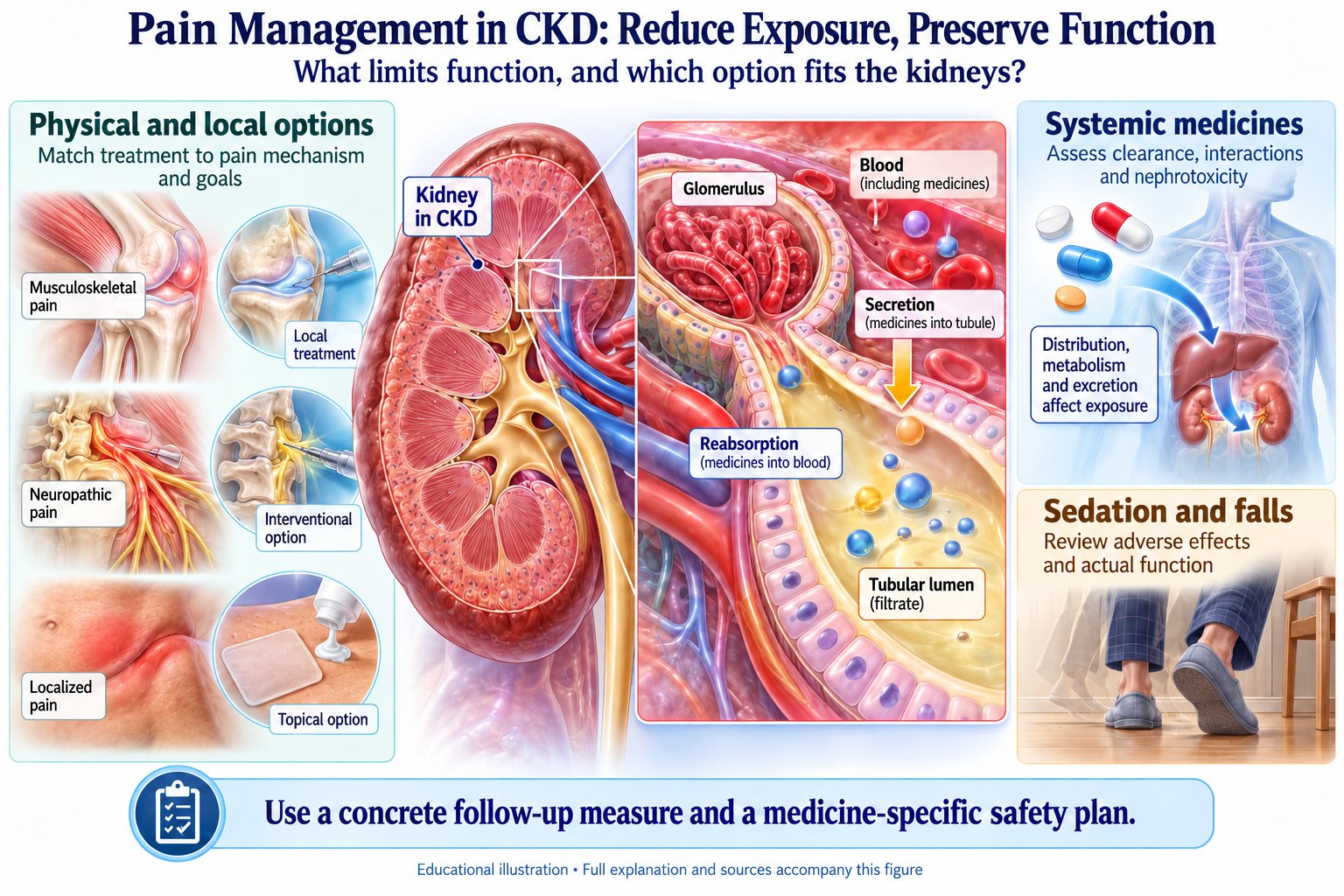
Browse the visual reference library · Download lesson Markdown
🎯 Learning Objectives
1. Why NSAIDs Matter
Your patients use NSAIDs. A lot of them. The limping knee-OA patient, the cardiac-rehab participant whose cardiologist just added a second diuretic, the fall-risk older adult on eight medications. You don't prescribe these drugs. You decide what to do with patients who are on them.
The paradox: NSAIDs help musculoskeletal pain — that's the population you see every day. But the same drugs cause AKI, worsen heart failure, raise BP, trigger ulcers, and interact with the cardiovascular medications your patients are on. Risk is not spread evenly — the higher the risk (CKD, CHF, elderly, on ACEi/ARB, on diuretics), the more your patient's exposure matters.
💡 The DPT/PA Clinician's Three Jobs on NSAIDs
- Recognize who is at high risk for NSAID harm.
- Recommend the DPT/PA-owned alternatives — topical NSAIDs, lidocaine patches, percussion massage, graded exercise, heat/ice, TENS.
- Escalate when red flags appear — you are often the first person to see them.
2. COX Mechanism
NSAIDs block cyclooxygenase (COX-1 and COX-2), reducing prostaglandin production. Prostaglandins do two things:
- Inflame (COX-2 at injury sites) — blocking this is the therapeutic effect.
- Protect (COX-1 in kidney, stomach, platelets) — blocking this is the adverse effect.
Every NSAID does both to some degree. COX-2-selectives (celecoxib) skew the ratio but still block renal prostaglandin synthesis meaningfully.
💡 Why the Kidney Cares About Prostaglandins
In a healthy volume-replete person at rest, renal blood flow is mostly unaffected by NSAIDs — the kidney doesn't "need" prostaglandins in the normal state. But in stress states (volume depletion, HF, cirrhosis, CKD), prostaglandins become critical mediators of afferent arteriolar dilation, maintaining glomerular perfusion against low effective circulating volume. Block the prostaglandins in that setting and the afferent constricts, perfusion pressure drops, GFR falls fast. That's hemodynamic AKI.
3. The Three Renal Harms
| Injury | Mechanism | Onset | What you'd see |
|---|---|---|---|
| Hemodynamic AKI | NSAID blocks prostaglandin-mediated afferent dilation in stress states | Hours to days | Sudden fatigue, reduced urine output, rising BUN/Cr, orthostasis |
| Acute interstitial nephritis (AIN) | Hypersensitivity in tubulointerstitium — not dose-related | Days to weeks | Low-grade fever, rash (sometimes), arthralgia, new fatigue, eosinophilia |
| Chronic CKD progression | Sustained high-dose use accelerates GFR decline in susceptible patients | Months to years | No acute signal — shows up on labs |
Meta-analysis of observational data: regular-dose NSAID use in moderate-to-severe CKD was not associated with accelerated progression (pooled OR 0.96, 95% CI 0.86–1.07); high-dose NSAID use was (pooled OR 1.26, 95% CI 1.06–1.50).[2] Dose and duration matter more than the drug class itself.
⚠️ 4. The "Triple Whammy"
NSAID + ACEi/ARB + diuretic. Lapi et al. 2013: 487,372 patients on antihypertensive drugs in the UK. This combination raised AKI risk by 31% (RR 1.31, 95% CI 1.12–1.53). Risk peaked at +82% in the first 30 days (RR 1.82, 95% CI 1.35–2.46).[3]
(Lapi 2013)
first 30 days
in cohort
stacking
Why 3 Drugs and Not Fewer
- Diuretic → volume contraction → RAAS activation, increased reliance on prostaglandin-mediated afferent dilation.
- ACEi / ARB → blocks efferent constriction. Kidney holds perfusion pressure only via afferent now.
- NSAID → blocks afferent prostaglandin-mediated dilation.
Both regulators disabled + volume-contracted → glomerulus loses perfusion pressure fast. Hemodynamic AKI in one recognizable pattern.
5. Topical vs Oral
Systemic exposure after topical diclofenac is a fraction of oral dosing. Voltaren Emulgel: approximately 6% systemic absorption over 12 hours non-occluded skin; steady-state plasma 20–40 nmol/L — well below therapeutic oral ranges.[4]
Cochrane overview: "Systemic or local adverse event rates with topical NSAIDs (4.3%) were no greater than with topical placebo (4.6%)" in acute pain; GI adverse events matched placebo.[6]
💡 Memorize This
Topical is not "weaker oral." Topical is a different risk profile — enough local drug to help, too little systemic drug to harm the kidney, stomach, or platelets.
Knee OA: Cochrane 2016 pooled topical diclofenac — NNT for clinical success (approximately 50% pain relief) at 6–12 weeks = 9.8 (95% CI 7.1–16), moderate-quality evidence.[7] Head-to-head vs oral showed similar efficacy in knee OA. That's the basis for "start topical."
6. The Eight High-Risk Populations
🚩 Red Flags During Rehab
| Finding | Signals |
|---|---|
| New LE edema, rapid weight gain (>2 lb/day) | Na retention, worsening HF, NSAID fluid overload |
| New/worsening dyspnea, orthopnea, PND | Decompensated HF |
| New/rising BP out of baseline | NSAID-driven BP rise or volume overload |
| Orthostatic drop >20 mmHg SBP with symptoms | Volume depletion — possible hemodynamic AKI setup |
| Reduced urine output | AKI |
| New fatigue, nausea, metallic taste, confusion | Uremic symptoms from AKI |
| Low-grade fever + rash + joint pain | AIN triad |
| Black/maroon stool, epigastric pain, coffee-ground emesis | GI bleeding |
| Lithium patient with new tremor/confusion/ataxia | Lithium toxicity |
Three Check-Questions Every Session
- Any new OTC medications since last time? (catches the Advil-for-a-tweak)
- How much water on exercise days? (catches volume depletion)
- Any new swelling or weight gain? (catches volume overload)
20 seconds; catches most NSAID decompensations before the ED.
7. Decision Algorithm
Patient reports using or considering an NSAID for MSK pain
        │
        ▼
In any high-risk bucket?
  (age >65, CKD, HF, ACEi/ARB/ARNI, diuretic, SGLT2i,
   lithium, volume-depleted)
        │
        ├── NO  →  Topical first. Short-course oral reasonable if
        │         topical inadequate and no contraindication. Document.
        │
        └── YES →  Do NOT recommend oral NSAIDs on your own.
                   Pivot to the DPT/PA-actionable bundle.
                   Escalate oral-NSAID decisions to the prescriber.
        │
        ▼
Red flag now?
        │
        ├── NO  →  Proceed, apply non-pharm tools, document.
        └── YES →  Stop session. Contact prescriber or route to ED.
8. The DPT/PA-Actionable Bundle
Three tools, counseling not prescription: Voltaren gel + lidocaine patch + percussion massage.
🧴 Tool 1 · Voltaren (Diclofenac) Gel 1%
Best for: localized OA — knee, hand, ankle, elbow (superficial joints).
Evidence: NNT 9.8 for knee OA at 6–12 weeks.[7]
Dose: 2 or 4 g (knee vs hand) × 4/day per OTC dosing card.
Counseling: rub in until dry, no occlusion, no heat over area for approximately 1 hr, wash hands.
Cautions: pregnancy (esp 3rd trimester), open skin, severe aspirin-sensitive asthma, active GI bleeding.
🩹 Tool 2 · Lidocaine Patch 5% (Rx) / 4% (OTC)
Best for: localized neuropathic pain (PHN), localized myofascial trigger. First-line for PHN.[8]
Dose: up to 3 patches at once, 12 hr on / 12 hr off.
Counseling: intact skin only; cut to shape before removing backing; no heating pad over patch; remove before bathing.
Cautions: severe hepatic disease, lidocaine allergy, caution with Class I antiarrhythmics.
💆 Tool 3 · Percussion Massage
Best for: DOMS, trigger-point release, warm-up/recovery.
Evidence: 40-min sessions improved VAS pain and knee ROM vs stretching at 48 hr post-exercise.[9]
Counseling: muscle bellies only, 1–2 min per area, pressure not pain. Avoid bony prominences, anterior neck, kidney area, over joints.
Contraindicated: suspected/confirmed DVT in affected limb; anticoagulation (low intensity or avoid); open wounds; acute fracture; recent surgery; severe osteoporosis; peripheral neuropathy with reduced sensation.
Non-Pharm Adjuncts
| Tool | Best for | Clinical role |
|---|---|---|
| Acetaminophen | Baseline analgesia in CKD/CHF/elderly | 3 g/day max in vulnerable (4 g otherwise); no alcohol; renal-/cardiac-safe. |
| Duloxetine | Chronic knee OA, chronic LBP | Modest effect (WMD −0.67 on 10-pt vs placebo).[10] Watch orthostasis, falls. |
| Topical capsaicin | Chronic localized pain, PHN, OA | Counsel initial burning; avoid eyes. |
| TENS | Chronic LBP, knee OA, muscle pain | Electrode placement, titration. |
| Heat / ice | Acute (ice), chronic stiffness (heat) | Not over topical NSAID or lidocaine application sites. |
| Graded therapeutic exercise | Almost everything | Primary intervention. Every other tool is adjunct. |
Drug Interactions
| If patient takes... | Adding NSAID risks | Action |
|---|---|---|
| ACEi / ARB / ARNI | AKI via blocked efferent + afferent dilation | Steer to topical; escalate if oral considered |
| Loop / thiazide diuretic | Volume-depletion AKI; diuretic resistance | Pivot to bundle |
| SGLT2i | Mild additional volume contraction | Pivot to bundle |
| MRA (spironolactone, eplerenone) | Hyperkalemia; AKI with ACEi/ARB | Escalate |
| Anticoagulants (warfarin, DOACs) | GI / intracranial bleeding | Avoid oral NSAID; prefer topical + non-pharm; report bruising |
| Antiplatelets (ASA, clopidogrel) | GI bleeding; NSAID may blunt aspirin antiplatelet effect | Same |
| Lithium | Reduced Li clearance → toxicity (tremor, confusion, ataxia) | Escalate; never freelance oral NSAID |
| Corticosteroids | Synergistic GI ulceration | Avoid oral NSAID counseling |
9. Five Patient-Teaching Scripts
💬 Starting with topical
"Ibuprofen and naproxen pills work, but they can hurt your kidneys, raise your BP, and make your heart medicines less effective. The gel and patch give you most of the pain relief without those risks — so that's where we're starting. If we can't get you comfortable with topical + exercise + heat/ice, I'll help you talk to your doctor about whether an oral pill is worth the tradeoff."
💬 Sick-day NSAID hold
"Any day you're throwing up, have diarrhea, or can't keep fluids down — skip the gel too, not just the pill. Your kidneys need water to work, and these medicines make them more sensitive to being dry. Same rule for a bad flu or any hospitalization — hold NSAIDs until you're drinking normally again."
💬 Daily weight (CHF / CKD)
"Weigh yourself every morning, same time, same scale, right after you empty your bladder. Call your doctor if you gain >2 lb overnight or >5 lb in a week — that's fluid, not fat, and it matters for your heart and kidneys."
💬 Percussion gun safety
"Think of this as pressure, not pain — if it hurts, ease off. Muscle only, not bone or joints. Not over front of neck, not over kidneys on your back, not over bruised or numb or healing areas. If you're on a blood thinner, let me show you a much lighter setting."
💬 Three-check-questions
"Before we start: any new OTC meds since last time? How much water on exercise days? Any new swelling or weight gain?" 20 seconds; catches the Advil-for-a-tweak, volume depletion, volume overload.
🩺 10. Case Vignettes
Case 1 · Triple Whammy in Cardiac Rehab
Setting: Cardiac rehab week 6. Mr. Harlan, 73, HFrEF (EF 35%), on lisinopril 20 mg, furosemide 40 mg BID, spironolactone 25 mg, metoprolol succinate, empagliflozin 10 mg.
Presentation: Yesterday's yardwork "tweaked my back." Took 600 mg ibuprofen last night + this morning. Asymptomatic. BP 118/76. Weight stable.
Risk
Classic triple whammy: NSAID + ACEi (lisinopril) + diuretic (furosemide). +31% AKI overall, +82% first 30 days.[3] Add empagliflozin + spironolactone and stack widens. Four of eight high-risk buckets simultaneously.
Action
- Stop the oral ibuprofen today.
- Call cardiology — report NSAID use, triple-whammy context. Recommend BMP.
- Pivot to bundle — Voltaren gel to lumbar (partial benefit given depth), lidocaine patch at night for sleep, low-intensity percussion to paraspinals (anticoag-adjacent stack), ice, graded return.
- Use "starting with topical" script.
- Daily weights + 3-check-questions each session × 2 weeks.
- Document.
Case 2 · Young Athlete with Shoulder Strain
Setting: Outpatient sports rehab. Ms. Rios, 24, volleyball player, no chronic conditions, no meds. Right-shoulder impingement after a tournament.
Presentation: Pain disrupts sleep. Ice + rest × 3 days inadequate. Asks about ibuprofen.
Is oral reasonable?
Yes. None of the 8 high-risk buckets: young, no CKD/HF/DM/HTN, no interacting meds, volume-replete.
Action
- Start topical if feasible — Voltaren works on superficial joints; shoulder is deeper so results may be partial. Lidocaine patch for night sleep.
- If oral used: standard-dose short course (ibuprofen 400 mg TID or naproxen 220–440 mg BID, with food, 5–7 days max).
- Hydration; hold on sick days.
- Return precautions: epigastric pain, coffee-ground emesis, dark stool, new swelling → stop and call.
- Document.
Case 3 · Lithium Patient Asks About Aleve
Setting: Outpatient ortho for hand OA. Ms. Park, 55, on lithium 900 mg/day for bipolar + HCTZ 25 mg for HTN.
Presentation: Asks whether to take Aleve for painful CMC joint.
Risk
Two categories stack: lithium (NSAIDs reduce Li clearance → toxicity: tremor, confusion, ataxia) + thiazide (triple-whammy-adjacent with any NSAID).
Action
- Do NOT recommend oral NSAID — lithium interaction alone is enough.
- Pivot to bundle — Voltaren gel on CMC joint (hand OA is sweet spot for topical), lidocaine patch, joint protection, graded hand exercise.
- Use "starting with topical" script.
- If bundle inadequate at 2 weeks, route to prescriber (psych + PCP coordination).
- Red flags: new tremor/confusion/unsteadiness → ED today.
Case 4 · Post-Op Day 10 — the AIN Pattern
Setting: Home-health PT. Mr. Edwards, 62, Day 10 post-TKA. Discharged on ibuprofen 600 mg TID × 2 weeks + oxycodone PRN.
Presentation: New fatigue, low-grade fever × 2 days, subtle rash on forearms, nausea. No GI bleeding signs. Weight stable. BP 124/78.
Pattern
AIN classic triad — fever + rash + arthralgia/malaise — days to weeks after starting an NSAID. Approximately 10 days into high-dose ibuprofen is textbook timing.
Action
- Stop the rehab session.
- Instruct him to stop the ibuprofen immediately.
- Call orthopedic surgeon AND PCP — BMP, CBC with eosinophil differential, UA, urine eosinophils TODAY.
- Escalate post-op pain control: acetaminophen scheduled, lidocaine patch, ice. Surgeon decides further analgesia.
- Watch for AKI complications; ED if altered mentation or reduced urine output.
- Document.
✍️ 11. Check Your Understanding
Q1. The triple whammy is:
- NSAID + acetaminophen + opioid
- NSAID + ACEi/ARB + diuretic
- NSAID + beta blocker + statin
- ACEi + ARB + MRA
Q2. Why NSAIDs cause hemodynamic AKI in high-risk but not healthy volume-replete adults:
- NSAIDs only harm diseased kidneys
- Healthy kidneys aren't prostaglandin-dependent at baseline; stress states make them so
- NSAIDs degrade differently in healthy patients
- Purely idiosyncratic
Q3. Most appropriate patient for short-course oral ibuprofen for acute MSK injury:
- 73yo HFrEF on lisinopril, furosemide, empagliflozin
- 24yo volleyball player, no meds, no problems
- 55yo on lithium + HCTZ
- 62yo post-op Day 10 with new fever + rash
Q4. Topical diclofenac delivers approximately what systemic exposure vs oral?
- approximately 6% over 12 hours non-occluded
- approximately 50%
- Equal
- Higher than oral
Q5. The DPT/PA-actionable bundle:
- Oral ibuprofen, acetaminophen, opioids
- Voltaren gel, lidocaine patch, percussion massage (+ non-pharm adjuncts)
- Acetaminophen only
- Celecoxib alone
Q6. Day 10 post-op patient on scheduled ibuprofen, new low-grade fever + rash + fatigue. FIRST:
- Reassure — probably flu
- Continue at lower intensity
- Stop session, stop ibuprofen, call surgeon + PCP for labs today
- Add lidocaine patch and continue
Q7. Who should NOT receive a percussion massage session?
- Healthy 24yo with DOMS
- 65yo with suspected DVT in right calf, targeting the right calf
- 50yo on creatine with muscle soreness
- Athletic 30yo post-workout
Q8. Sick-day rule for NSAIDs in CHF/CKD patients:
- Continue all meds exactly as prescribed
- Double the NSAID to compensate for lost food
- Hold NSAIDs (oral AND topical) during vomiting/diarrhea/inability to drink; call prescriber
- Switch oral to topical and continue
Q9. Highest likelihood of hemodynamic AKI from an oral NSAID:
- Healthy 25yo at rest
- 65yo HFrEF on lisinopril + furosemide
- 40yo well-controlled HTN on amlodipine only
- Hydrated marathoner 48 hr post-race
Q10. Lithium + HCTZ patient asks about Aleve for CMC OA. Recommend:
- Aleve 220 mg BID × 2 weeks
- Voltaren gel + lidocaine patch + joint protection; do NOT recommend oral; route to prescriber if bundle inadequate
- Stop lithium
- Stop HCTZ
📌 Take-Home Points
- NSAIDs block both inflammation and protection. COX-2 = therapeutic target; COX-1 in kidney, stomach, platelets = adverse.
- Three renal harms: hemodynamic AKI (hours–days), AIN (days–weeks), chronic CKD progression (months–years).
- Triple whammy: NSAID + ACEi/ARB + diuretic = +31% AKI, +82% first 30 days.[3]
- Eight high-risk populations: age >65, CKD, HF, ACEi/ARB/ARNI, diuretic, SGLT2i, lithium, volume-depleted.
- DPT/PA bundle: Voltaren gel + lidocaine patch + percussion massage, plus acetaminophen, TENS, heat/ice, graded exercise.
- Topical is different, not weaker (approximately 6% systemic; AEs match placebo).[4],[6]
- Sick-day rule: hold NSAIDs (oral AND topical) during volume depletion.
- Three check-questions every session: new OTCs? water intake? swelling/weight gain?
📚 References
- Derry S, Moore RA, Rabbie R. Topical NSAIDs for chronic musculoskeletal pain in adults. Cochrane Database Syst Rev 2012;9:CD007400. PMID: 22972108. PubMed
- Nderitu P, Doos L, Jones PW, et al. NSAIDs and CKD progression: systematic review. Fam Pract 2013;30(3):247–55. PMID: 23302818. PubMed
- Lapi F, Azoulay L, Yin H, Nessim SJ, Suissa S. Concurrent diuretics, ACEi/ARB, NSAIDs and AKI risk. BMJ 2013;346:e8525. PMID: 23299844. PubMed
- Riess W, Schmid K, Botta L, et al. Percutaneous absorption of diclofenac. Arzneimittelforschung 1986;36(7):1092–6. PMID: 3768079. PubMed
- Brunner M, Davies D, Martin W, et al. Topical diclofenac bioavailability. Br J Clin Pharmacol 2011;71(6):852–9. PMID: 21241352. PubMed
- Derry S, Wiffen PJ, Kalso EA, et al. Topical analgesics — Cochrane overview. Cochrane Database Syst Rev 2017;5:CD008609. PMID: 28497473. PubMed
- Derry S, Conaghan P, Da Silva JAP, et al. Topical NSAIDs for chronic MSK pain. Cochrane Database Syst Rev 2016;4:CD007400. PMID: 27103611. PubMed
- Tang J, Zhang Y, Liu C, Zeng A, Song L. Therapeutic strategies for postherpetic neuralgia. Curr Pain Headache Rep 2023;27(9):307–319. PMID: 37493871. PubMed
- Li H, Luo L, Zhang J, et al. Percussion massage therapy on DOMS recovery — RCT. Front Public Health 2025;13:1561970. PMID: 40206177. PubMed
- Weng C, Xu J, Wang Q, Lu W, Liu Z. Duloxetine in OA or chronic LBP — systematic review and meta-analysis. Osteoarthritis Cartilage 2020;28(6):721–734. PMID: 32169731. PubMed