🥩 Protein, Kidneys, and the Rehab Patient
Why "more protein" is right for the older rehab patient — and wrong for pre-dialysis CKD. The CKD→ESRD reversal every DPT clinician must own.
Visual reference
Browse the visual reference library · Download lesson Markdown
🎯 Learning Objectives
1. Why Protein Matters
Protein is the single most important nutritional lever for almost every rehabilitation goal: recovery, sarcopenia prevention, post-op strength, weight loss without muscle loss, frailty reduction. And it is the lever most likely to be set wrong by the patient in front of you.
- The older adult hitting the 0.8 g/kg/day RDA and still losing strength.
- The cardiac-rehab patient on a GLP-1 RA eating a quarter of what they used to.
- The CKD patient who heard "no protein" ten years ago and now, on dialysis, should be eating more.
- The college athlete buying expensive proprietary powders when a rotisserie chicken would do the same.
💡 The DPT/PA Clinician's Three Jobs on Protein
- Know the target for the patient in front of you — older adult, athlete, rehab, CKD, dialysis, post-op are all different.
- Teach per-meal distribution — 3–4 meals/day with enough complete protein per meal to cross the anabolic threshold.
- Flag the CKD→ESRD transition — a patient whose "no protein" rule hasn't been updated on starting dialysis is at risk of protein-energy wasting.
2. Biology in One Page
Dietary protein → amino acids → muscle, enzymes, hormones, energy. Muscle protein synthesis (MPS) is regulated, not continuous. Triggered by feeding (protein meal) and resistance loading (exercise stimulus). Combined multiplicatively: a protein meal after resistance training beats either alone. The amino-acid signal is leucine. Each meal must cross a leucine threshold — and that threshold rises with age.
Anabolic resistance: stable-isotope work shows MPS response to a standardized protein dose is blunted in older adults. Young plateau approximately 0.24 g/kg/meal; older approximately 0.40 g/kg/meal.[3] A 70-kg older adult eating 20 g protein at each of 3 meals (total 60 g/day, 0.86 g/kg) looks "adequate" by RDA but each meal is sub-threshold — MPS never fires.
3. The Per-Meal Rule
| Population | Per-meal target | Meals/day | Daily total |
|---|---|---|---|
| Young adult | approximately 0.24 g/kg = approximately 17 g | 3–4 | 0.8–1.0 g/kg RDA |
| Older adult | approximately 0.40 g/kg = approximately 28 g | 3–4 | 1.2–1.6 g/kg |
| Strength/power athlete | 0.40–0.55 g/kg = approximately 28–40 g | 3–5 | 1.6–2.2 g/kg[4] |
MPS plateau (g/kg/meal)
MPS plateau
for MPS firing
per older-adult meal
Quality and Sources
- Complete proteins — animal sources + soy. Contain all essential amino acids.
- Leucine density — whey highest; beef, chicken, eggs, dairy, soy all strong.
- Whole food default. Powder is a tool when meals are disrupted.
- Animal vs plant in CKD: plant-forward often preferred for lower acid + phosphorus load.
4. Targets by Population — Master Table
| Population | Daily target (g/kg/day) | Clinical emphasis |
|---|---|---|
| Healthy adult, sedentary (RDA) | 0.8 | Minimum to avoid deficiency; NOT optimal for rehab. |
| Healthy older adult | 1.0–1.2[1] | Anabolic resistance — more per meal AND per day. |
| Older adult with disease | 1.2–1.5[1] | Highest-value rehab population. |
| General exercise / endurance athlete | 1.2–1.4 | Slightly elevated; total calories matter. |
| Strength/power athlete | 1.6–2.2[4] | Per-meal distribution across 3–5 meals. |
| Post-op / trauma / critical illness | 1.2–1.5+ | Catabolic state; coordinate with team. |
| Weight loss while active | 1.2–1.6 | Protect lean mass; pair with resistance training. |
| CKD stages 3–5, NOT on dialysis | 0.55–0.60 with keto-analogs or 0.60–0.80 without[2] | Under nephrology + renal dietitian only. |
| Dialysis (HD/PD) — the reversal | 1.0–1.2+ (PD often 1.2–1.3)[2] | Higher than pre-dialysis. PEW is a major mortality driver. |
| Kidney transplant (stable) | 0.8–1.0 maintenance | Coordinate with transplant team. |
💡 Does Protein Harm Normal Kidneys?
In patients with normal kidney function, higher protein intake within ranges studied (up to approximately 2.2 g/kg/day) has not been shown to harm the kidney.[4] The myth persists because data showing harm are from CKD populations — where restriction is appropriate — and get generalized incorrectly.
⚠️ 5. The CKD→ESRD Reversal
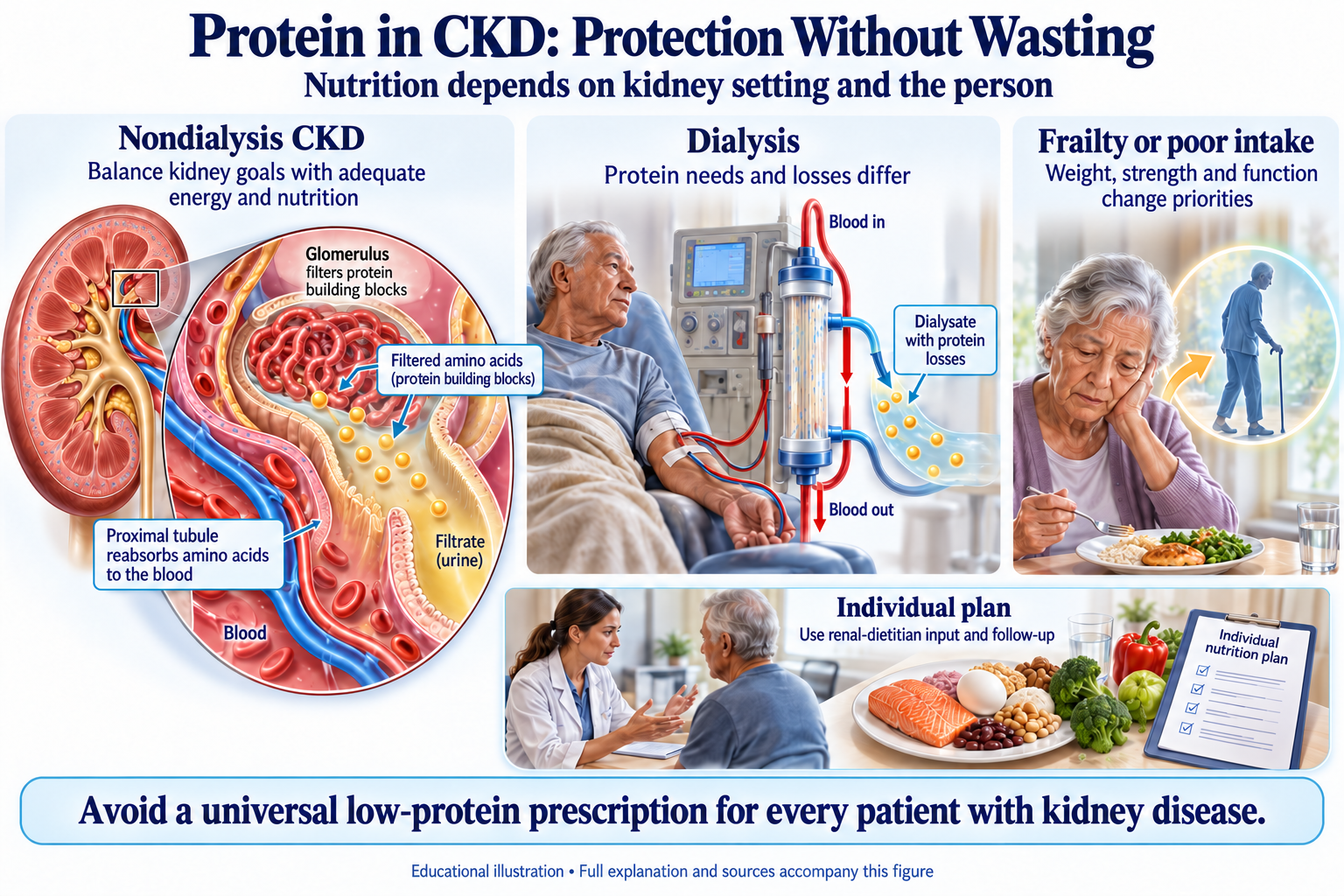
Many CKD patients — and many clinicians — internalize "kidney disease = low protein" and carry that rule onto dialysis. It is wrong. On dialysis, protein needs rise:
- Dialysis removes amino acids (approximately 6–12 g per HD session).
- Dialysis triggers catabolism.
- Protein-energy wasting (PEW) is one of the strongest mortality predictors in dialysis.
(g/kg/day)
(g/kg/day)
HD session
driver in dialysis
DPT/PA role: flag the transition. Ask what the dialysis team told them. If they still think "no protein," route to the renal dietitian. Do NOT set the new target yourself.
6. Decision Algorithm
Patient arrives — is protein intake appropriate?
        │
        ▼
Step 1 — CKD or ESRD?
  ├── CKD stage 3–5 NOT on dialysis → defer to nephrology + renal
  │     dietitian. Do NOT set target.
  ├── On dialysis (HD or PD) → target 1.0–1.2+ g/kg/day. Flag if
  │     patient still thinks "low protein" — route to dietitian.
  └── Normal kidney function → continue.
        ▼
Step 2 — Age, activity, disease?
  ├── Younger sedentary → 0.8–1.0 g/kg/day baseline.
  ├── Older healthy → 1.0–1.2.
  ├── Older + disease / rehab → 1.2–1.5.
  ├── Strength/power athlete → 1.6–2.2.
  └── Weight-losing active → 1.2–1.6 + resistance + creatine.
        ▼
Step 3 — Per-meal distribution?
  approximately 0.4 g/kg per meal in older adults
  (approximately 25–40 g complete protein). 3–4 meals/day.
        ▼
Step 4 — Source quality?
  Complete proteins + leucine density. Whey only when meals
  inadequate. CKD → plant-forward per renal dietitian.
7. The Sarcopenia Toolkit
EWGSOP2 defines sarcopenia by low muscle strength, reduced muscle quantity/quality, and reduced physical performance.[5]
| Component | Target | Why |
|---|---|---|
| Resistance training | 2–3 sessions/week, progressive | Non-negotiable. Protein without training builds little in older adults. |
| Protein | 1.2–1.5 g/kg/day, ≥0.4 g/kg per meal, 3–4 meals/day[1],[3] | The anabolic signal. |
| Creatine monohydrate | 3–5 g/day[6] | Adds approximately 1.37 kg lean mass and strength when paired with resistance training. See Module 4. |
| Adequate calories | Avoid prolonged deficit | Protein doesn't build muscle in deep deficit without resistance protection. |
| Vitamin D | Per clinician | Permissive for muscle function. |
💡 Practical Eating Plan — 70-kg Older Adult, Target 1.2 g/kg approximately 85 g/day
| Meal | Example | Protein |
|---|---|---|
| Breakfast | 3 large eggs + 1 cup Greek yogurt | approximately 33 g |
| Lunch | 4 oz chicken breast + beans | approximately 37 g |
| Dinner | 5 oz salmon + 1/2 cup lentils | approximately 44 g |
| Total | approximately 114 g/day (1.6 g/kg) | Per-meal threshold met |
When meals are disrupted (GLP-1 nausea, post-op small appetite, athletic cut): one 25–30 g whey shake replaces a meal.
8. Five Patient-Teaching Scripts
💬 Per-meal distribution
"You're hitting your daily target on paper — but most is at dinner. Your muscle doesn't remember dinner the next morning. Spread it across three meals with about 25–30 grams of complete protein each. Eggs and yogurt at breakfast, chicken at lunch, fish at dinner."
💬 CKD-to-dialysis transition
"When you were in pre-dialysis CKD, the rule was less protein — to take load off your kidneys. Now on dialysis, the rule reverses. Dialysis removes protein every session, and low protein on dialysis is your biggest nutritional risk. Your renal dietitian sets the exact target — usually around 1 to 1.2 grams per kilogram per day. The old 'no protein' rule is out."
💬 Whey vs whole food
"Protein powder isn't magic. Whole foods cover most of what you need. Powder helps days with poor appetite, after a workout when food isn't practical, or on a budget. A plain whey shake is fine. Fancy blends almost always over-promise."
💬 Protein doesn't harm normal kidneys
"The 'protein damages kidneys' idea comes from people who already have kidney disease. If your kidney function is normal, higher intake in ranges athletes and older adults need has not been shown to harm the kidney. What WILL harm you long-term is losing muscle you never rebuild. Eat the protein."
💬 Weight loss with lean-mass preservation
"You're eating less overall — that's the point. But keep muscle. Hit a higher protein ratio than at normal weight, 1.2 to 1.6 g/kg. Three meals, 25–30 g complete protein each. Resistance training twice weekly minimum. Consider creatine 3–5 g/day. Without these you lose fat AND muscle."
🩺 9. Case Vignettes
Case 1 · Post-Hip Replacement, Under-Eating
Setting: Week 3 post-right hip replacement, outpatient rehab. Mrs. Gomez, 74, 70 kg, OA and well-controlled HTN. No CKD. Down 4 lb since surgery.
Presentation: Eating "lighter" — toast and tea, sometimes soup. Estimates 45 g protein/day. Struggling with quad activation and sit-to-stand.
Target
Post-op older adult + rehab = 1.2–1.5 g/kg/day. At 70 kg, target approximately 85–105 g/day.[1] She's at 45 g/day (53% of target); per-meal almost certainly sub-threshold.
Action
- Set target approximately 85 g/day, distributed 28 g/meal × 3.
- Concrete meals: 3 eggs + Greek yogurt (33 g), 4 oz chicken + beans (37 g), 5 oz fish + lentils (44 g).
- 25-g whey shake as insurance on low-appetite days.
- Pair with resistance training 2–3/week.
- Consider creatine 3–5 g/day (coord PCP).
- Reassess at 2–4 weeks with strength + functional tests.
Case 2 · CKD-to-Dialysis Transition Still Carrying the Old Rule
Setting: Home-health rehab. Mr. Wu, 68, 80 kg, started HD 4 months ago after a decade of stage 4 CKD. Was on nephrology-prescribed low-protein diet pre-dialysis.
Presentation: "Still on the low-protein diet — dietitian said it protects the kidneys." Eating approximately 0.6 g/kg/day (48 g). Lost 3 kg since starting dialysis, persistent fatigue. Albumin 3.2 g/dL.
What's happening
CKD→ESRD reversal not yet applied. On dialysis the target is approximately 1.0–1.2+ g/kg/day (approximately 80–96 g/day at 80 kg).[2] He's at 60% of the floor while losing AAs every session. Weight loss + low albumin + fatigue = classic PEW.
Action
- Do NOT set new target — specialist-directed. Route back to renal dietitian and dialysis team today.
- Teach the reversal with the CKD-to-dialysis script.
- Document weight trajectory, albumin, fatigue, calls made.
- Modify rehab — avoid high-intensity loading until nutrition managed.
Case 3 · Older Adult on Semaglutide, Small Appetite
Setting: Outpatient rehab for knee OA. Mrs. Whitman, 66, 85 kg, T2DM + obesity. On semaglutide 3 months, down 18 lb.
Presentation: "Not hungry." Skips breakfast; small salad lunch; small protein dinner. Estimates 40 g protein/day. Feels weaker than expected.
Target
Weight-losing active older adult = 1.2–1.6 g/kg/day (approximately 100–135 g/day at 85 kg). She's at 40 g/day. Weakness is expected — GLP-1 RA weight loss can be up to 25–40% lean mass without intervention.
Action
- Protein-first eating — eat protein portion first when appetite is maximal.
- Whey shake 25–30 g replaces a meal on low-appetite days.
- Resistance training 2–3/week, progressive.
- Consider creatine 3–5 g/day (coord endocrinology).
- Communicate with endocrinologist if GI blocking intake.
Case 4 · Young Athlete Worried Protein Damages His Kidneys
Setting: Sports rehab for rotator-cuff injury. Alex, 22yo wrestler, 80 kg, normal kidney function, lifting 5×/week.
Presentation: At 2.0 g/kg/day (whole food + 2 whey shakes). Mother read protein damages kidneys; he's considering cutting back.
Evidence
For normal kidney function, intake up to approximately 2.2 g/kg/day has not been shown to harm.[4] ISSN supports 1.6–2.2 g/kg/day for strength athletes. Myth from generalizing CKD data.
Action
- Reassure with the evidence — "protein doesn't harm normal kidneys" script.
- Confirm 2.0 g/kg at 80 kg = 160 g/day is within ISSN range.
- Check for confounders — creatine, NSAIDs, dehydration drive most athlete creatinine concerns (see Module 4).
- Offer baseline eGFR + cystatin C if he wants certainty. Creatinine alone misleading in a muscular athlete on creatine.
- Annual recheck given training volume.
✍️ 10. Check Your Understanding
Q1. The RDA 0.8 g/kg/day is:
- Optimal for healthy older adults
- Minimum to avoid deficiency in healthy young adults
- Dialysis target
- Strength athlete target
Q2. Per-meal MPS plateau in OLDER adults:
- 0.10 g/kg
- 0.24 g/kg
- 0.40 g/kg
- 0.80 g/kg
Q3. Patient started HD 3 months ago, still thinks she's on low-protein diet. Action?
- Reinforce low-protein
- Tell her 2.0 g/kg immediately
- Explain reversal, route to renal dietitian, don't set target yourself
- Recommend plant-only
Q4. Most accurate about protein and kidney damage:
- Any intake > 1.0 g/kg damages kidneys
- In normal kidney function, up to approximately 2.2 g/kg/day has not been shown to harm
- Whey specifically causes kidney damage
- Plant is always safer than animal for the kidney
Q5. 75yo eats 60 g protein/day, all at dinner. Adequate?
- Yes — over RDA
- Yes — only total matters
- No — distribution matters; sub-threshold at breakfast and lunch so MPS may not fire
- No — needs ≥150 g/day regardless
Q6. Which should you NOT independently recommend "more protein" to?
- 74yo post-hip, 0.7 g/kg/day
- 68yo CKD stage 4 pre-dialysis, eGFR 25
- 22yo wrestler, normal labs
- 66yo on semaglutide losing weight fast
Q7. Full sarcopenia toolkit for older adult with disease in rehab:
- Protein alone
- Resistance training alone
- RT + protein 1.2–1.5 + creatine + calories + vitamin D
- High-protein shake daily + stretching
Q8. 66yo on semaglutide eating 40 g/day during rapid weight loss. Best:
- Stop semaglutide
- Maintain 40 g
- Increase to 1.2–1.6 g/kg, protein-first eating, resistance training, consider creatine; coord endo if GI blocking
- Add fluids only
Q9. Whey favored because:
- All 20 AAs in equal amounts
- Highest leucine density per gram
- Only complete protein
- Cheaper than whole food
Q10. Strongest suggestion of PEW in dialysis:
- Stable weight 6 months
- Unintentional weight loss + falling grip strength + low albumin in patient eating "low protein"
- Mild fatigue on dialysis days only
- Elevated BUN relative to creatinine
📌 Take-Home Points
- RDA (0.8 g/kg/day) is a minimum — not optimal for older adults, rehab, or athletes.
- PROT-AGE: 1.0–1.2 healthy older, 1.2–1.5 with disease.[1]
- Per-meal distribution matters — approximately 0.4 g/kg in older adults, 3–4 meals/day.[3]
- CKD→ESRD reversal: restrict pre-dialysis (0.55–0.80), INCREASE on dialysis (1.0–1.2+).[2]
- Sarcopenia toolkit: resistance + protein + creatine + calories + vitamin D.
- Protein doesn't harm normal kidneys up to approximately 2.2 g/kg/day.[4]
- Weight loss with lean-mass preservation: 1.2–1.6 g/kg + resistance training + creatine.
📚 References
- Bauer J, Biolo G, Cederholm T, et al. PROT-AGE Study Group. J Am Med Dir Assoc 2013;14(8):542–59. PMID: 23867520. PubMed
- Ikizler TA, Burrowes JD, Byham-Gray LD, et al. KDOQI Clinical Practice Guideline for Nutrition in CKD: 2020 Update. Am J Kidney Dis 2020;76(3 Suppl 1):S1–S107. PMID: 32829751. PubMed
- Moore DR, Churchward-Venne TA, Witard O, et al. Protein ingestion to stimulate myofibrillar protein synthesis. J Gerontol A Biol Sci Med Sci 2015;70(1):57–62. PMID: 25056502. PubMed
- Jäger R, Kerksick CM, Campbell BI, et al. ISSN Position Stand: protein and exercise. J Int Soc Sports Nutr 2017;14:20. PMID: 28642676. PubMed
- Cruz-Jentoft AJ, Bahat G, Bauer J, et al. EWGSOP2 consensus on sarcopenia. Age Ageing 2019;48(1):16–31. PMID: 30312372. PubMed
- Chilibeck PD, Kaviani M, Candow DG, Zello GA. Creatine + resistance training in older adults meta-analysis. Open Access J Sports Med 2017;8:213–226. PMID: 29138605. PubMed