Visual summary
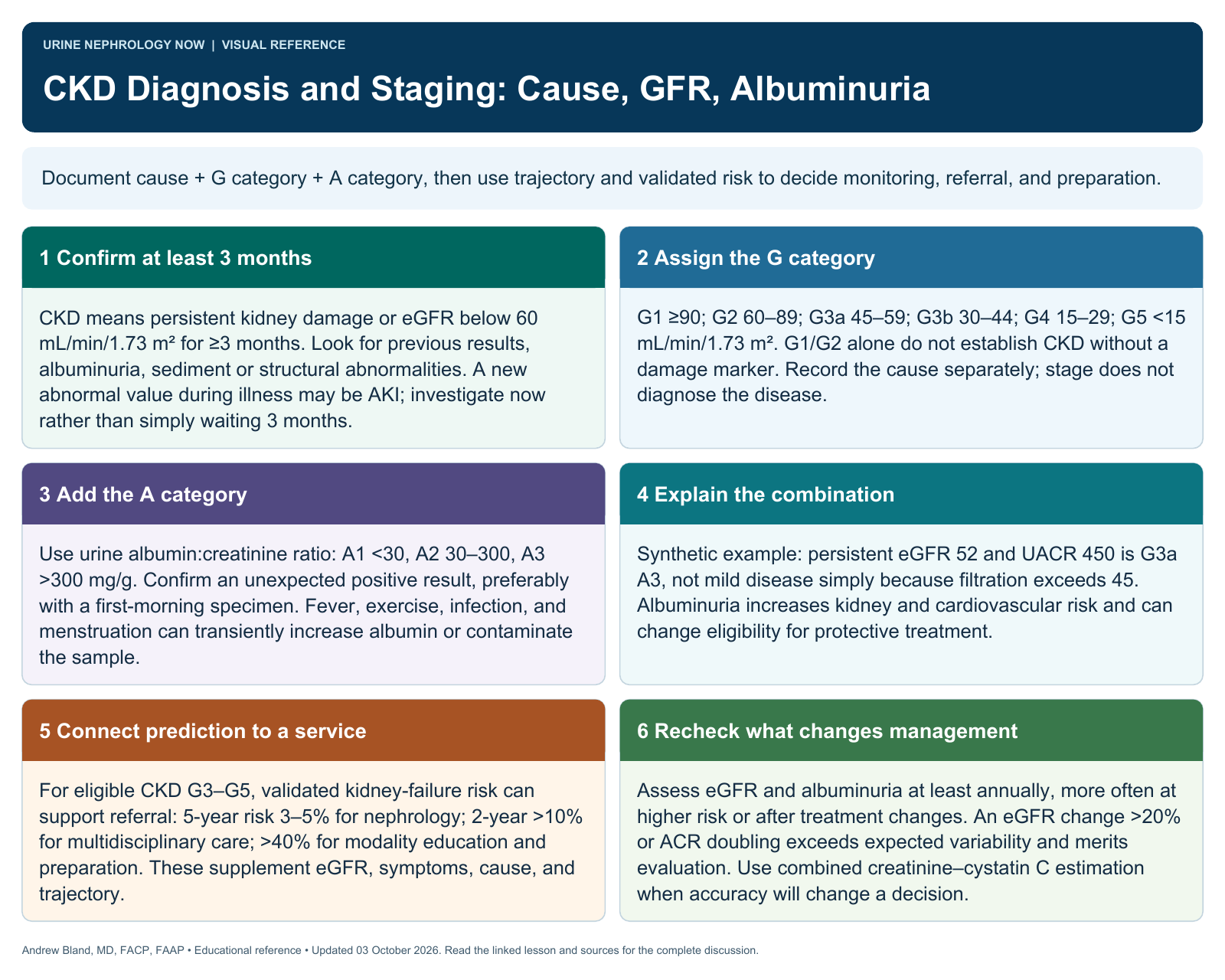
Document cause + G category + A category, then use trajectory and validated risk to decide monitoring, referral, and preparation.
Text version
Confirm at least 3 months
CKD means persistent kidney damage or eGFR below 60 mL/min/1.73 m² for ≥3 months. Look for previous results, albuminuria, sediment or structural abnormalities. A new abnormal value during illness may be AKI; investigate now rather than simply waiting 3 months.
Assign the G category
G1 ≥90; G2 60–89; G3a 45–59; G3b 30–44; G4 15–29; G5 <15 mL/min/1.73 m². G1/G2 alone do not establish CKD without a damage marker. Record the cause separately; stage does not diagnose the disease.
Add the A category
Use urine albumin:creatinine ratio: A1 <30, A2 30–300, A3 >300 mg/g. Confirm an unexpected positive result, preferably with a first-morning specimen. Fever, exercise, infection, and menstruation can transiently increase albumin or contaminate the sample.
Explain the combination
Synthetic example: persistent eGFR 52 and UACR 450 is G3a A3, not mild disease simply because filtration exceeds 45. Albuminuria increases kidney and cardiovascular risk and can change eligibility for protective treatment.
Connect prediction to a service
For eligible CKD G3–G5, validated kidney-failure risk can support referral: 5-year risk 3–5% for nephrology; 2-year >10% for multidisciplinary care; >40% for modality education and preparation. These supplement eGFR, symptoms, cause, and trajectory.
Recheck what changes management
Assess eGFR and albuminuria at least annually, more often at higher risk or after treatment changes. An eGFR change >20% or ACR doubling exceeds expected variability and merits evaluation. Use combined creatinine–cystatin C estimation when accuracy will change a decision.