Visual summary
A useful dialysis prescription balances clearance and fluid removal with cardiovascular tolerance and the patient’s clinical trajectory.
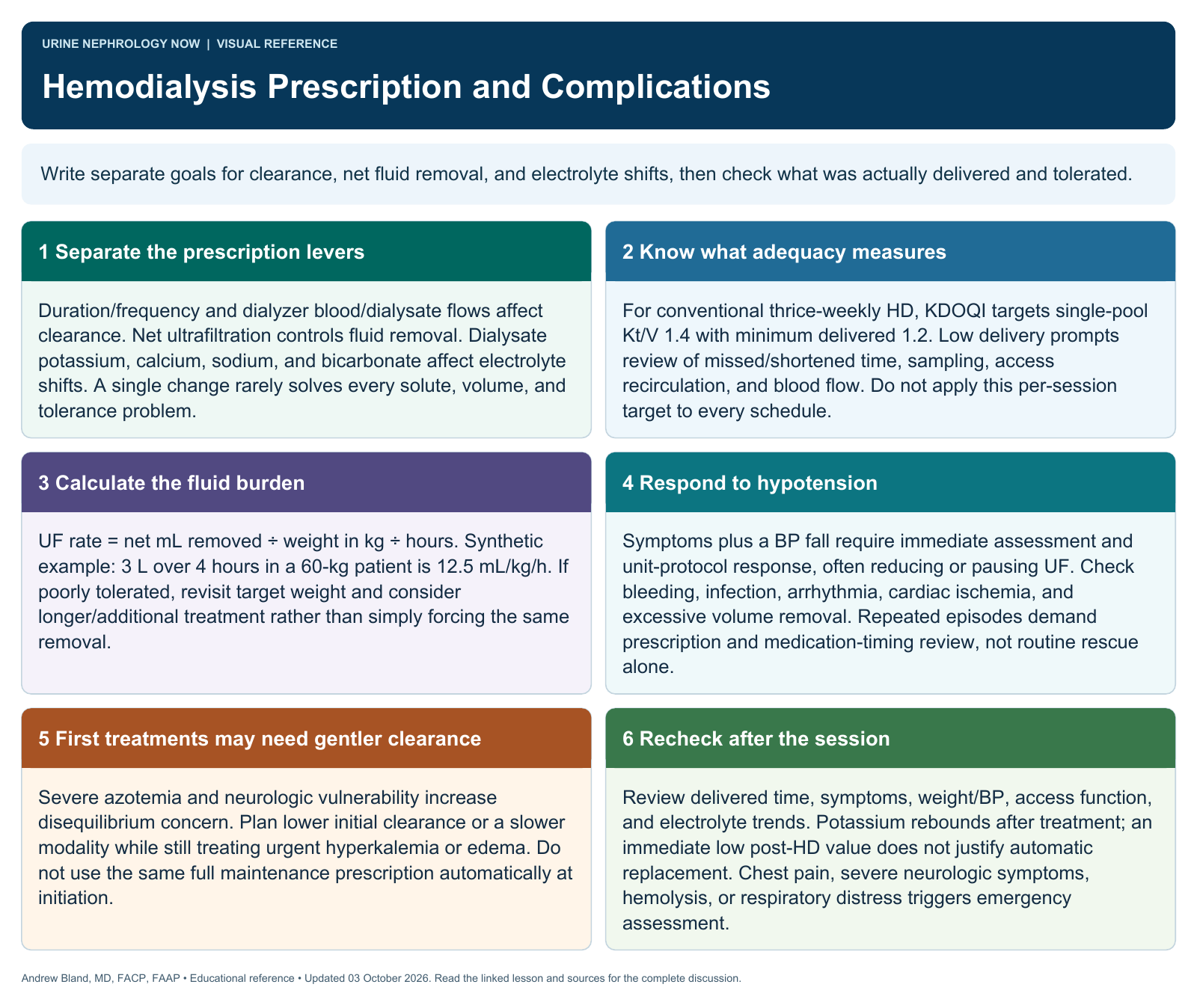
Text version
A prescription has several levers
Treatment duration, frequency, blood and dialysate flow, membrane, dialysate composition, and ultrafiltration jointly determine delivered therapy. Adjustments should address the individual patient’s solute, fluid, and hemodynamic needs.
Anticipate instability
Intradialytic hypotension, cramps, arrhythmia, access problems, and disequilibrium can interrupt treatment. New chest pain, neurologic symptoms, respiratory distress, or suspected hemolysis require prompt assessment and a dialysis-unit emergency response.
Assess adequacy and tolerance
Review delivered clearance, treatment adherence, access performance, interdialytic weight change, blood pressure, symptoms, and laboratory trends. Urea-based adequacy measures complement clinical assessment and should not become the sole measure of success.
Individualize fluid removal
Set a realistic fluid goal and reassess estimated target weight. Excessively rapid removal can impair perfusion. Longer or additional treatments, sodium review, and addressing interdialytic intake may be preferable to simply escalating ultrafiltration.
Use a cautious first treatment
A severely uremic patient starting dialysis may need a gentler initial prescription to reduce disequilibrium risk. Coordinate the clearance and fluid goals with hemodynamic stability, neurologic condition, and the urgency of electrolyte correction.
Avoid formula-only prescribing
Dialysate potassium, calcium, bicarbonate, and glucose need individualized review. A potassium heuristic such as the “rule of eight” is not a safety standard. Review post-treatment rebound and serial results before further intervention.
Continue learning
This graphic summarizes a topic. The full educational pages provide the broader discussion and references.