Visual summary
Write separate goals for clearance, net fluid removal, and electrolyte shifts, then check what was actually delivered and tolerated.
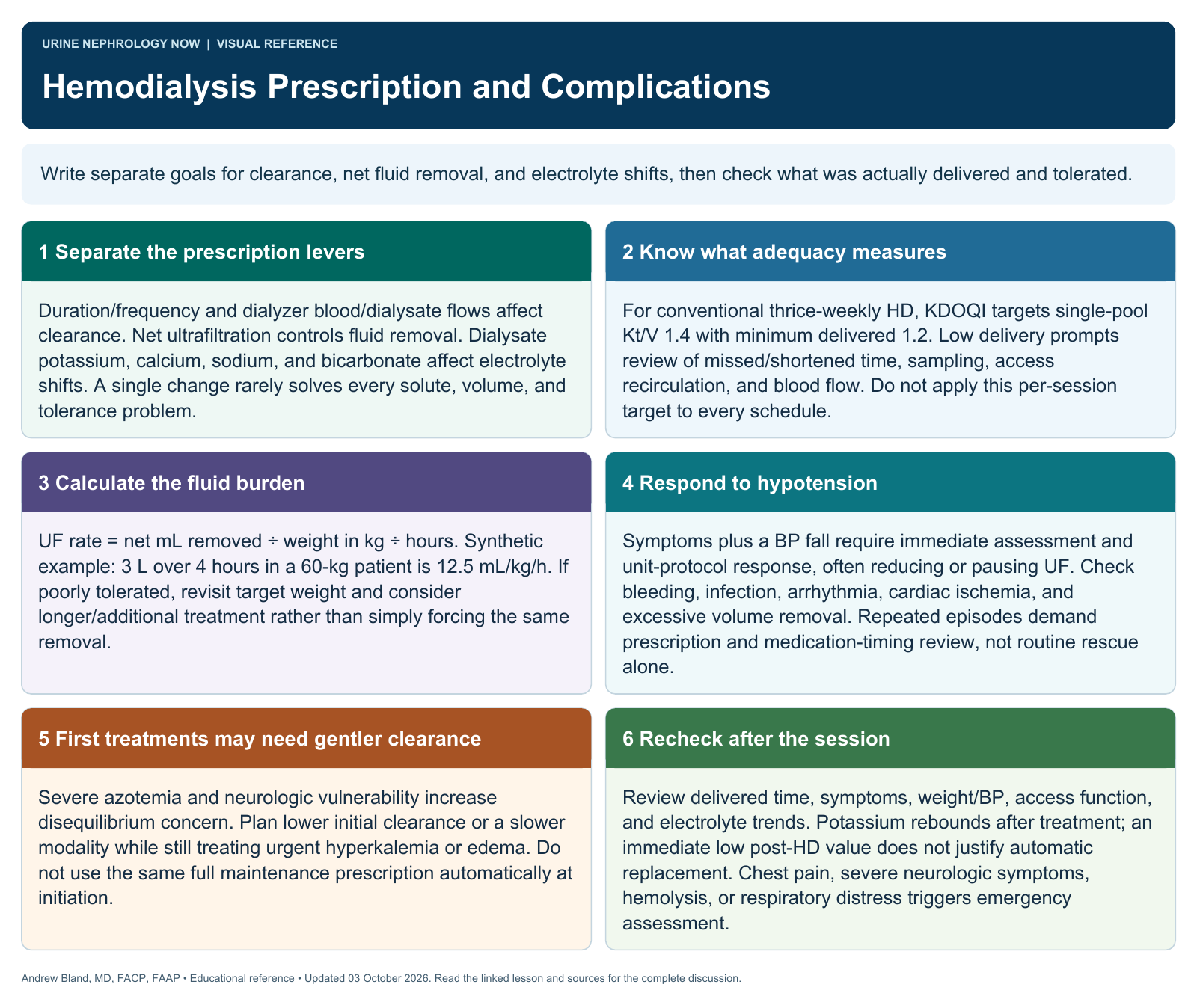
Text version
Separate the prescription levers
Duration/frequency and dialyzer blood/dialysate flows affect clearance. Net ultrafiltration controls fluid removal. Dialysate potassium, calcium, sodium, and bicarbonate affect electrolyte shifts. A single change rarely solves every solute, volume, and tolerance problem.
Know what adequacy measures
For conventional thrice-weekly HD, KDOQI targets single-pool Kt/V 1.4 with minimum delivered 1.2. Low delivery prompts review of missed/shortened time, sampling, access recirculation, and blood flow. Do not apply this per-session target to every schedule.
Calculate the fluid burden
UF rate = net mL removed ÷ weight in kg ÷ hours. Synthetic example: 3 L over 4 hours in a 60-kg patient is 12.5 mL/kg/h. If poorly tolerated, revisit target weight and consider longer/additional treatment rather than simply forcing the same removal.
Respond to hypotension
Symptoms plus a BP fall require immediate assessment and unit-protocol response, often reducing or pausing UF. Check bleeding, infection, arrhythmia, cardiac ischemia, and excessive volume removal. Repeated episodes demand prescription and medication-timing review, not routine rescue alone.
First treatments may need gentler clearance
Severe azotemia and neurologic vulnerability increase disequilibrium concern. Plan lower initial clearance or a slower modality while still treating urgent hyperkalemia or edema. Do not use the same full maintenance prescription automatically at initiation.
Recheck after the session
Review delivered time, symptoms, weight/BP, access function, and electrolyte trends. Potassium rebounds after treatment; an immediate low post-HD value does not justify automatic replacement. Chest pain, severe neurologic symptoms, hemolysis, or respiratory distress triggers emergency assessment.