Visual summary
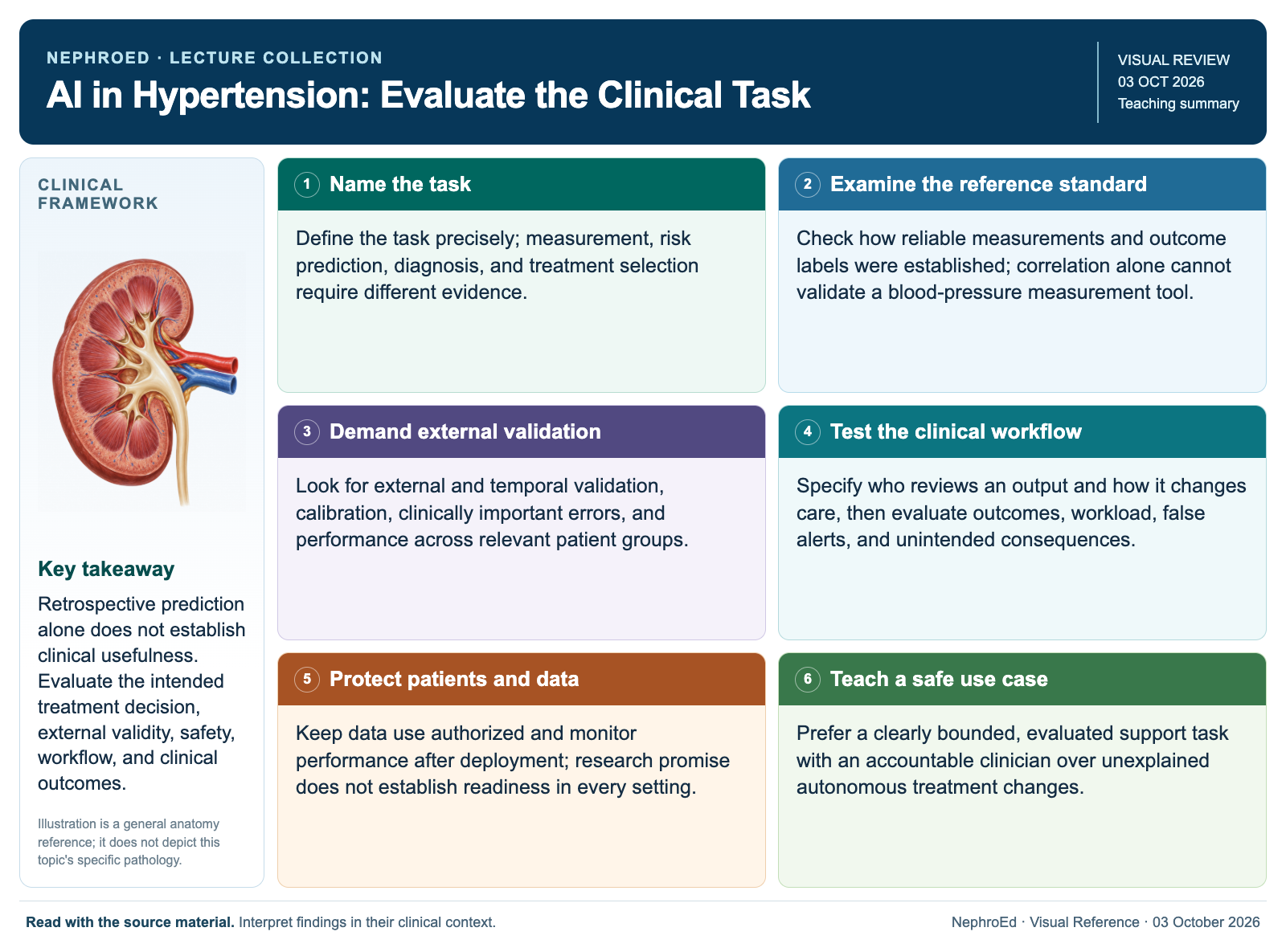
Retrospective prediction alone does not establish clinical usefulness. Evaluate the intended treatment decision, external validity, safety, workflow, and clinical outcomes.
Text version
Name the task
Define the task precisely; measurement, risk prediction, diagnosis, and treatment selection require different evidence.
Examine the reference standard
Check how reliable measurements and outcome labels were established; correlation alone cannot validate a blood-pressure measurement tool.
Demand external validation
Look for external and temporal validation, calibration, clinically important errors, and performance across relevant patient groups.
Test the clinical workflow
Specify who reviews an output and how it changes care, then evaluate outcomes, workload, false alerts, and unintended consequences.
Protect patients and data
Keep data use authorized and monitor performance after deployment; research promise does not establish readiness in every setting.
Teach a safe use case
Prefer a clearly bounded, evaluated support task with an accountable clinician over unexplained autonomous treatment changes.
Continue learning
This graphic summarizes a topic. The full educational pages provide the broader discussion and references.