Visual summary
Judge an AI tool by its defined decision, measurement quality, external performance, and effect on care—not by an impressive accuracy score alone.
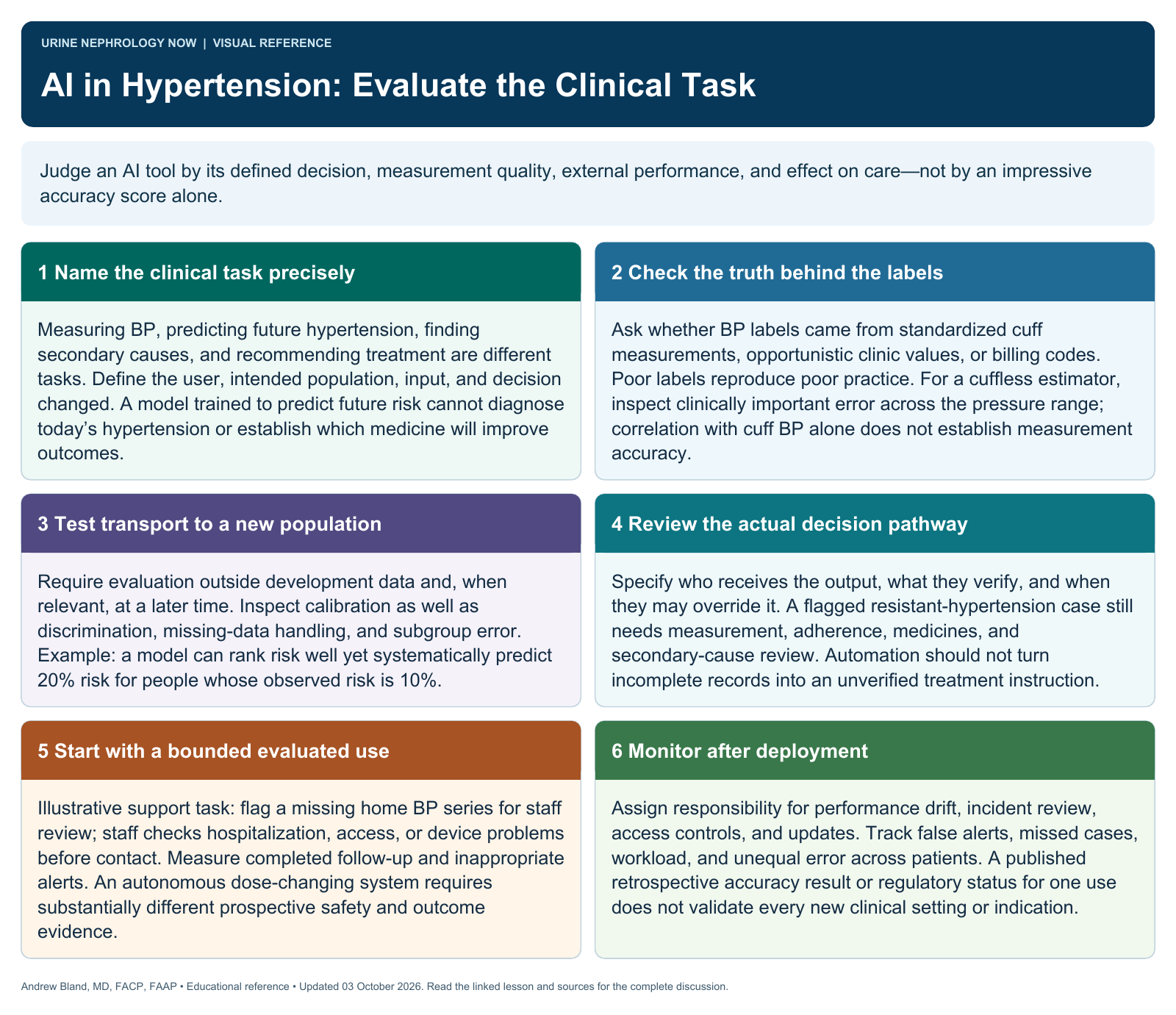
Text version
Name the clinical task precisely
Measuring BP, predicting future hypertension, finding secondary causes, and recommending treatment are different tasks. Define the user, intended population, input, and decision changed. A model trained to predict future risk cannot diagnose today’s hypertension or establish which medicine will improve outcomes.
Check the truth behind the labels
Ask whether BP labels came from standardized cuff measurements, opportunistic clinic values, or billing codes. Poor labels reproduce poor practice. For a cuffless estimator, inspect clinically important error across the pressure range; correlation with cuff BP alone does not establish measurement accuracy.
Test transport to a new population
Require evaluation outside development data and, when relevant, at a later time. Inspect calibration as well as discrimination, missing-data handling, and subgroup error. Example: a model can rank risk well yet systematically predict 20% risk for people whose observed risk is 10%.
Review the actual decision pathway
Specify who receives the output, what they verify, and when they may override it. A flagged resistant-hypertension case still needs measurement, adherence, medicines, and secondary-cause review. Automation should not turn incomplete records into an unverified treatment instruction.
Start with a bounded evaluated use
Illustrative support task: flag a missing home BP series for staff review; staff checks hospitalization, access, or device problems before contact. Measure completed follow-up and inappropriate alerts. An autonomous dose-changing system requires substantially different prospective safety and outcome evidence.
Monitor after deployment
Assign responsibility for performance drift, incident review, access controls, and updates. Track false alerts, missed cases, workload, and unequal error across patients. A published retrospective accuracy result or regulatory status for one use does not validate every new clinical setting or indication.