Visual summary
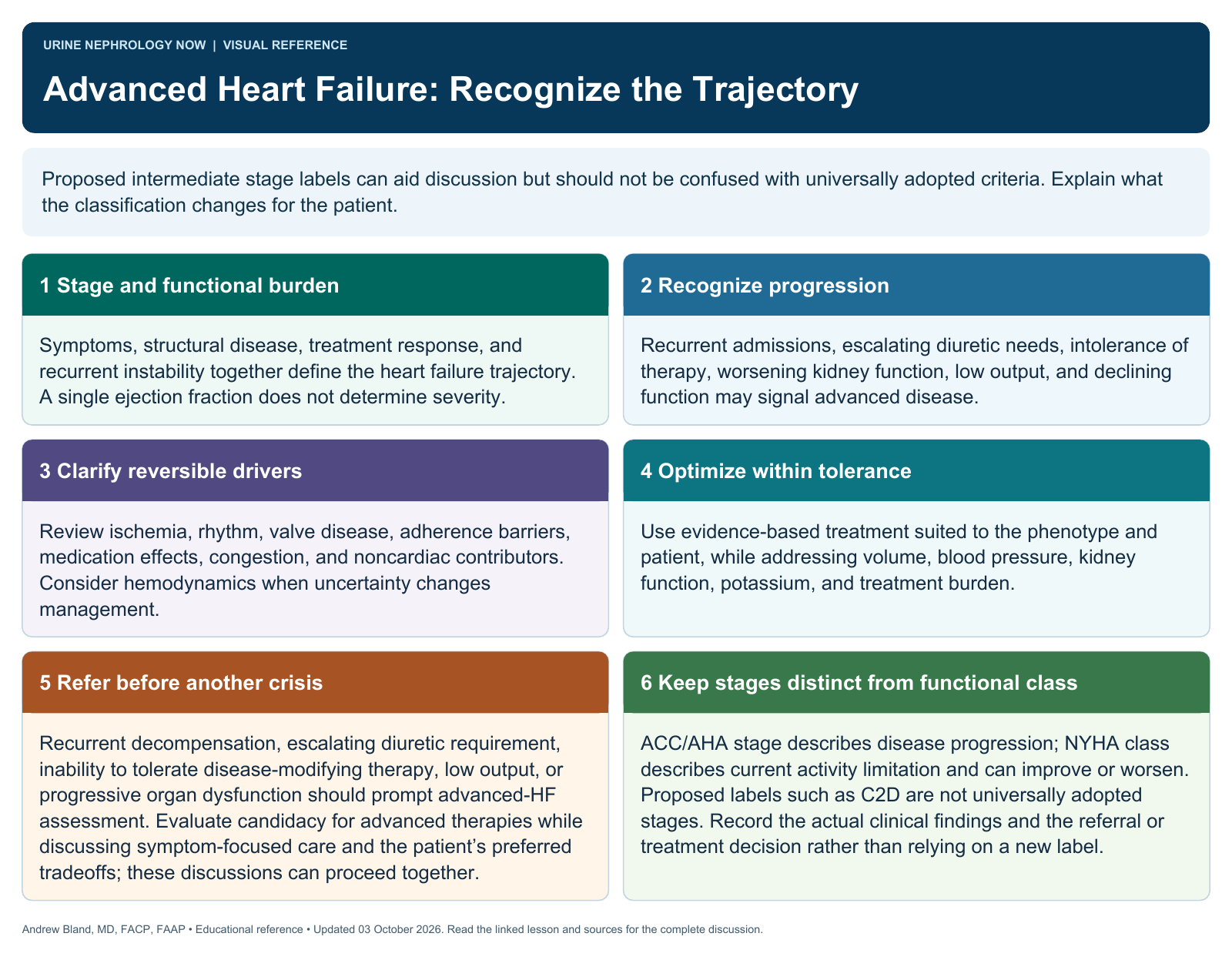
Proposed intermediate stage labels can aid discussion but should not be confused with universally adopted criteria. Explain what the classification changes for the patient.
Text version
Stage and functional burden
Symptoms, structural disease, treatment response, and recurrent instability together define the heart failure trajectory. A single ejection fraction does not determine severity.
Recognize progression
Recurrent admissions, escalating diuretic needs, intolerance of therapy, worsening kidney function, low output, and declining function may signal advanced disease.
Clarify reversible drivers
Review ischemia, rhythm, valve disease, adherence barriers, medication effects, congestion, and noncardiac contributors. Consider hemodynamics when uncertainty changes management.
Optimize within tolerance
Use evidence-based treatment suited to the phenotype and patient, while addressing volume, blood pressure, kidney function, potassium, and treatment burden.
Refer before collapse
Advanced therapies, transplant assessment, supportive care, and goals-of-care discussions are more useful when introduced before repeated crises.
Avoid false precision
Proposed intermediate stage labels can aid discussion but should not be confused with universally adopted criteria. Explain what the classification changes for the patient.
Continue learning
This graphic summarizes a topic. The full educational pages provide the broader discussion and references.