Visual summary
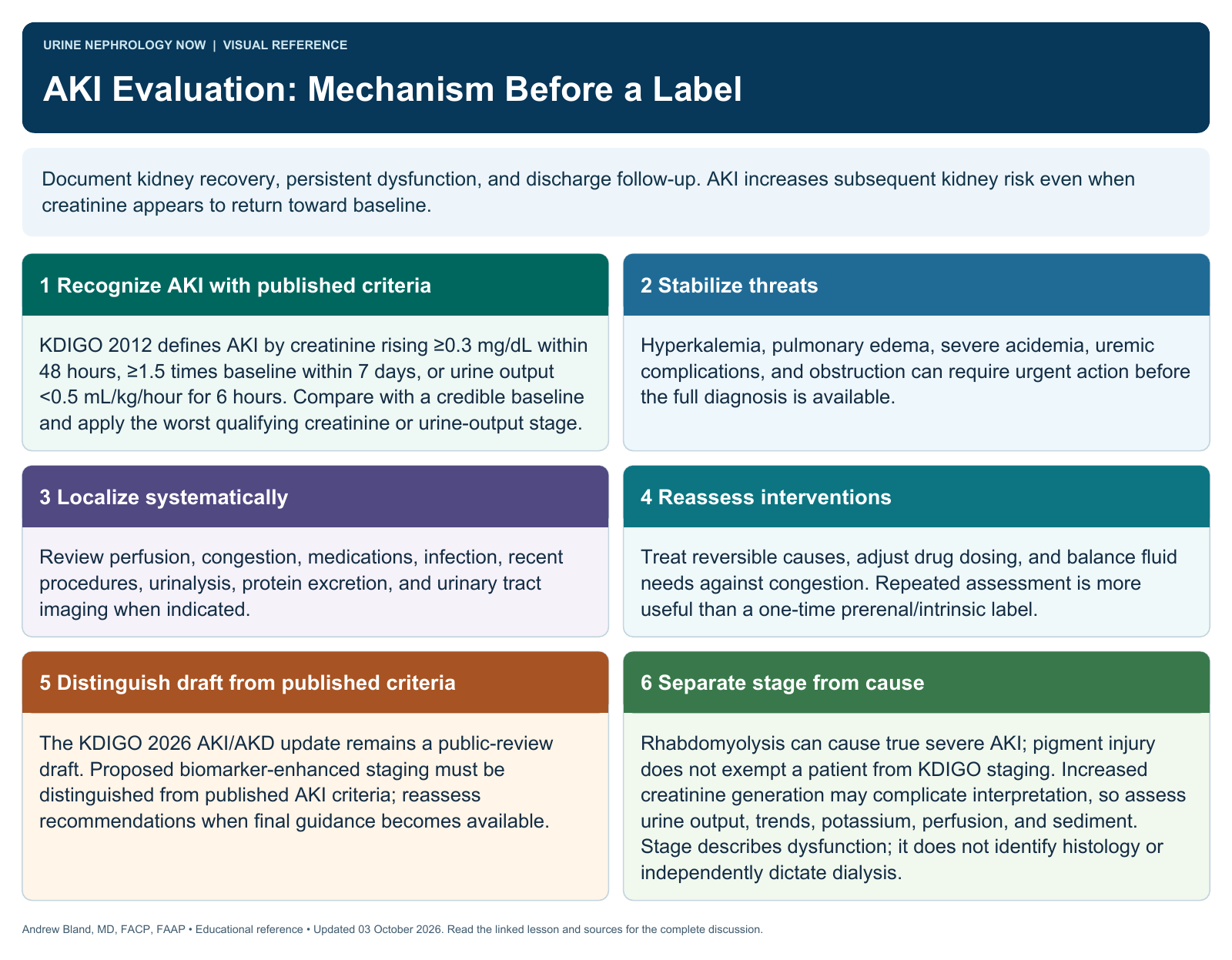
Document kidney recovery, persistent dysfunction, and discharge follow-up. AKI increases subsequent kidney risk even when creatinine appears to return toward baseline.
Text version
An evolving syndrome
Creatinine and urine output describe complementary features of kidney dysfunction. Compare with a credible baseline and consider the timing of injury, resuscitation, and sampling.
Stabilize threats
Hyperkalemia, pulmonary edema, severe acidemia, uremic complications, and obstruction can require urgent action before the full diagnosis is available.
Localize systematically
Review perfusion, congestion, medications, infection, recent procedures, urinalysis, protein excretion, and urinary tract imaging when indicated.
Reassess interventions
Treat reversible causes, adjust drug dosing, and balance fluid needs against congestion. Repeated assessment is more useful than a one-time prerenal/intrinsic label.
Distinguish draft from published criteria
The KDIGO 2026 AKI/AKD update remains a public-review draft. Proposed biomarker-enhanced staging must be distinguished from published AKI criteria; reassess recommendations when final guidance becomes available.
Follow recovery
Document kidney recovery, persistent dysfunction, and discharge follow-up. AKI increases subsequent kidney risk even when creatinine appears to return toward baseline.
Continue learning
This graphic summarizes a topic. The full educational pages provide the broader discussion and references.