Visual summary
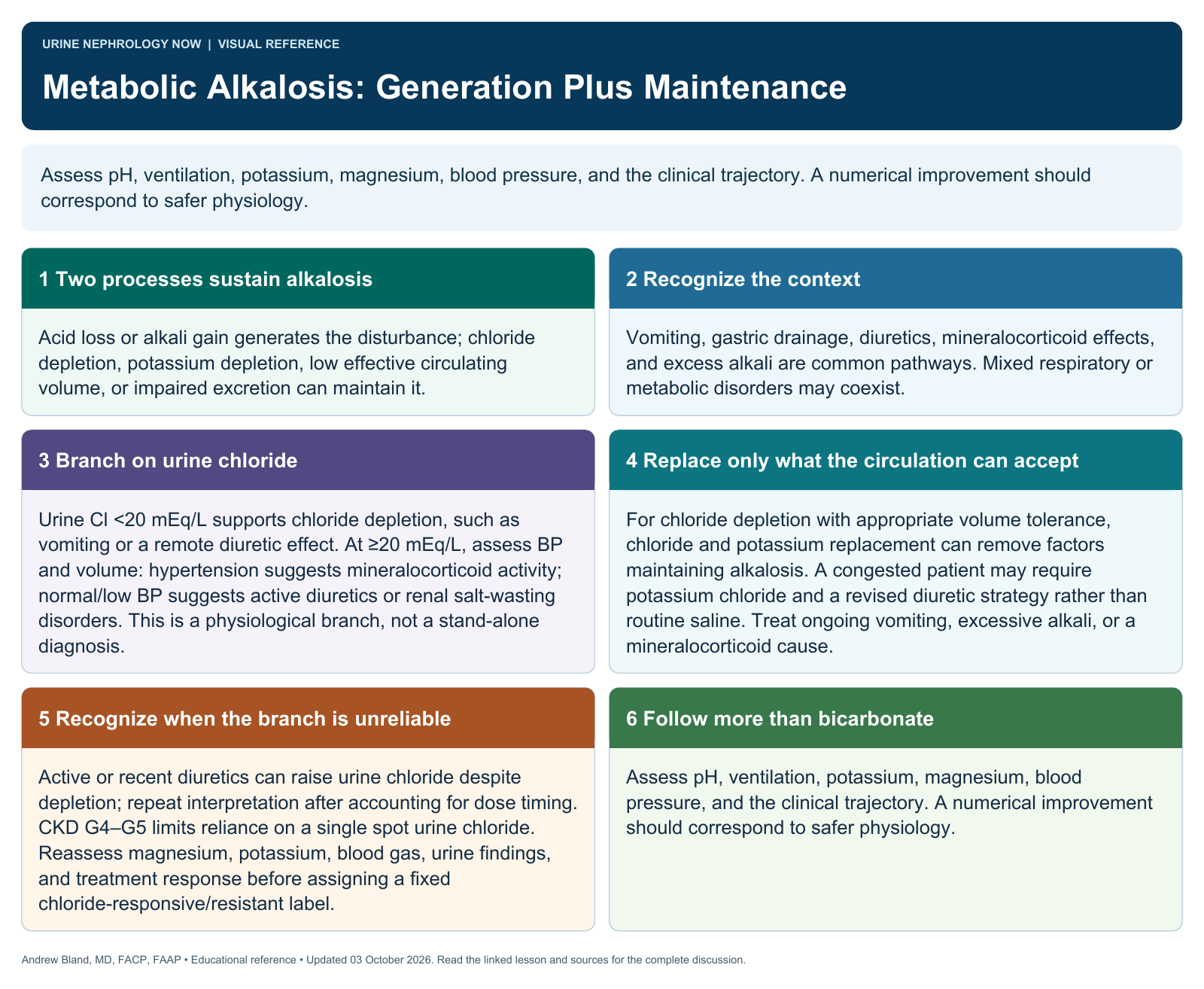
Assess pH, ventilation, potassium, magnesium, blood pressure, and the clinical trajectory. A numerical improvement should correspond to safer physiology.
Text version
Two processes sustain alkalosis
Acid loss or alkali gain generates the disturbance; chloride depletion, potassium depletion, low effective circulating volume, or impaired excretion can maintain it.
Recognize the context
Vomiting, gastric drainage, diuretics, mineralocorticoid effects, and excess alkali are common pathways. Mixed respiratory or metabolic disorders may coexist.
Use urine chloride thoughtfully
Urine chloride can help distinguish physiological patterns, but recent diuretic exposure and changing treatment can confound a single measurement.
Correct the sustaining problem
Restore needed chloride and potassium, address the cause, and choose fluid according to congestion and perfusion. Saline is not appropriate for every patient.
Escalate selectively
Severe or persistent alkalemia may require specialist approaches that account for kidney function and volume tolerance.
Follow more than bicarbonate
Assess pH, ventilation, potassium, magnesium, blood pressure, and the clinical trajectory. A numerical improvement should correspond to safer physiology.
Continue learning
This graphic summarizes a topic. The full educational pages provide the broader discussion and references.