Visual summary
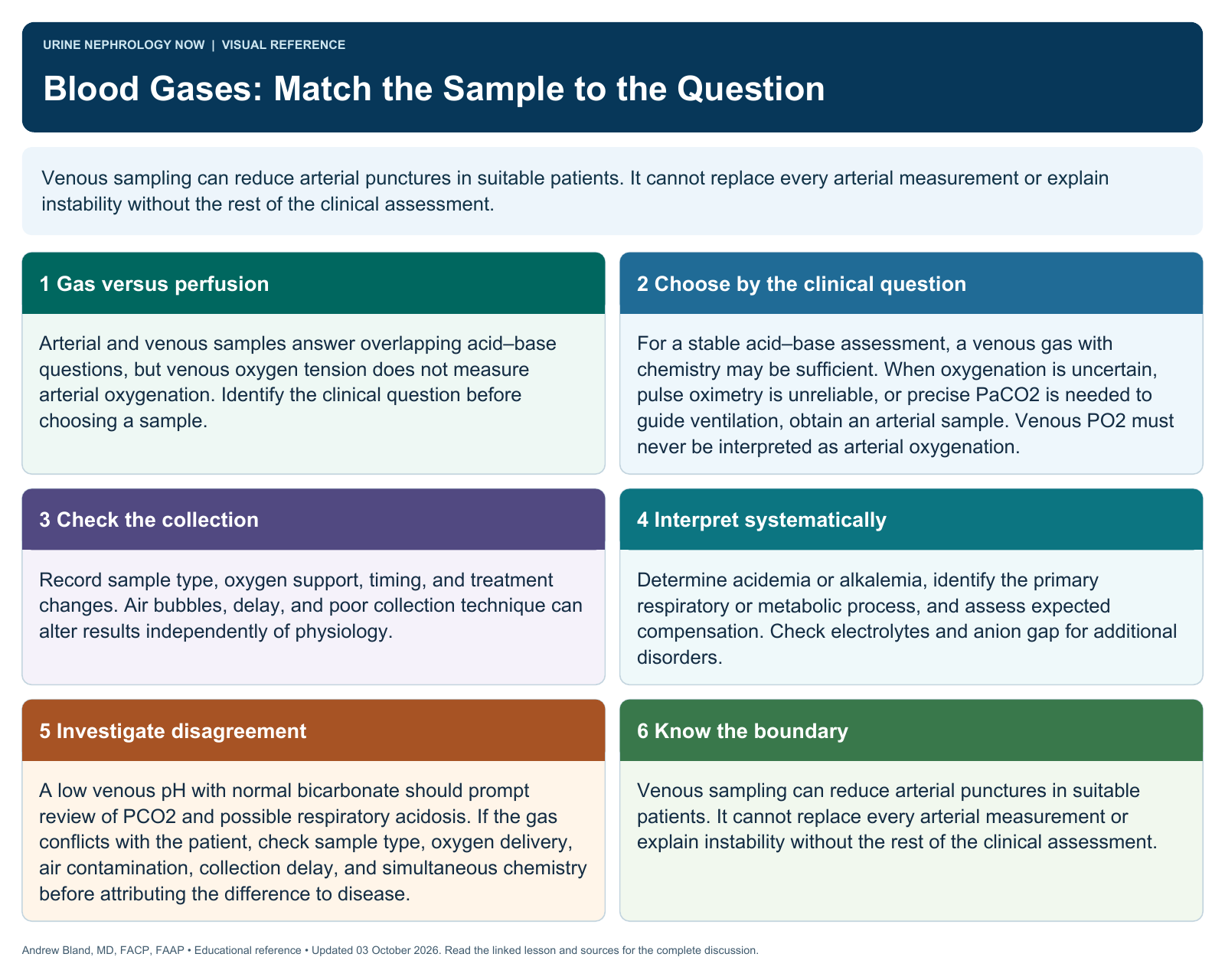
Venous sampling can reduce arterial punctures in suitable patients. It cannot replace every arterial measurement or explain instability without the rest of the clinical assessment.
Text version
Gas versus perfusion
Arterial and venous samples answer overlapping acid–base questions, but venous oxygen tension does not measure arterial oxygenation. Identify the clinical question before choosing a sample.
Assess the patient
Respiratory distress, shock, changing ventilation, or uncertain oxygenation can make arterial measurement important. Interpret the gas alongside examination, pulse oximetry, and hemodynamics.
Check the collection
Record sample type, oxygen support, timing, and treatment changes. Air bubbles, delay, and poor collection technique can alter results independently of physiology.
Interpret systematically
Determine acidemia or alkalemia, identify the primary respiratory or metabolic process, and assess expected compensation. Check electrolytes and anion gap for additional disorders.
Compare trends carefully
A change in sample site can look like a physiological change. Use consistent sampling when possible and investigate clinically important disagreement.
Know the boundary
Venous sampling can reduce arterial punctures in suitable patients. It cannot replace every arterial measurement or explain instability without the rest of the clinical assessment.
Continue learning
This graphic summarizes a topic. The full educational pages provide the broader discussion and references.