Visual summary
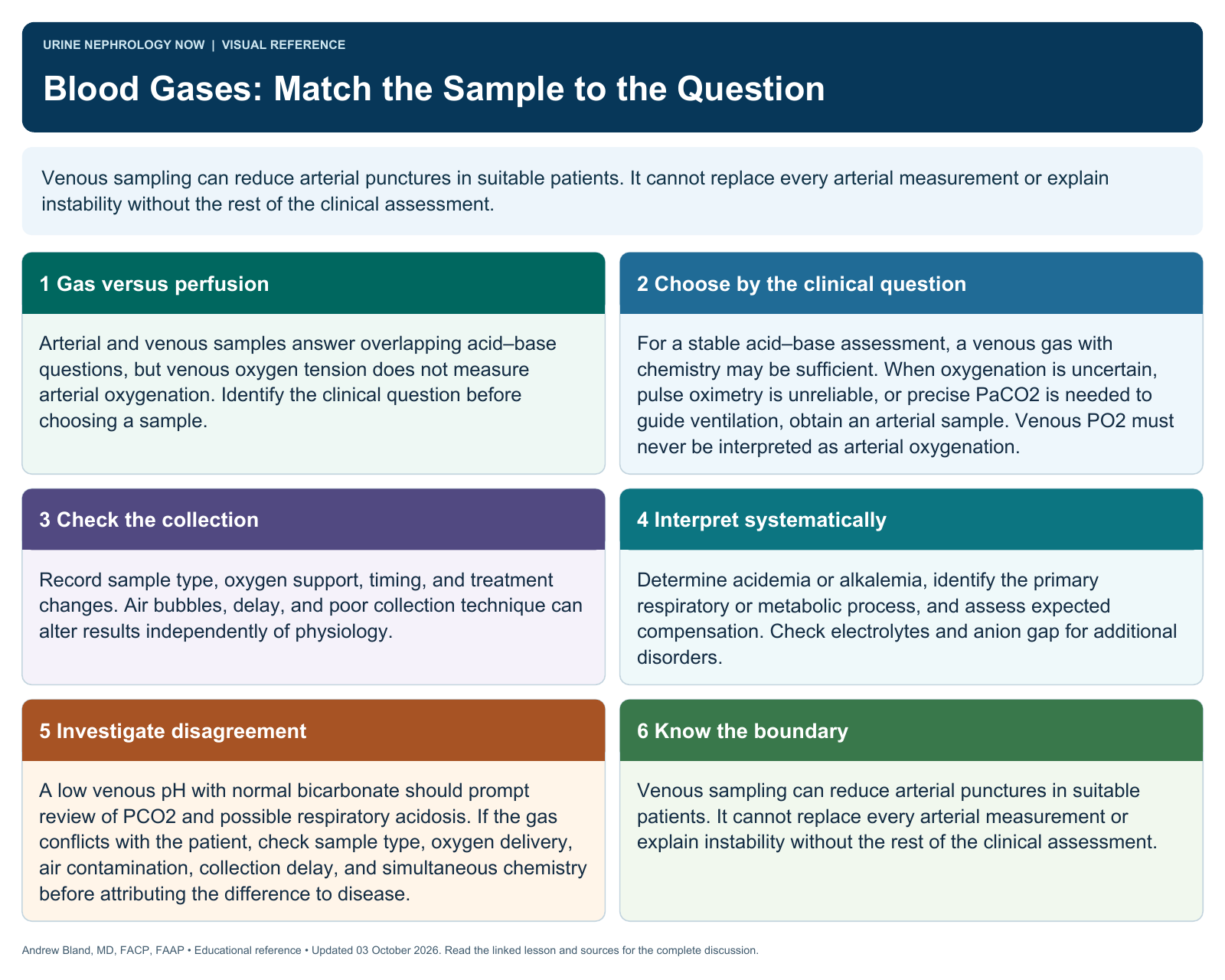
Venous sampling can reduce arterial punctures in suitable patients. It cannot replace every arterial measurement or explain instability without the rest of the clinical assessment.
Text version
Gas versus perfusion
Arterial and venous samples answer overlapping acid–base questions, but venous oxygen tension does not measure arterial oxygenation. Identify the clinical question before choosing a sample.
Choose by the clinical question
For a stable acid–base assessment, a venous gas with chemistry may be sufficient. When oxygenation is uncertain, pulse oximetry is unreliable, or precise PaCO2 is needed to guide ventilation, obtain an arterial sample. Venous PO2 must never be interpreted as arterial oxygenation.
Check the collection
Record sample type, oxygen support, timing, and treatment changes. Air bubbles, delay, and poor collection technique can alter results independently of physiology.
Interpret systematically
Determine acidemia or alkalemia, identify the primary respiratory or metabolic process, and assess expected compensation. Check electrolytes and anion gap for additional disorders.
Investigate disagreement
A low venous pH with normal bicarbonate should prompt review of PCO2 and possible respiratory acidosis. If the gas conflicts with the patient, check sample type, oxygen delivery, air contamination, collection delay, and simultaneous chemistry before attributing the difference to disease.
Know the boundary
Venous sampling can reduce arterial punctures in suitable patients. It cannot replace every arterial measurement or explain instability without the rest of the clinical assessment.