Visual summary
Bone disease, stones, tissue calcification, nutrition, and underlying endocrine or systemic disease determine the broader clinical importance.
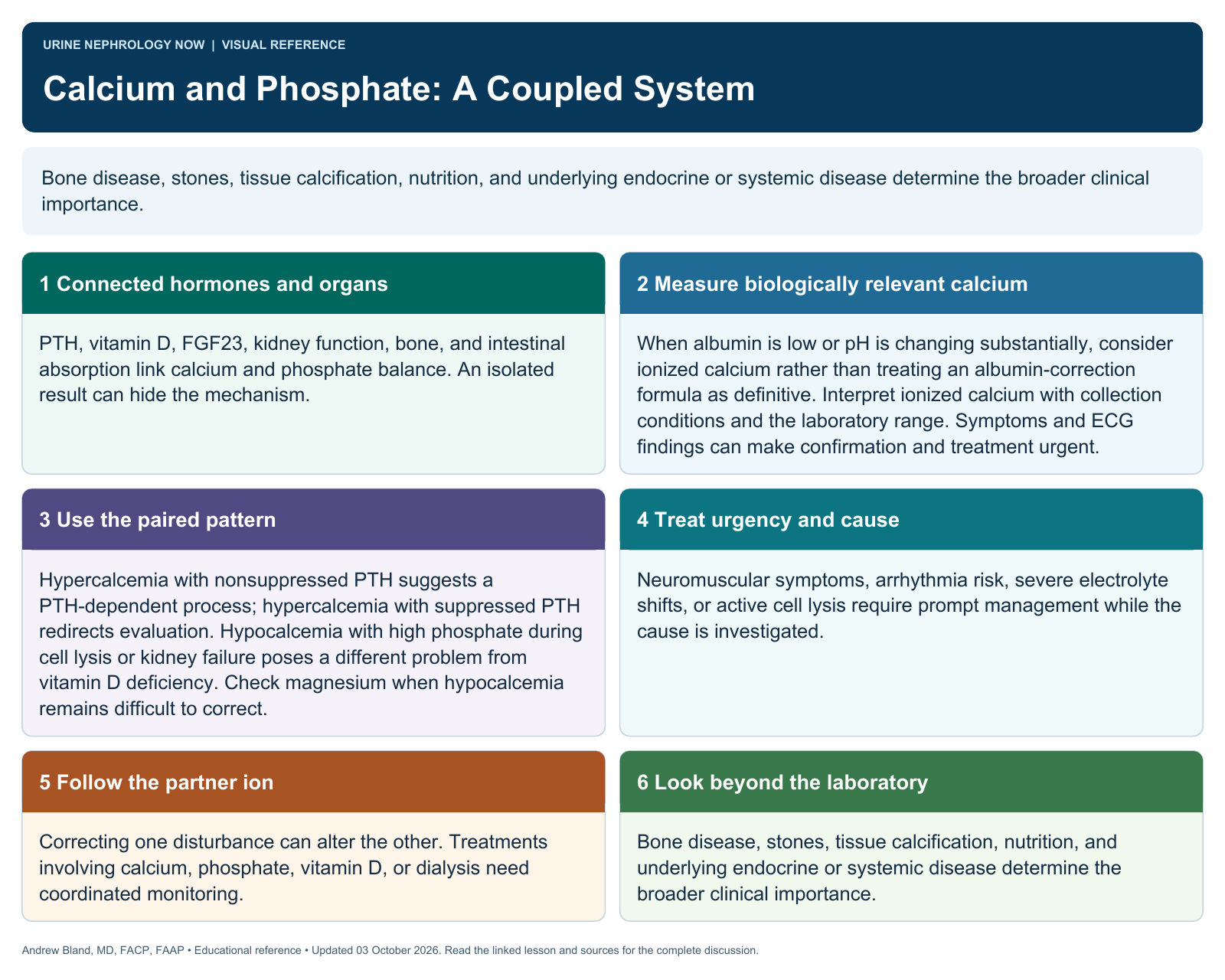
Text version
Connected hormones and organs
PTH, vitamin D, FGF23, kidney function, bone, and intestinal absorption link calcium and phosphate balance. An isolated result can hide the mechanism.
Confirm the abnormality
Assess albumin and consider ionized calcium when binding or acid–base changes make total calcium difficult to interpret. Review sampling and recent treatment.
Use a mechanistic differential
PTH status, kidney function, vitamin D exposure, medications, malignancy, and cell breakdown help explain paired abnormalities.
Treat urgency and cause
Neuromuscular symptoms, arrhythmia risk, severe electrolyte shifts, or active cell lysis require prompt management while the cause is investigated.
Follow the partner ion
Correcting one disturbance can alter the other. Treatments involving calcium, phosphate, vitamin D, or dialysis need coordinated monitoring.
Look beyond the laboratory
Bone disease, stones, tissue calcification, nutrition, and underlying endocrine or systemic disease determine the broader clinical importance.
Continue learning
This graphic summarizes a topic. The full educational pages provide the broader discussion and references.