Visual summary
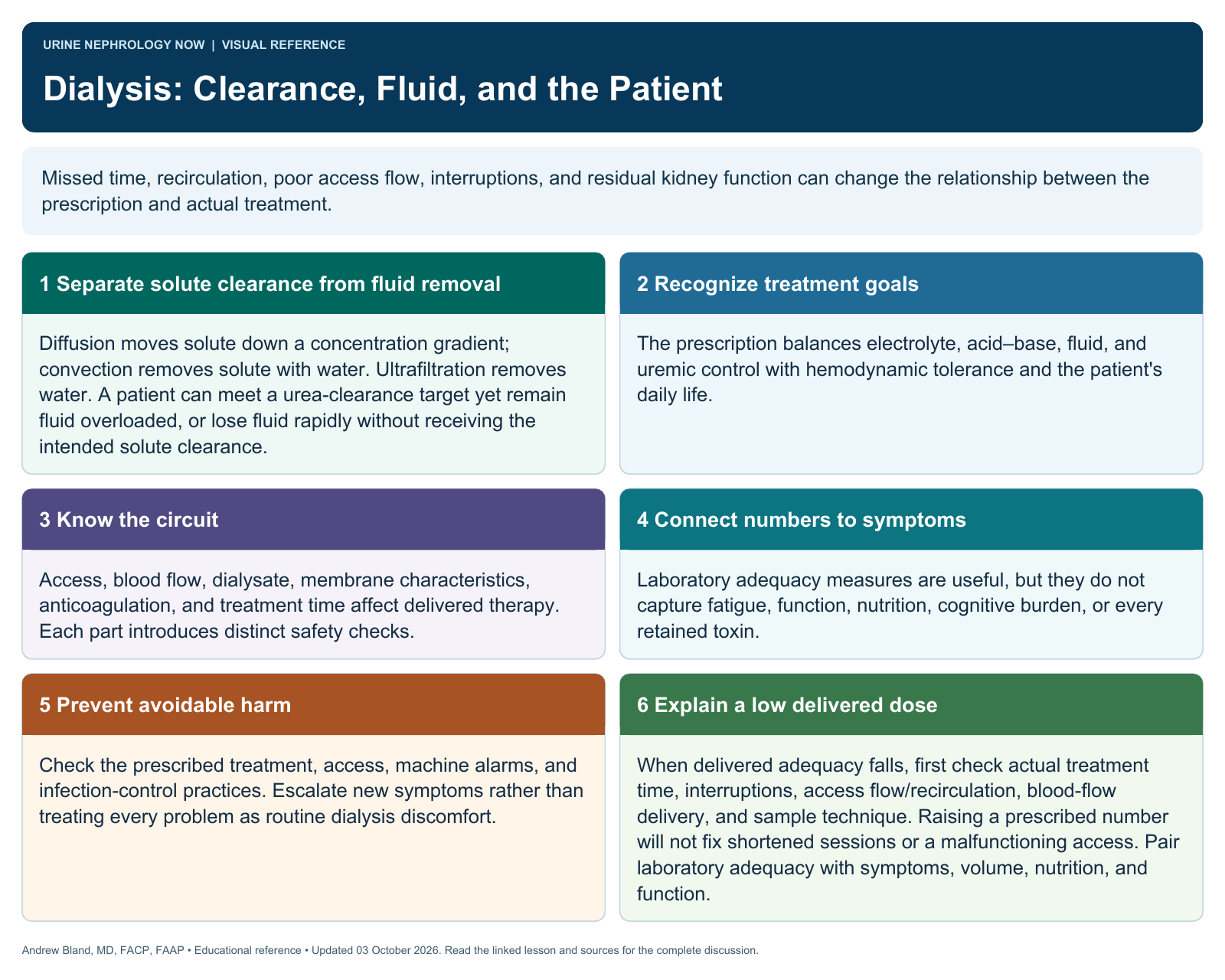
Missed time, recirculation, poor access flow, interruptions, and residual kidney function can change the relationship between the prescription and actual treatment.
Text version
Two transport mechanisms
Diffusion moves solutes along a concentration gradient; convection carries solute with water movement. Ultrafiltration removes fluid and is not synonymous with solute clearance.
Recognize treatment goals
The prescription balances electrolyte, acid–base, fluid, and uremic control with hemodynamic tolerance and the patient's daily life.
Know the circuit
Access, blood flow, dialysate, membrane characteristics, anticoagulation, and treatment time affect delivered therapy. Each part introduces distinct safety checks.
Connect numbers to symptoms
Laboratory adequacy measures are useful, but they do not capture fatigue, function, nutrition, cognitive burden, or every retained toxin.
Prevent avoidable harm
Check the prescribed treatment, access, machine alarms, and infection-control practices. Escalate new symptoms rather than treating every problem as routine dialysis discomfort.
Assess delivery honestly
Missed time, recirculation, poor access flow, interruptions, and residual kidney function can change the relationship between the prescription and actual treatment.
Continue learning
This graphic summarizes a topic. The full educational pages provide the broader discussion and references.