Visual summary
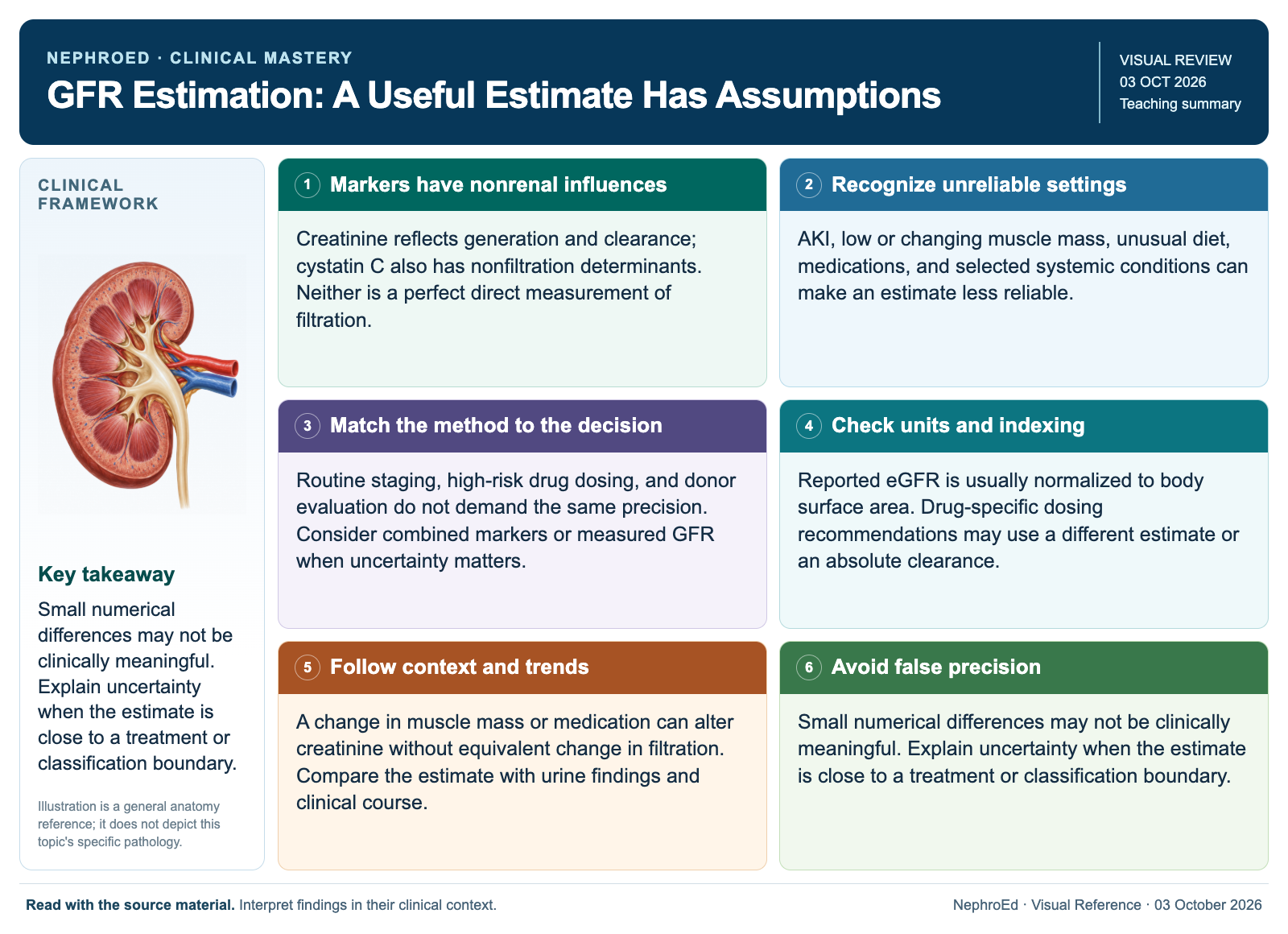
Small numerical differences may not be clinically meaningful. Explain uncertainty when the estimate is close to a treatment or classification boundary.
Text version
Markers have nonrenal influences
Creatinine reflects generation and clearance; cystatin C also has nonfiltration determinants. Neither is a perfect direct measurement of filtration.
Recognize unreliable settings
AKI, low or changing muscle mass, unusual diet, medications, and selected systemic conditions can make an estimate less reliable.
Match the method to the decision
Routine staging, high-risk drug dosing, and donor evaluation do not demand the same precision. Consider combined markers or measured GFR when uncertainty matters.
Check units and indexing
Reported eGFR is usually normalized to body surface area. Drug-specific dosing recommendations may use a different estimate or an absolute clearance.
Follow context and trends
A change in muscle mass or medication can alter creatinine without equivalent change in filtration. Compare the estimate with urine findings and clinical course.
Avoid false precision
Small numerical differences may not be clinically meaningful. Explain uncertainty when the estimate is close to a treatment or classification boundary.
Continue learning
This graphic summarizes a topic. The full educational pages provide the broader discussion and references.