Visual summary
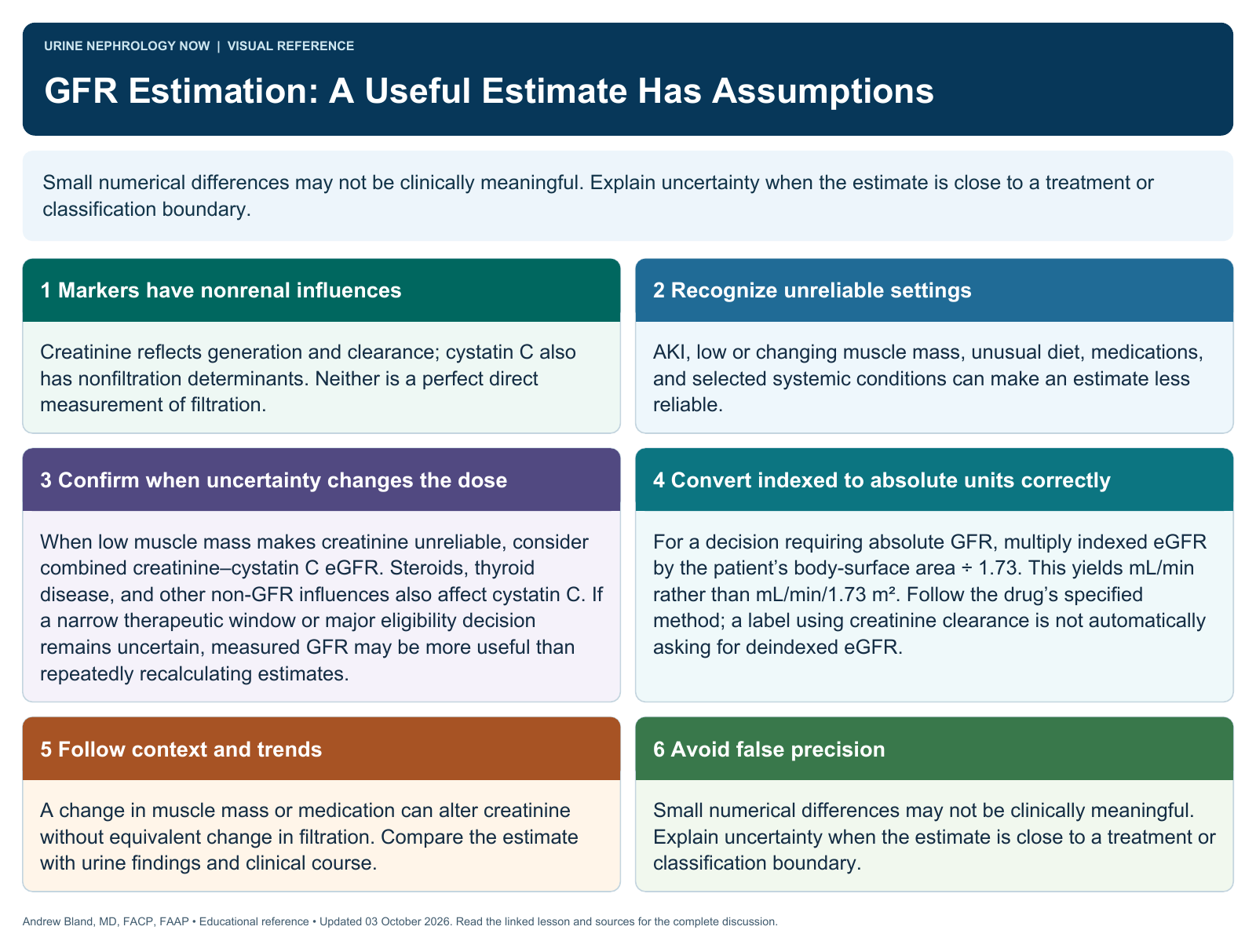
Small numerical differences may not be clinically meaningful. Explain uncertainty when the estimate is close to a treatment or classification boundary.
Text version
Markers have nonrenal influences
Creatinine reflects generation and clearance; cystatin C also has nonfiltration determinants. Neither is a perfect direct measurement of filtration.
Recognize unreliable settings
AKI, low or changing muscle mass, unusual diet, medications, and selected systemic conditions can make an estimate less reliable.
Confirm when uncertainty changes the dose
When low muscle mass makes creatinine unreliable, consider combined creatinine–cystatin C eGFR. Steroids, thyroid disease, and other non-GFR influences also affect cystatin C. If a narrow therapeutic window or major eligibility decision remains uncertain, measured GFR may be more useful than repeatedly recalculating estimates.
Convert indexed to absolute units correctly
For a decision requiring absolute GFR, multiply indexed eGFR by the patient’s body-surface area ÷ 1.73. This yields mL/min rather than mL/min/1.73 m². Follow the drug’s specified method; a label using creatinine clearance is not automatically asking for deindexed eGFR.
Follow context and trends
A change in muscle mass or medication can alter creatinine without equivalent change in filtration. Compare the estimate with urine findings and clinical course.
Avoid false precision
Small numerical differences may not be clinically meaningful. Explain uncertainty when the estimate is close to a treatment or classification boundary.