Visual summary
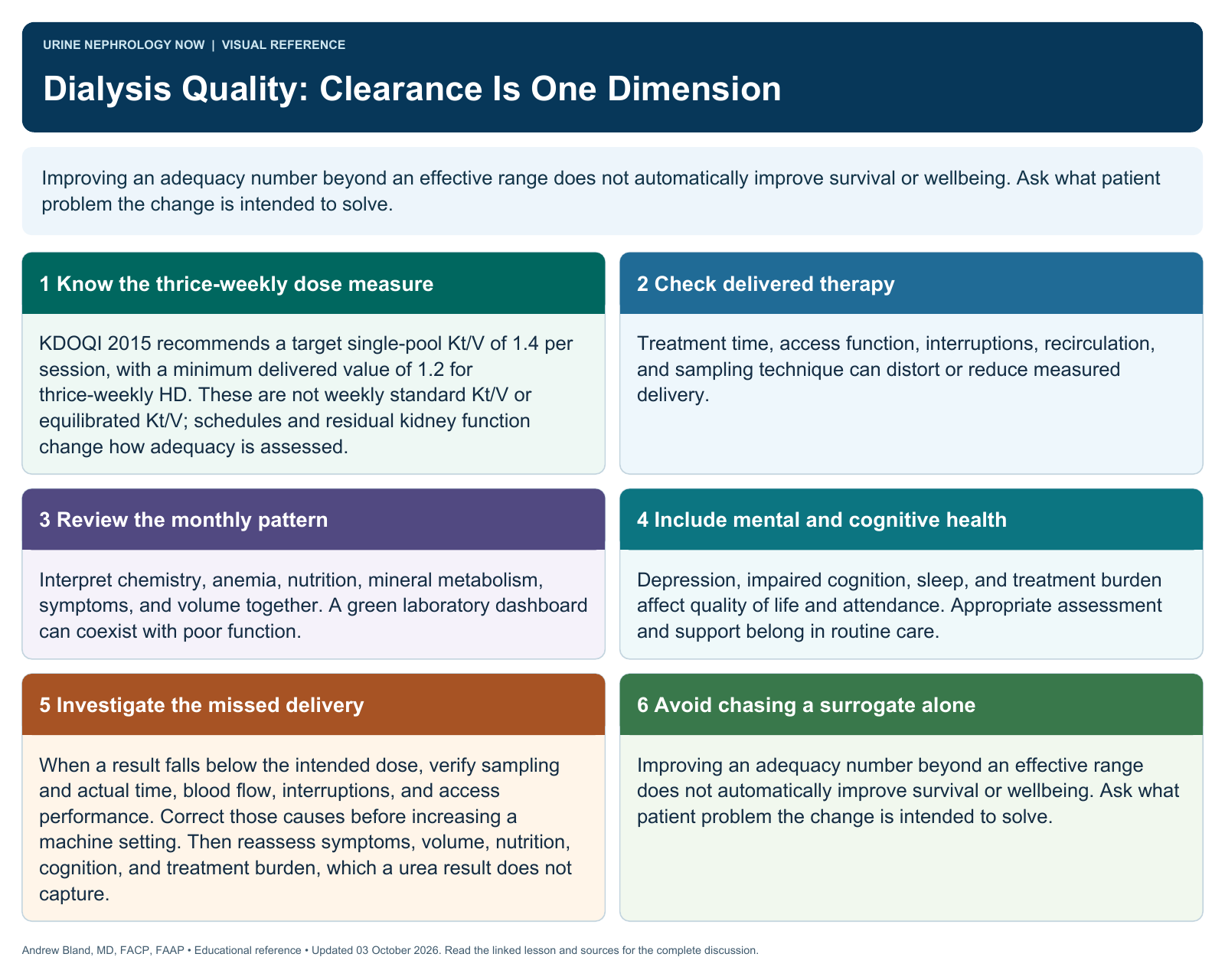
Improving an adequacy number beyond an effective range does not automatically improve survival or wellbeing. Ask what patient problem the change is intended to solve.
Text version
Know the thrice-weekly dose measure
KDOQI 2015 recommends a target single-pool Kt/V of 1.4 per session, with a minimum delivered value of 1.2 for thrice-weekly HD. These are not weekly standard Kt/V or equilibrated Kt/V; schedules and residual kidney function change how adequacy is assessed.
Check delivered therapy
Treatment time, access function, interruptions, recirculation, and sampling technique can distort or reduce measured delivery.
Review the monthly pattern
Interpret chemistry, anemia, nutrition, mineral metabolism, symptoms, and volume together. A green laboratory dashboard can coexist with poor function.
Include mental and cognitive health
Depression, impaired cognition, sleep, and treatment burden affect quality of life and attendance. Appropriate assessment and support belong in routine care.
Investigate the missed delivery
When a result falls below the intended dose, verify sampling and actual time, blood flow, interruptions, and access performance. Correct those causes before increasing a machine setting. Then reassess symptoms, volume, nutrition, cognition, and treatment burden, which a urea result does not capture.
Avoid chasing a surrogate alone
Improving an adequacy number beyond an effective range does not automatically improve survival or wellbeing. Ask what patient problem the change is intended to solve.