Visual summary
Repeated trauma and unrecognized dysfunction accumulate. Document findings and communicate across the team so trends are acted on.
Text version
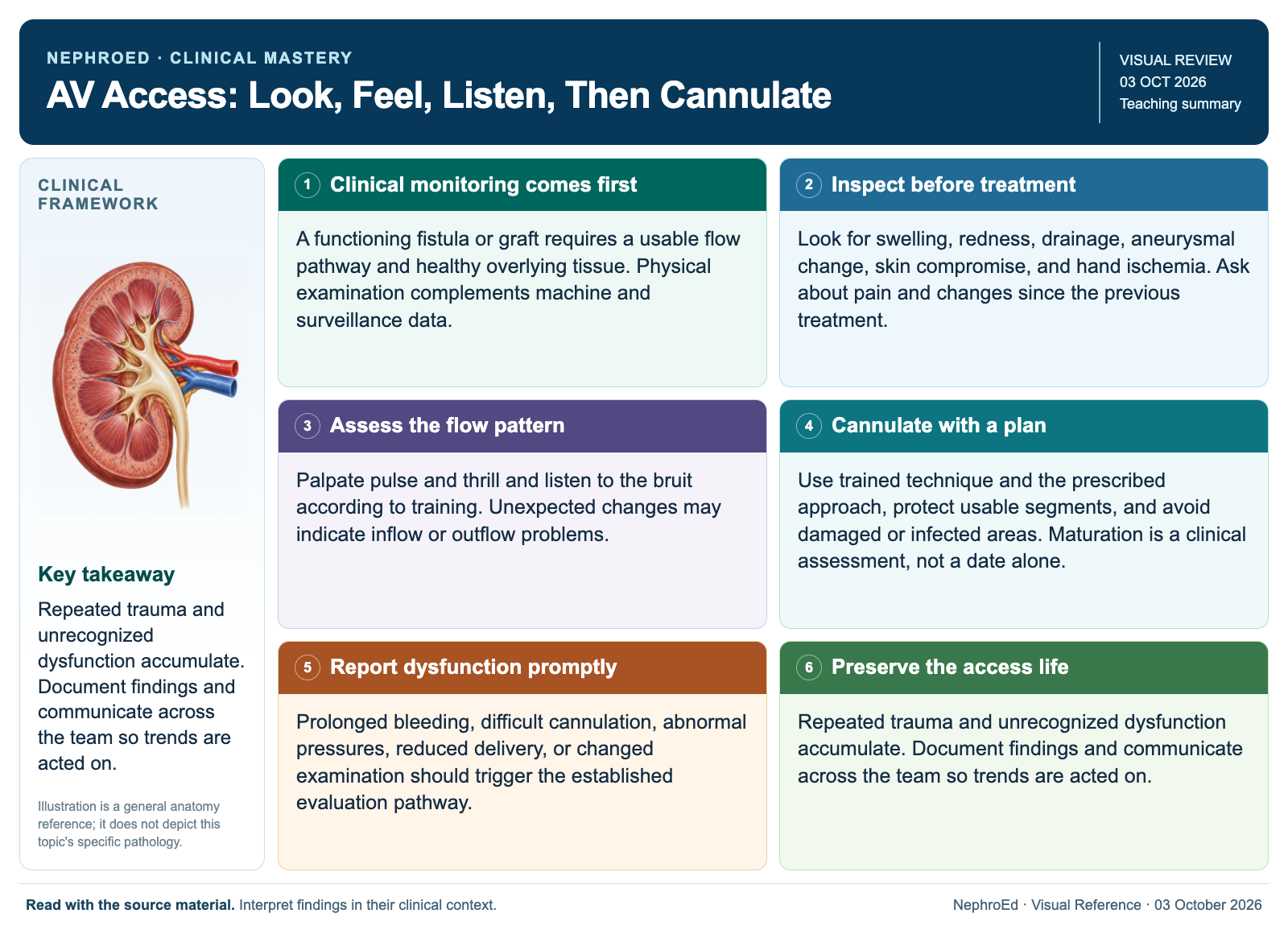
Clinical monitoring comes first
A functioning fistula or graft requires a usable flow pathway and healthy overlying tissue. Physical examination complements machine and surveillance data.
Inspect before treatment
Look for swelling, redness, drainage, aneurysmal change, skin compromise, and hand ischemia. Ask about pain and changes since the previous treatment.
Assess the flow pattern
Palpate pulse and thrill and listen to the bruit according to training. Unexpected changes may indicate inflow or outflow problems.
Cannulate with a plan
Use trained technique and the prescribed approach, protect usable segments, and avoid damaged or infected areas. Maturation is a clinical assessment, not a date alone.
Report dysfunction promptly
Prolonged bleeding, difficult cannulation, abnormal pressures, reduced delivery, or changed examination should trigger the established evaluation pathway.
Preserve the access life
Repeated trauma and unrecognized dysfunction accumulate. Document findings and communicate across the team so trends are acted on.
Continue learning
This graphic summarizes a topic. The full educational pages provide the broader discussion and references.