Visual summary
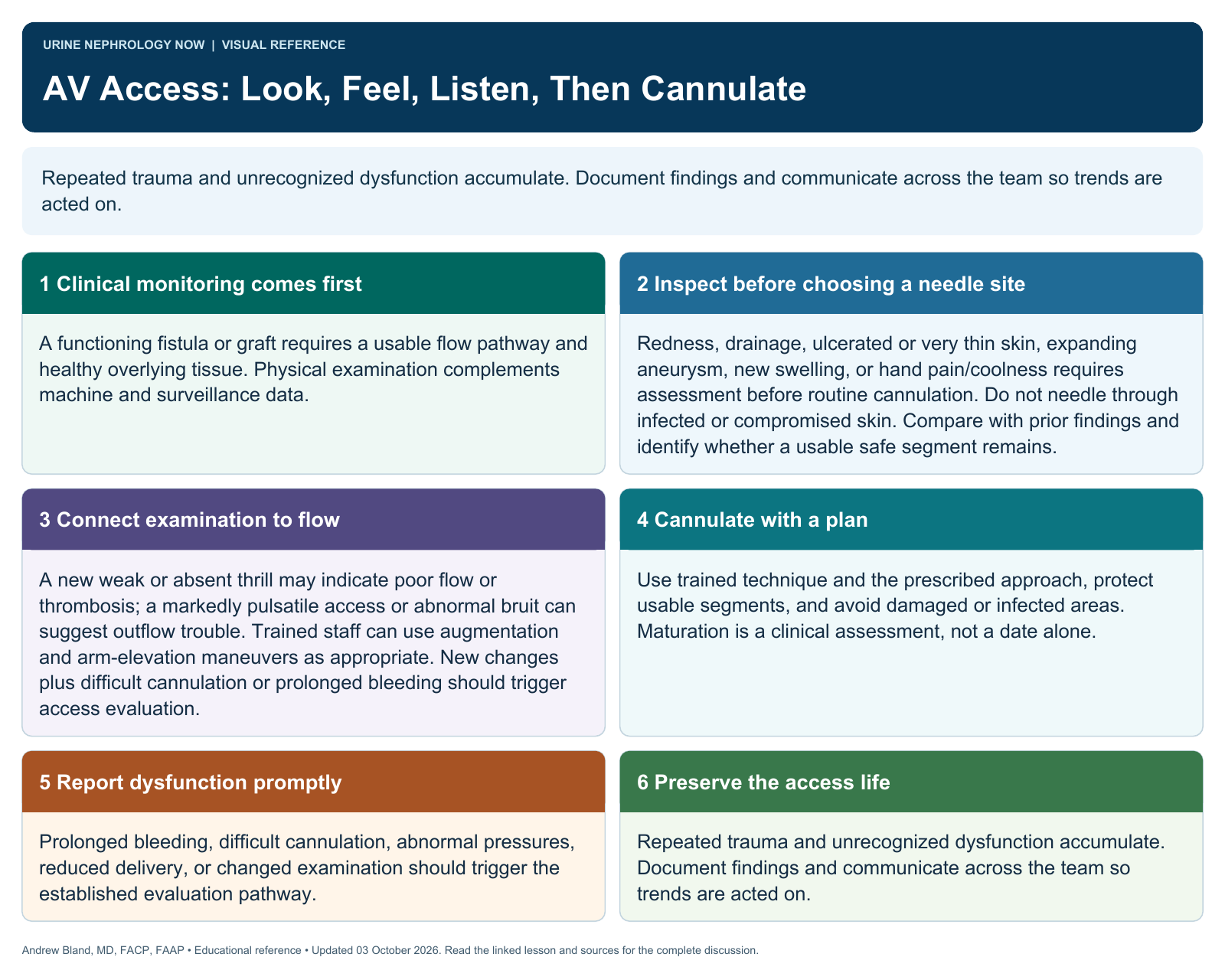
Repeated trauma and unrecognized dysfunction accumulate. Document findings and communicate across the team so trends are acted on.
Text version
Clinical monitoring comes first
A functioning fistula or graft requires a usable flow pathway and healthy overlying tissue. Physical examination complements machine and surveillance data.
Inspect before choosing a needle site
Redness, drainage, ulcerated or very thin skin, expanding aneurysm, new swelling, or hand pain/coolness requires assessment before routine cannulation. Do not needle through infected or compromised skin. Compare with prior findings and identify whether a usable safe segment remains.
Connect examination to flow
A new weak or absent thrill may indicate poor flow or thrombosis; a markedly pulsatile access or abnormal bruit can suggest outflow trouble. Trained staff can use augmentation and arm-elevation maneuvers as appropriate. New changes plus difficult cannulation or prolonged bleeding should trigger access evaluation.
Cannulate with a plan
Use trained technique and the prescribed approach, protect usable segments, and avoid damaged or infected areas. Maturation is a clinical assessment, not a date alone.
Report dysfunction promptly
Prolonged bleeding, difficult cannulation, abnormal pressures, reduced delivery, or changed examination should trigger the established evaluation pathway.
Preserve the access life
Repeated trauma and unrecognized dysfunction accumulate. Document findings and communicate across the team so trends are acted on.