Visual summary
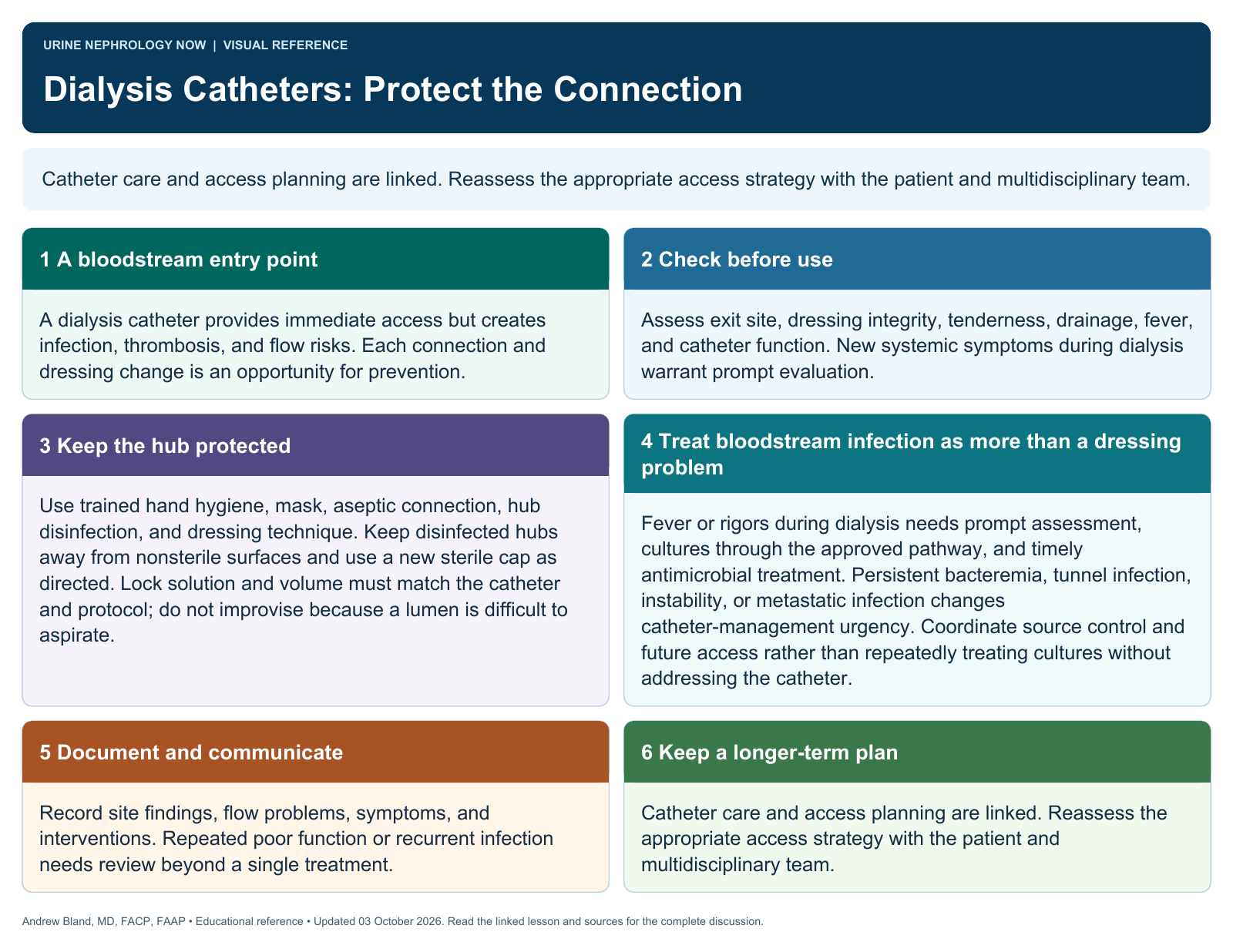
Catheter care and access planning are linked. Reassess the appropriate access strategy with the patient and multidisciplinary team.
Text version
A bloodstream entry point
A dialysis catheter provides immediate access but creates infection, thrombosis, and flow risks. Each connection and dressing change is an opportunity for prevention.
Check before use
Assess exit site, dressing integrity, tenderness, drainage, fever, and catheter function. New systemic symptoms during dialysis warrant prompt evaluation.
Keep the hub protected
Use trained hand hygiene, mask, aseptic connection, hub disinfection, and dressing technique. Keep disinfected hubs away from nonsterile surfaces and use a new sterile cap as directed. Lock solution and volume must match the catheter and protocol; do not improvise because a lumen is difficult to aspirate.
Treat bloodstream infection as more than a dressing problem
Fever or rigors during dialysis needs prompt assessment, cultures through the approved pathway, and timely antimicrobial treatment. Persistent bacteremia, tunnel infection, instability, or metastatic infection changes catheter-management urgency. Coordinate source control and future access rather than repeatedly treating cultures without addressing the catheter.
Document and communicate
Record site findings, flow problems, symptoms, and interventions. Repeated poor function or recurrent infection needs review beyond a single treatment.
Keep a longer-term plan
Catheter care and access planning are linked. Reassess the appropriate access strategy with the patient and multidisciplinary team.