Visual summary
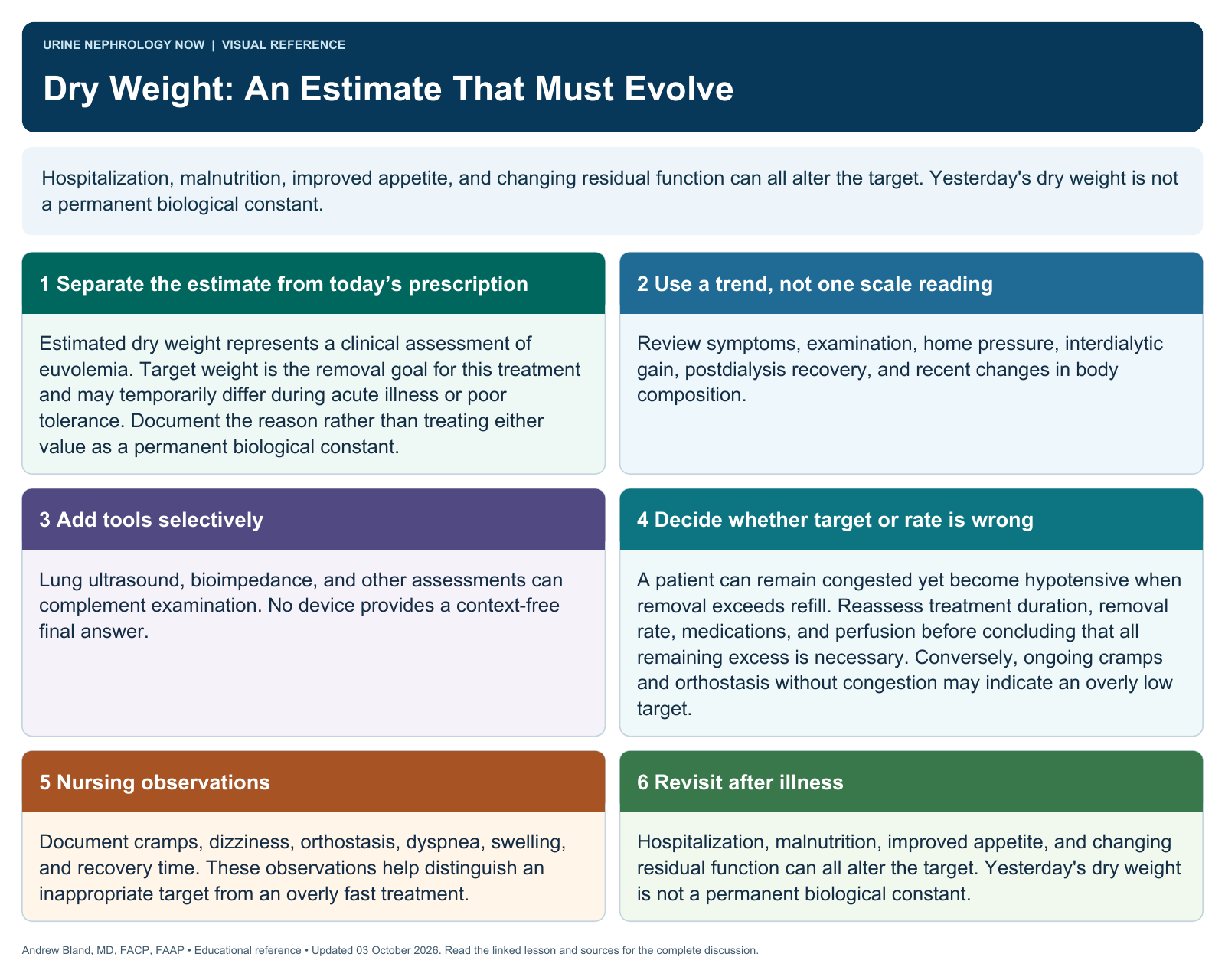
Hospitalization, malnutrition, improved appetite, and changing residual function can all alter the target. Yesterday's dry weight is not a permanent biological constant.
Text version
Volume has compartments
Total extracellular excess and effective circulating volume can diverge. A patient can be congested yet poorly tolerate rapid removal.
Use a trend, not one scale reading
Review symptoms, examination, home pressure, interdialytic gain, postdialysis recovery, and recent changes in body composition.
Add tools selectively
Lung ultrasound, bioimpedance, and other assessments can complement examination. No device provides a context-free final answer.
Adjust deliberately
Changes in target weight should have a clear rationale and monitoring plan. Allow time and consider treatment duration when removal is poorly tolerated.
Nursing observations
Document cramps, dizziness, orthostasis, dyspnea, swelling, and recovery time. These observations help distinguish an inappropriate target from an overly fast treatment.
Revisit after illness
Hospitalization, malnutrition, improved appetite, and changing residual function can all alter the target. Yesterday's dry weight is not a permanent biological constant.
Continue learning
This graphic summarizes a topic. The full educational pages provide the broader discussion and references.