Visual summary
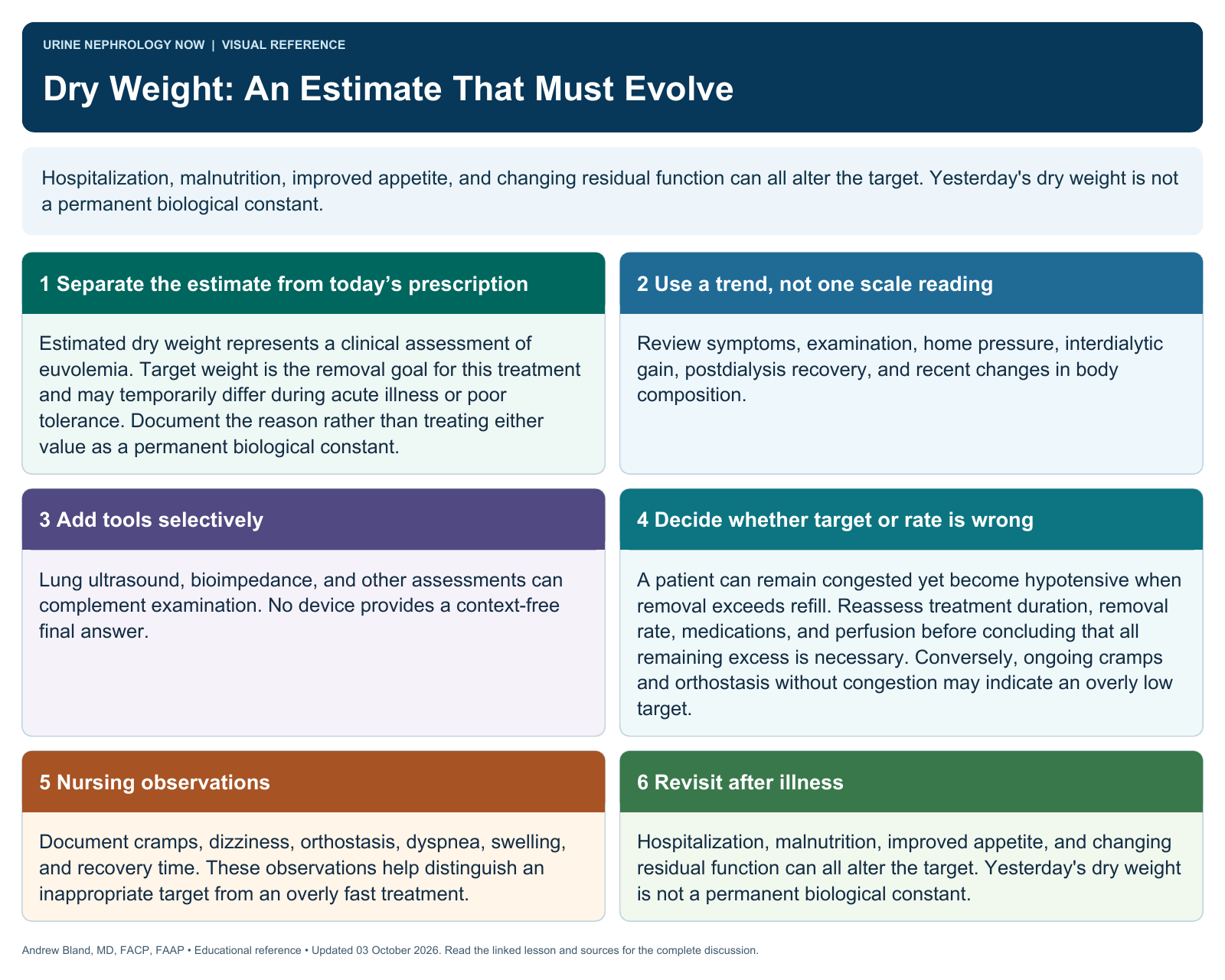
Hospitalization, malnutrition, improved appetite, and changing residual function can all alter the target. Yesterday's dry weight is not a permanent biological constant.
Text version
Separate the estimate from today’s prescription
Estimated dry weight represents a clinical assessment of euvolemia. Target weight is the removal goal for this treatment and may temporarily differ during acute illness or poor tolerance. Document the reason rather than treating either value as a permanent biological constant.
Use a trend, not one scale reading
Review symptoms, examination, home pressure, interdialytic gain, postdialysis recovery, and recent changes in body composition.
Add tools selectively
Lung ultrasound, bioimpedance, and other assessments can complement examination. No device provides a context-free final answer.
Decide whether target or rate is wrong
A patient can remain congested yet become hypotensive when removal exceeds refill. Reassess treatment duration, removal rate, medications, and perfusion before concluding that all remaining excess is necessary. Conversely, ongoing cramps and orthostasis without congestion may indicate an overly low target.
Nursing observations
Document cramps, dizziness, orthostasis, dyspnea, swelling, and recovery time. These observations help distinguish an inappropriate target from an overly fast treatment.
Revisit after illness
Hospitalization, malnutrition, improved appetite, and changing residual function can all alter the target. Yesterday's dry weight is not a permanent biological constant.