Visual summary
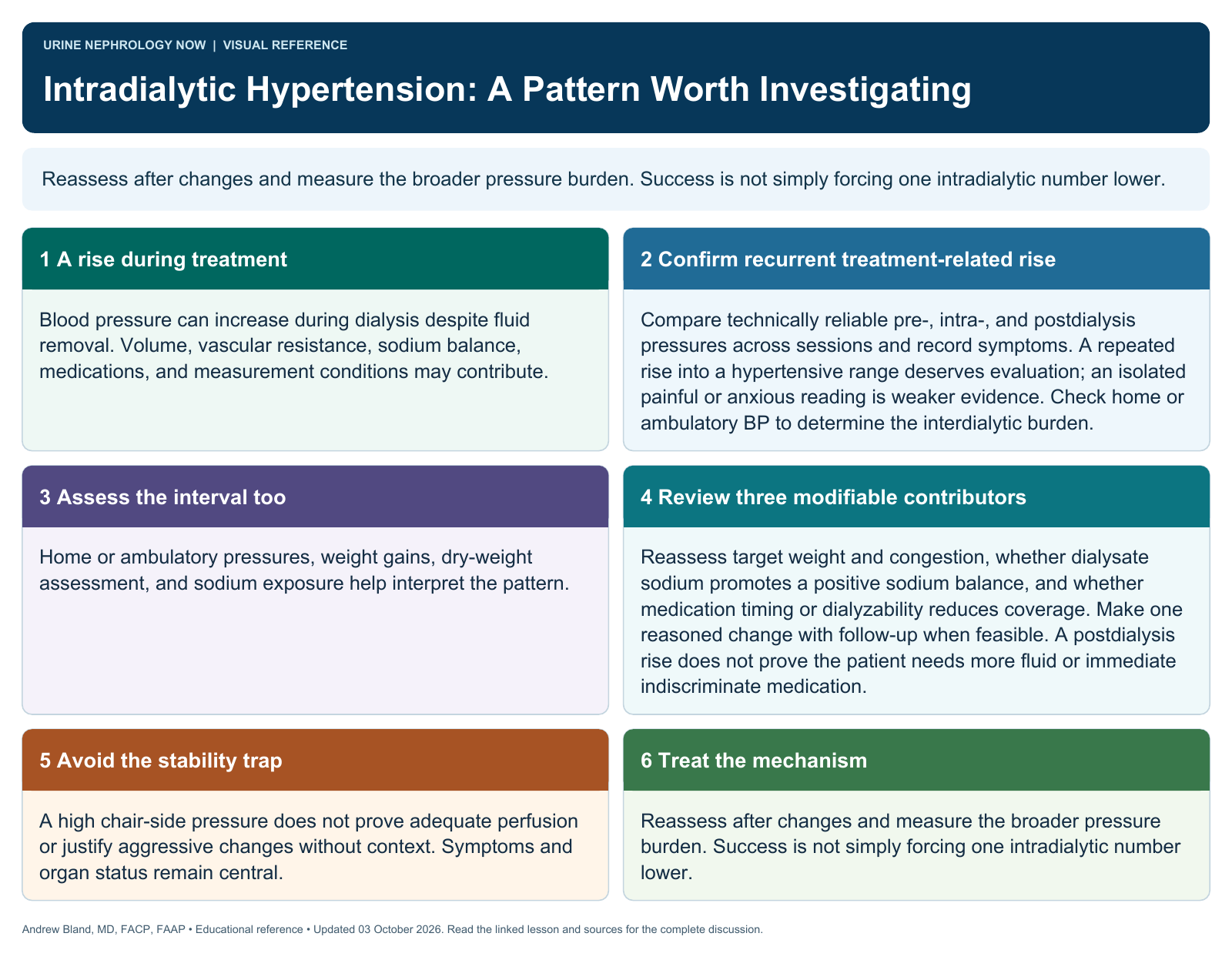
Reassess after changes and measure the broader pressure burden. Success is not simply forcing one intradialytic number lower.
Text version
A rise during treatment
Blood pressure can increase during dialysis despite fluid removal. Volume, vascular resistance, sodium balance, medications, and measurement conditions may contribute.
Confirm a recurrent pattern
Check technique and symptoms and compare multiple sessions. Distinguish an isolated high reading from a consistent treatment-related response.
Assess the interval too
Home or ambulatory pressures, weight gains, dry-weight assessment, and sodium exposure help interpret the pattern.
Review the prescription
Consider volume management, dialysate composition, treatment delivery, and medication timing with the treating team.
Avoid the stability trap
A high chair-side pressure does not prove adequate perfusion or justify aggressive changes without context. Symptoms and organ status remain central.
Treat the mechanism
Reassess after changes and measure the broader pressure burden. Success is not simply forcing one intradialytic number lower.
Continue learning
This graphic summarizes a topic. The full educational pages provide the broader discussion and references.