Visual summary
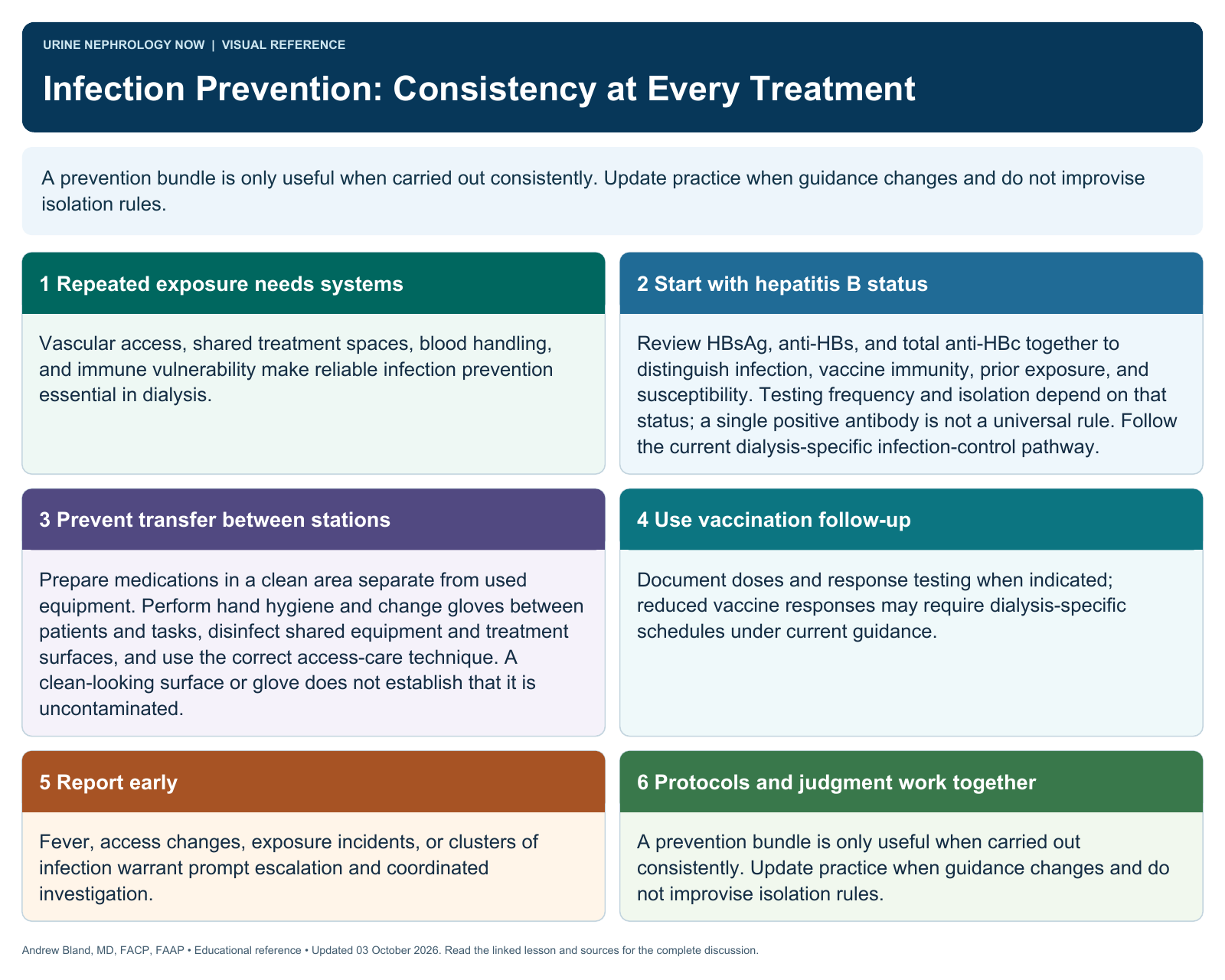
A prevention bundle is only useful when carried out consistently. Update practice when guidance changes and do not improvise isolation rules.
Text version
Repeated exposure needs systems
Vascular access, shared treatment spaces, blood handling, and immune vulnerability make reliable infection prevention essential in dialysis.
Start with hepatitis B status
Review HBsAg, anti-HBs, and total anti-HBc together to distinguish infection, vaccine immunity, prior exposure, and susceptibility. Testing frequency and isolation depend on that status; a single positive antibody is not a universal rule. Follow the current dialysis-specific infection-control pathway.
Prevent transfer between stations
Prepare medications in a clean area separate from used equipment. Perform hand hygiene and change gloves between patients and tasks, disinfect shared equipment and treatment surfaces, and use the correct access-care technique. A clean-looking surface or glove does not establish that it is uncontaminated.
Use vaccination follow-up
Document doses and response testing when indicated; reduced vaccine responses may require dialysis-specific schedules under current guidance.
Report early
Fever, access changes, exposure incidents, or clusters of infection warrant prompt escalation and coordinated investigation.
Protocols and judgment work together
A prevention bundle is only useful when carried out consistently. Update practice when guidance changes and do not improvise isolation rules.