Visual summary
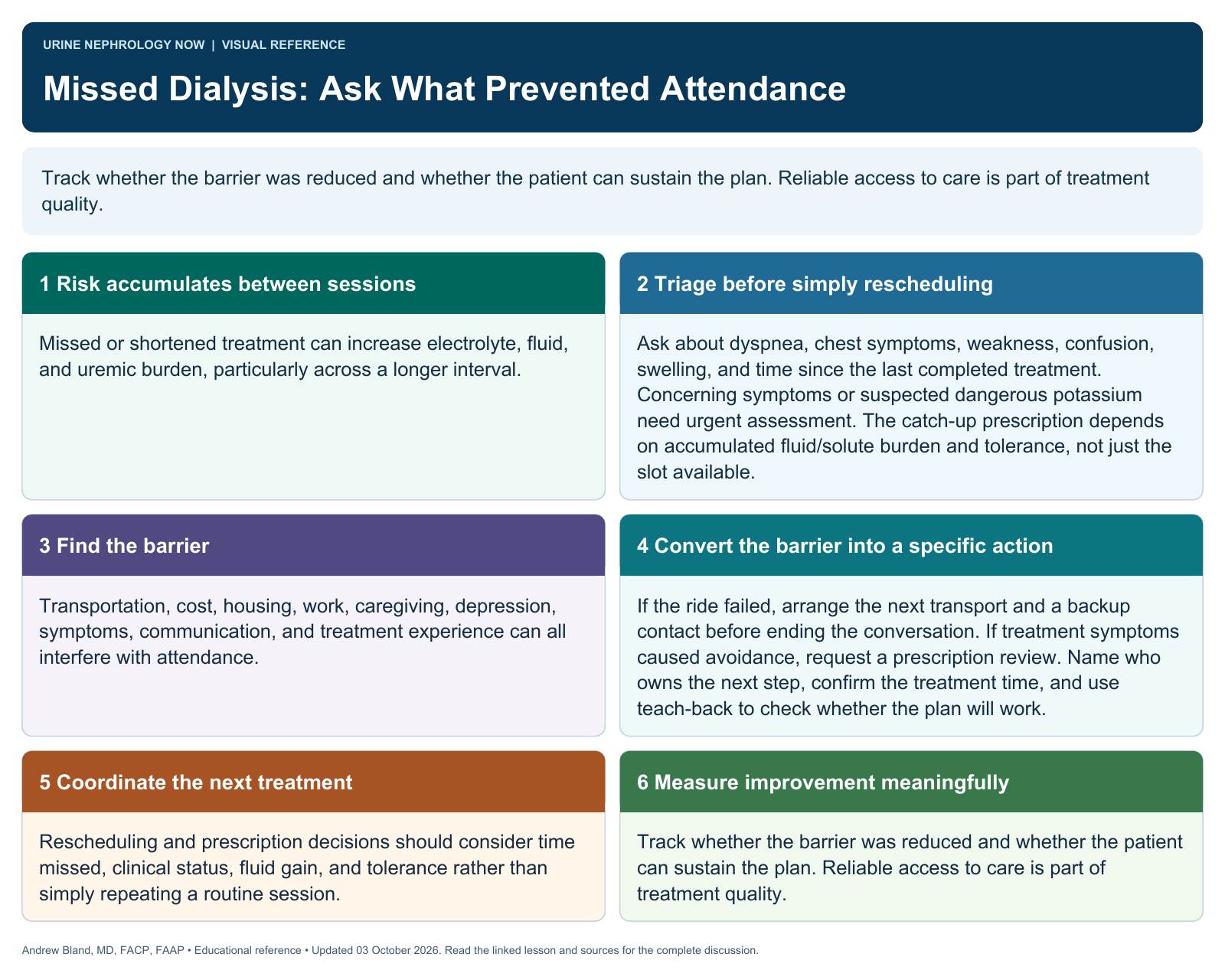
Track whether the barrier was reduced and whether the patient can sustain the plan. Reliable access to care is part of treatment quality.
Text version
Risk accumulates between sessions
Missed or shortened treatment can increase electrolyte, fluid, and uremic burden, particularly across a longer interval.
Assess urgent consequences
Dyspnea, weakness, chest symptoms, confusion, or a concerning potassium result requires prompt clinical assessment and an appropriate treatment plan.
Find the barrier
Transportation, cost, housing, work, caregiving, depression, symptoms, communication, and treatment experience can all interfere with attendance.
Respond without blame
Ask what made attendance difficult and connect the patient with practical support. A label of nonadherence does not solve the cause.
Coordinate the next treatment
Rescheduling and prescription decisions should consider time missed, clinical status, fluid gain, and tolerance rather than simply repeating a routine session.
Measure improvement meaningfully
Track whether the barrier was reduced and whether the patient can sustain the plan. Reliable access to care is part of treatment quality.
Continue learning
This graphic summarizes a topic. The full educational pages provide the broader discussion and references.