Visual summary
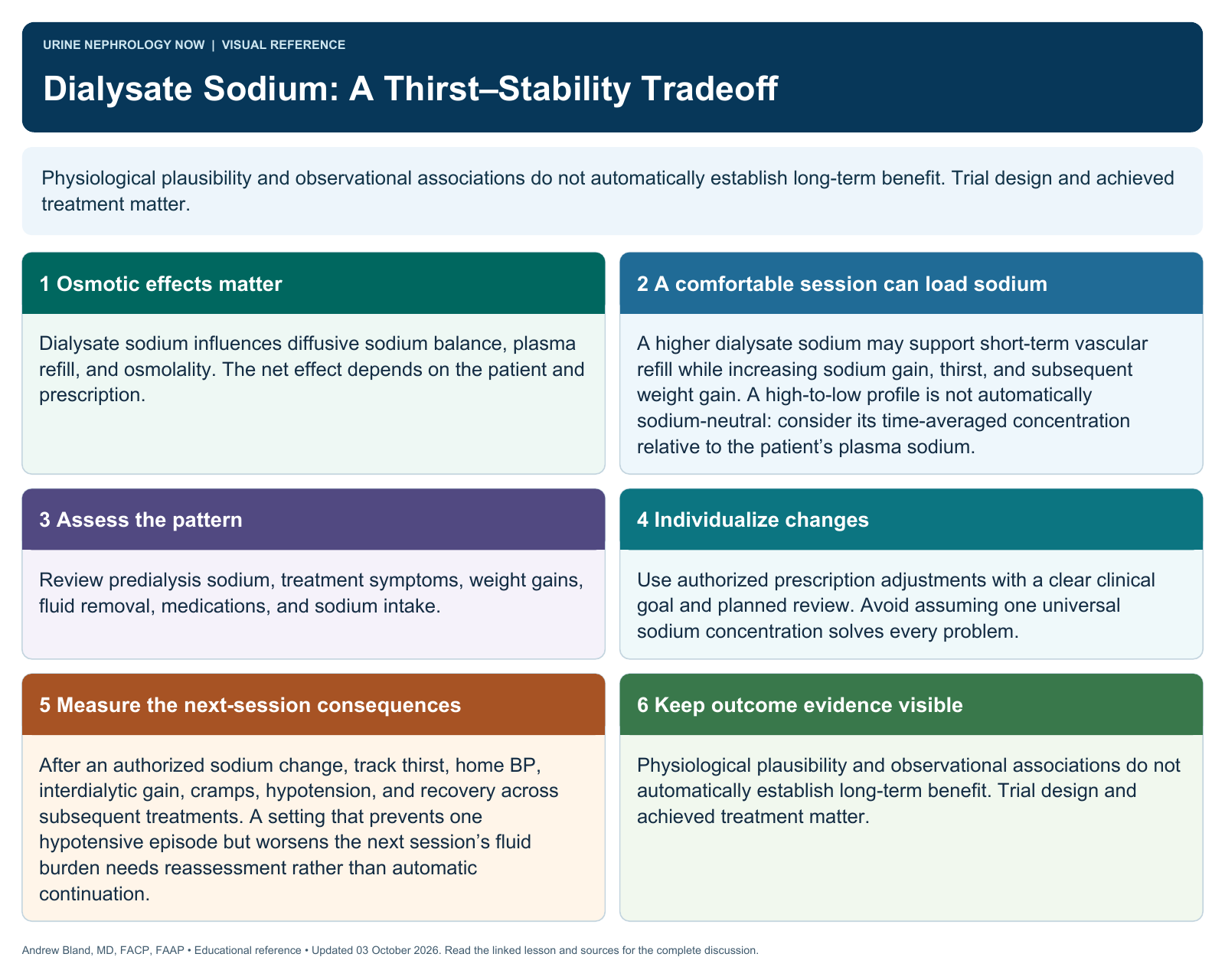
Physiological plausibility and observational associations do not automatically establish long-term benefit. Trial design and achieved treatment matter.
Text version
Osmotic effects matter
Dialysate sodium influences diffusive sodium balance, plasma refill, and osmolality. The net effect depends on the patient and prescription.
Recognize competing goals
A strategy that improves short-term tolerance may increase thirst, interdialytic weight gain, or blood pressure; a lower setting may reduce tolerance in some patients.
Assess the pattern
Review predialysis sodium, treatment symptoms, weight gains, fluid removal, medications, and sodium intake.
Individualize changes
Use authorized prescription adjustments with a clear clinical goal and planned review. Avoid assuming one universal sodium concentration solves every problem.
Follow beyond the session
Track thirst, home blood pressure, subsequent weight gain, and repeated intradialytic symptoms, not just whether today's treatment finished.
Keep outcome evidence visible
Physiological plausibility and observational associations do not automatically establish long-term benefit. Trial design and achieved treatment matter.
Continue learning
This graphic summarizes a topic. The full educational pages provide the broader discussion and references.