Visual summary
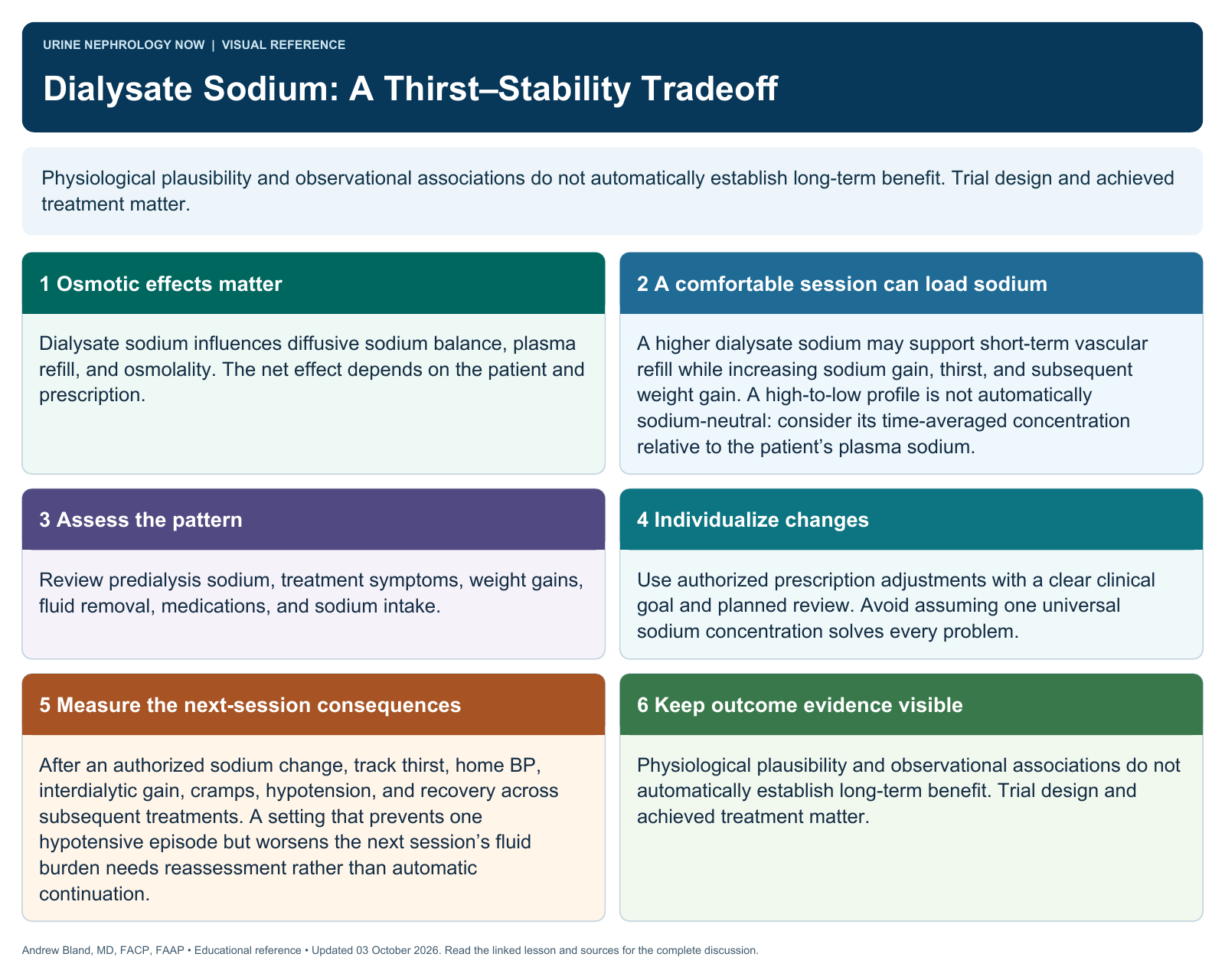
Physiological plausibility and observational associations do not automatically establish long-term benefit. Trial design and achieved treatment matter.
Text version
Osmotic effects matter
Dialysate sodium influences diffusive sodium balance, plasma refill, and osmolality. The net effect depends on the patient and prescription.
A comfortable session can load sodium
A higher dialysate sodium may support short-term vascular refill while increasing sodium gain, thirst, and subsequent weight gain. A high-to-low profile is not automatically sodium-neutral: consider its time-averaged concentration relative to the patient’s plasma sodium.
Assess the pattern
Review predialysis sodium, treatment symptoms, weight gains, fluid removal, medications, and sodium intake.
Individualize changes
Use authorized prescription adjustments with a clear clinical goal and planned review. Avoid assuming one universal sodium concentration solves every problem.
Measure the next-session consequences
After an authorized sodium change, track thirst, home BP, interdialytic gain, cramps, hypotension, and recovery across subsequent treatments. A setting that prevents one hypotensive episode but worsens the next session’s fluid burden needs reassessment rather than automatic continuation.
Keep outcome evidence visible
Physiological plausibility and observational associations do not automatically establish long-term benefit. Trial design and achieved treatment matter.