Visual summary
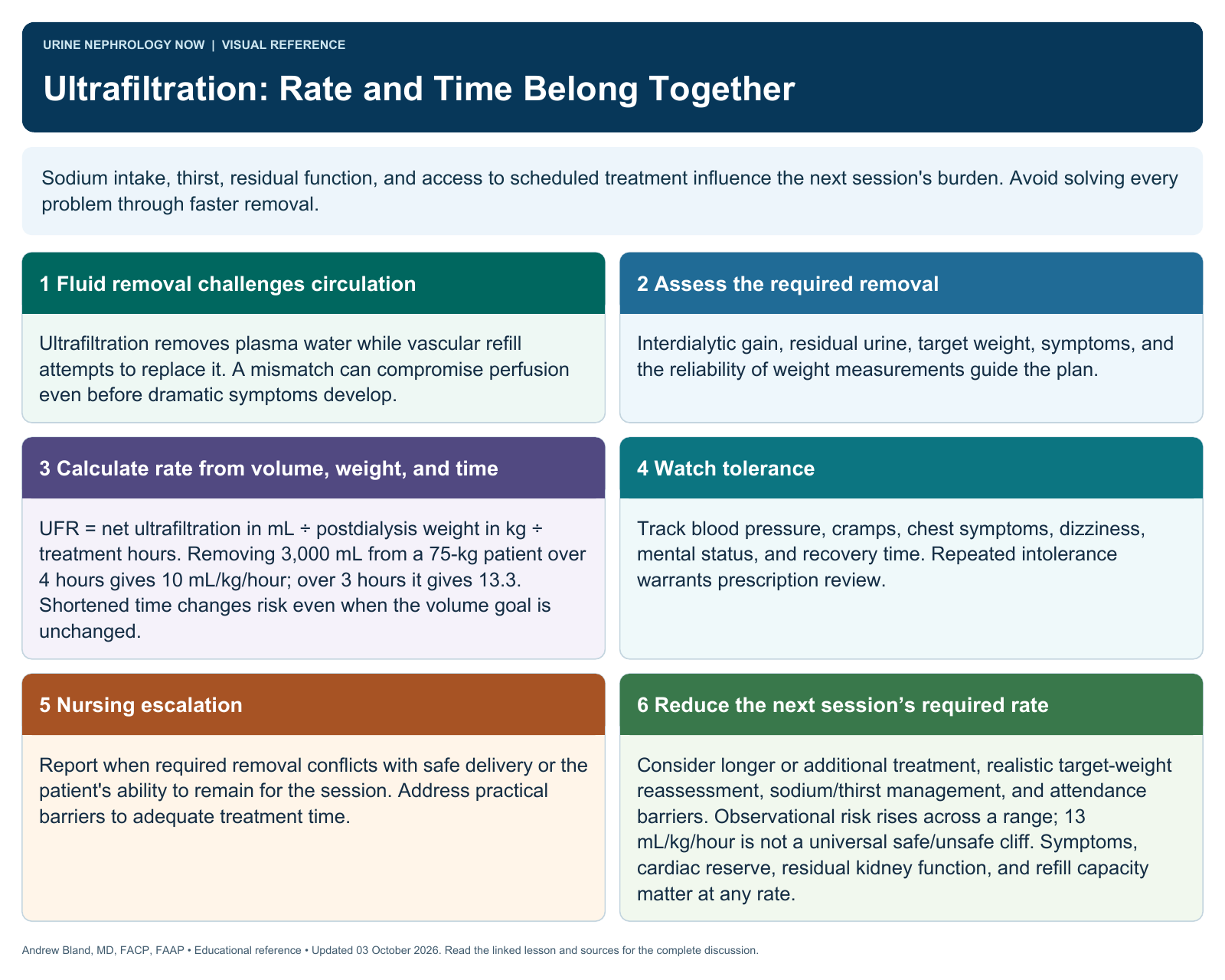
Sodium intake, thirst, residual function, and access to scheduled treatment influence the next session's burden. Avoid solving every problem through faster removal.
Text version
Fluid removal challenges circulation
Ultrafiltration removes plasma water while vascular refill attempts to replace it. A mismatch can compromise perfusion even before dramatic symptoms develop.
Assess the required removal
Interdialytic gain, residual urine, target weight, symptoms, and the reliability of weight measurements guide the plan.
Calculate rate from volume, weight, and time
UFR = net ultrafiltration in mL ÷ postdialysis weight in kg ÷ treatment hours. Removing 3,000 mL from a 75-kg patient over 4 hours gives 10 mL/kg/hour; over 3 hours it gives 13.3. Shortened time changes risk even when the volume goal is unchanged.
Watch tolerance
Track blood pressure, cramps, chest symptoms, dizziness, mental status, and recovery time. Repeated intolerance warrants prescription review.
Nursing escalation
Report when required removal conflicts with safe delivery or the patient's ability to remain for the session. Address practical barriers to adequate treatment time.
Reduce the next session’s required rate
Consider longer or additional treatment, realistic target-weight reassessment, sodium/thirst management, and attendance barriers. Observational risk rises across a range; 13 mL/kg/hour is not a universal safe/unsafe cliff. Symptoms, cardiac reserve, residual kidney function, and refill capacity matter at any rate.