Visual summary
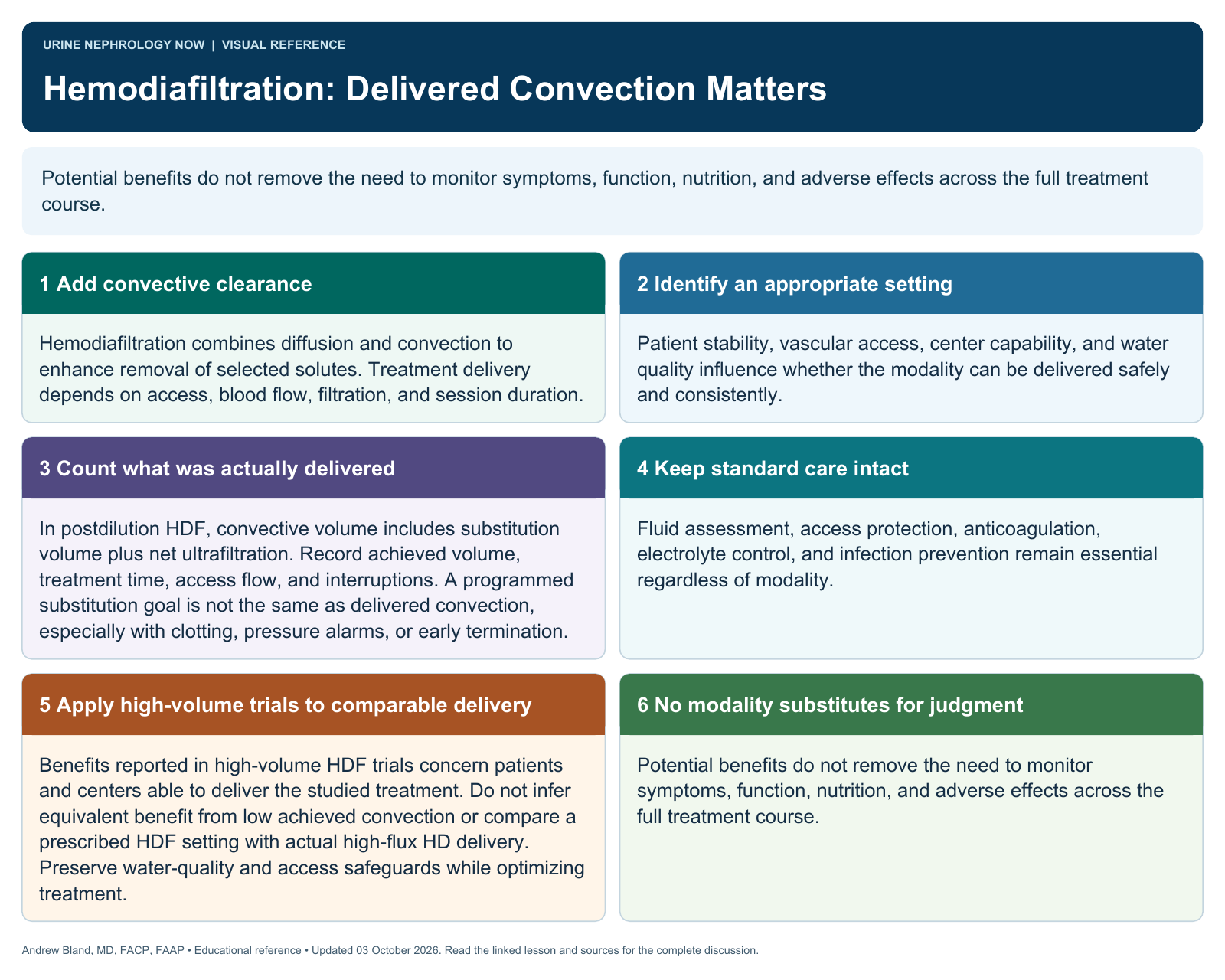
Potential benefits do not remove the need to monitor symptoms, function, nutrition, and adverse effects across the full treatment course.
Text version
Add convective clearance
Hemodiafiltration combines diffusion and convection to enhance removal of selected solutes. Treatment delivery depends on access, blood flow, filtration, and session duration.
Identify an appropriate setting
Patient stability, vascular access, center capability, and water quality influence whether the modality can be delivered safely and consistently.
Count what was actually delivered
In postdilution HDF, convective volume includes substitution volume plus net ultrafiltration. Record achieved volume, treatment time, access flow, and interruptions. A programmed substitution goal is not the same as delivered convection, especially with clotting, pressure alarms, or early termination.
Keep standard care intact
Fluid assessment, access protection, anticoagulation, electrolyte control, and infection prevention remain essential regardless of modality.
Apply high-volume trials to comparable delivery
Benefits reported in high-volume HDF trials concern patients and centers able to deliver the studied treatment. Do not infer equivalent benefit from low achieved convection or compare a prescribed HDF setting with actual high-flux HD delivery. Preserve water-quality and access safeguards while optimizing treatment.
No modality substitutes for judgment
Potential benefits do not remove the need to monitor symptoms, function, nutrition, and adverse effects across the full treatment course.