Visual summary
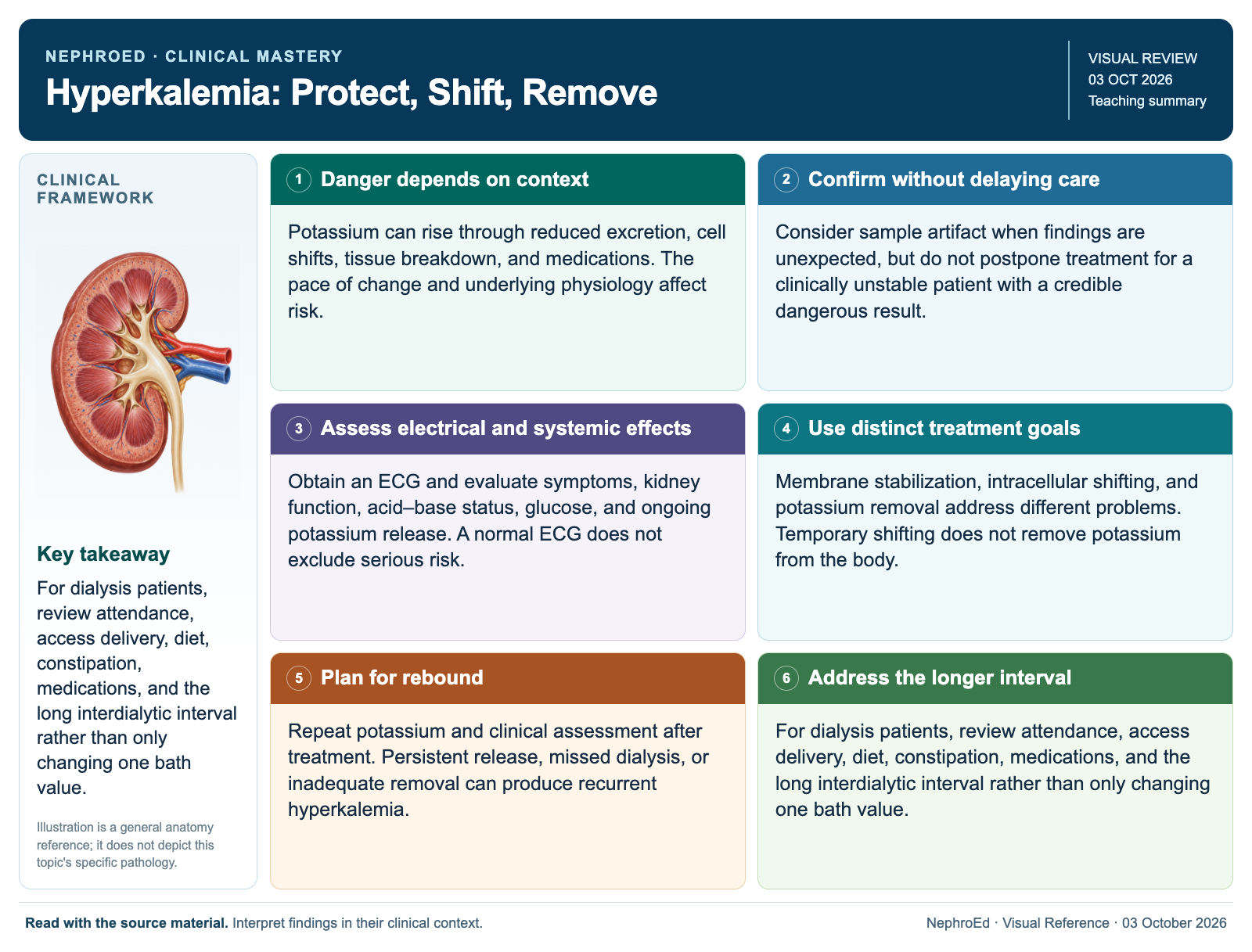
For dialysis patients, review attendance, access delivery, diet, constipation, medications, and the long interdialytic interval rather than only changing one bath value.
Text version
Danger depends on context
Potassium can rise through reduced excretion, cell shifts, tissue breakdown, and medications. The pace of change and underlying physiology affect risk.
Confirm without delaying care
Consider sample artifact when findings are unexpected, but do not postpone treatment for a clinically unstable patient with a credible dangerous result.
Assess electrical and systemic effects
Obtain an ECG and evaluate symptoms, kidney function, acid–base status, glucose, and ongoing potassium release. A normal ECG does not exclude serious risk.
Use distinct treatment goals
Membrane stabilization, intracellular shifting, and potassium removal address different problems. Temporary shifting does not remove potassium from the body.
Plan for rebound
Repeat potassium and clinical assessment after treatment. Persistent release, missed dialysis, or inadequate removal can produce recurrent hyperkalemia.
Address the longer interval
For dialysis patients, review attendance, access delivery, diet, constipation, medications, and the long interdialytic interval rather than only changing one bath value.
Continue learning
This graphic summarizes a topic. The full educational pages provide the broader discussion and references.