Visual summary
The observed sodium trajectory is more important than a calculation alone. Neurologic status, chronicity, and treatment tolerance remain central.
Text version
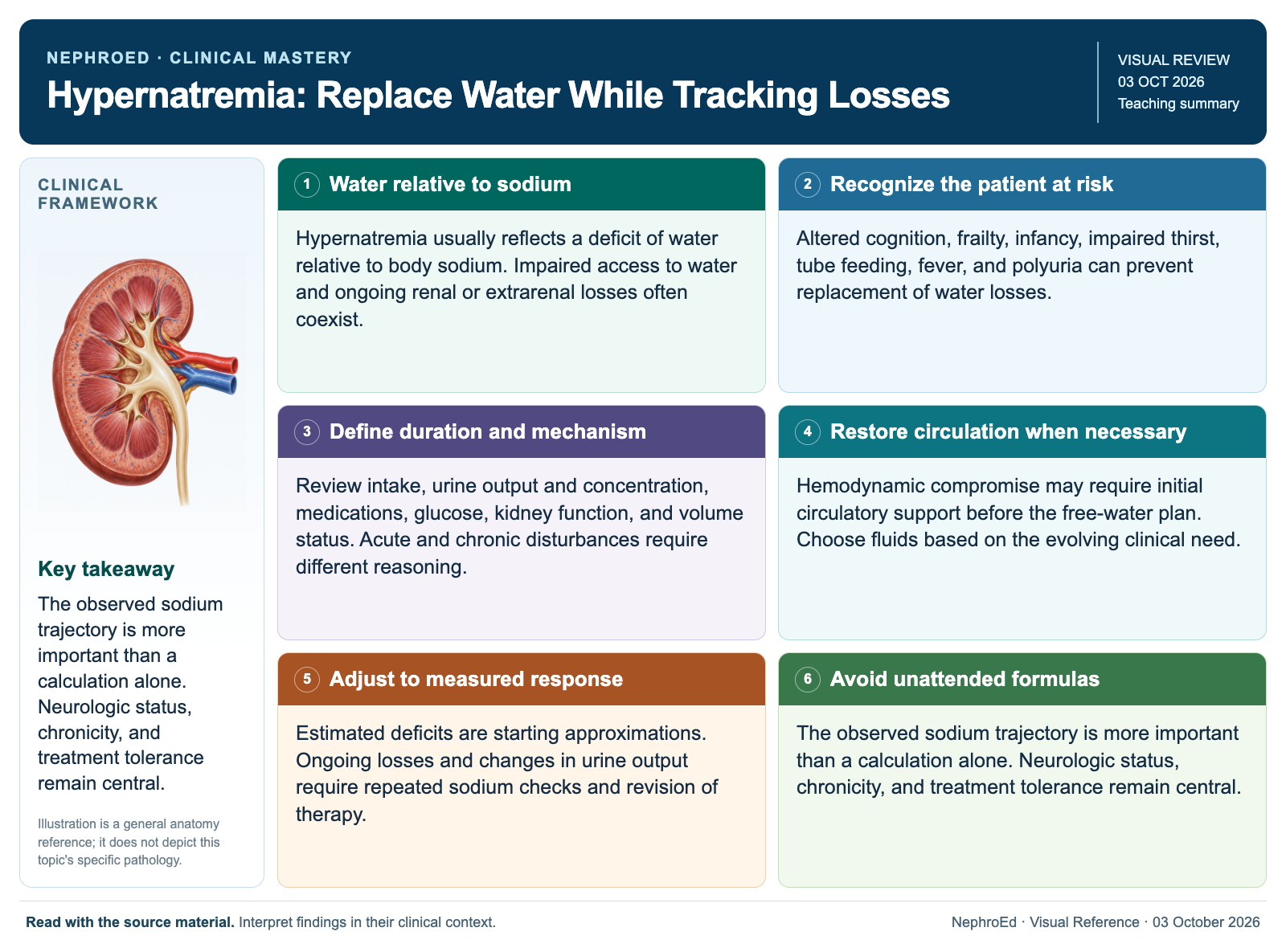
Water relative to sodium
Hypernatremia usually reflects a deficit of water relative to body sodium. Impaired access to water and ongoing renal or extrarenal losses often coexist.
Recognize the patient at risk
Altered cognition, frailty, infancy, impaired thirst, tube feeding, fever, and polyuria can prevent replacement of water losses.
Define duration and mechanism
Review intake, urine output and concentration, medications, glucose, kidney function, and volume status. Acute and chronic disturbances require different reasoning.
Restore circulation when necessary
Hemodynamic compromise may require initial circulatory support before the free-water plan. Choose fluids based on the evolving clinical need.
Adjust to measured response
Estimated deficits are starting approximations. Ongoing losses and changes in urine output require repeated sodium checks and revision of therapy.
Avoid unattended formulas
The observed sodium trajectory is more important than a calculation alone. Neurologic status, chronicity, and treatment tolerance remain central.
Continue learning
This graphic summarizes a topic. The full educational pages provide the broader discussion and references.