Visual summary
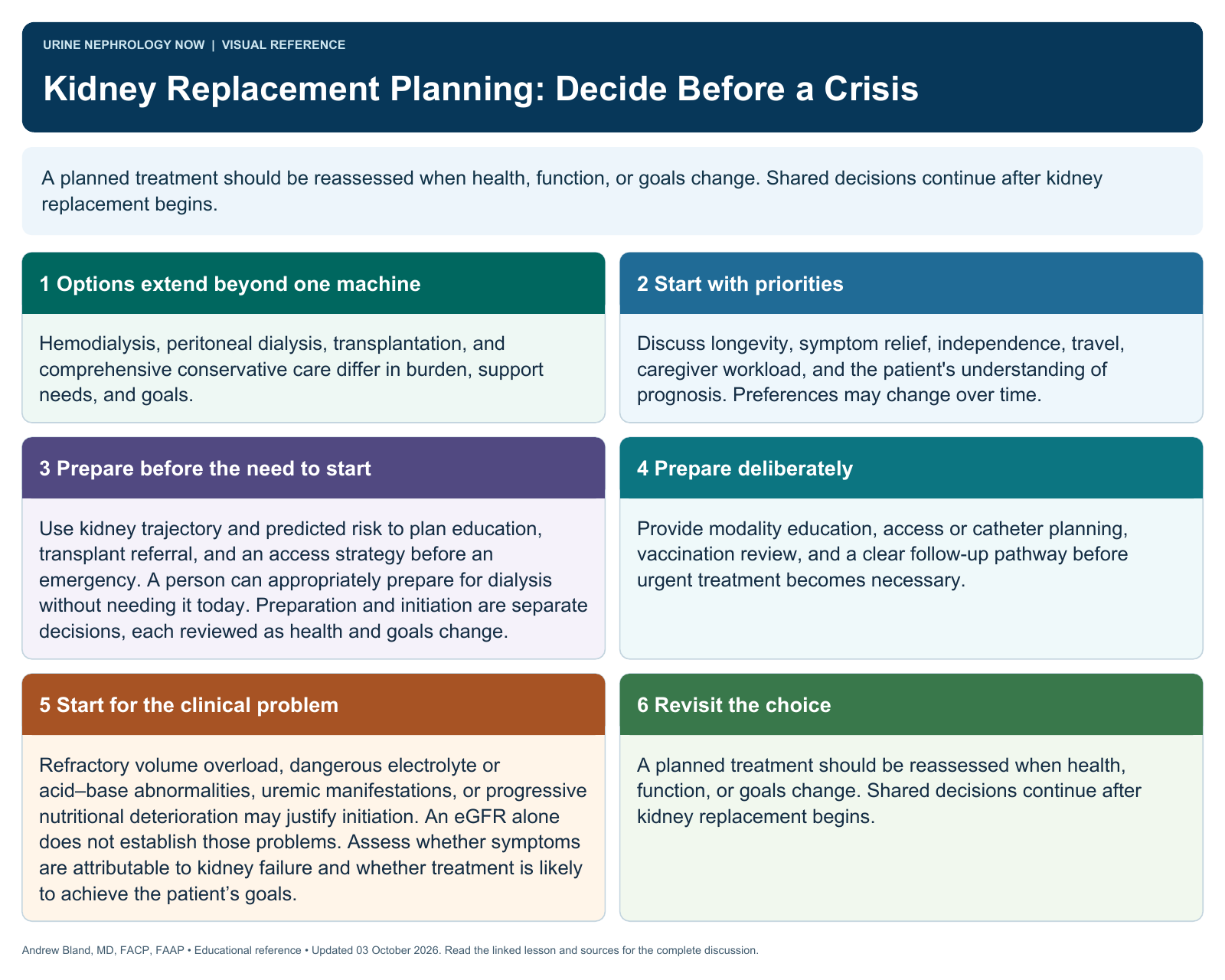
A planned treatment should be reassessed when health, function, or goals change. Shared decisions continue after kidney replacement begins.
Text version
Options extend beyond one machine
Hemodialysis, peritoneal dialysis, transplantation, and comprehensive conservative care differ in burden, support needs, and goals.
Start with priorities
Discuss longevity, symptom relief, independence, travel, caregiver workload, and the patient's understanding of prognosis. Preferences may change over time.
Prepare before the need to start
Use kidney trajectory and predicted risk to plan education, transplant referral, and an access strategy before an emergency. A person can appropriately prepare for dialysis without needing it today. Preparation and initiation are separate decisions, each reviewed as health and goals change.
Prepare deliberately
Provide modality education, access or catheter planning, vaccination review, and a clear follow-up pathway before urgent treatment becomes necessary.
Start for the clinical problem
Refractory volume overload, dangerous electrolyte or acid–base abnormalities, uremic manifestations, or progressive nutritional deterioration may justify initiation. An eGFR alone does not establish those problems. Assess whether symptoms are attributable to kidney failure and whether treatment is likely to achieve the patient’s goals.
Revisit the choice
A planned treatment should be reassessed when health, function, or goals change. Shared decisions continue after kidney replacement begins.