Visual summary
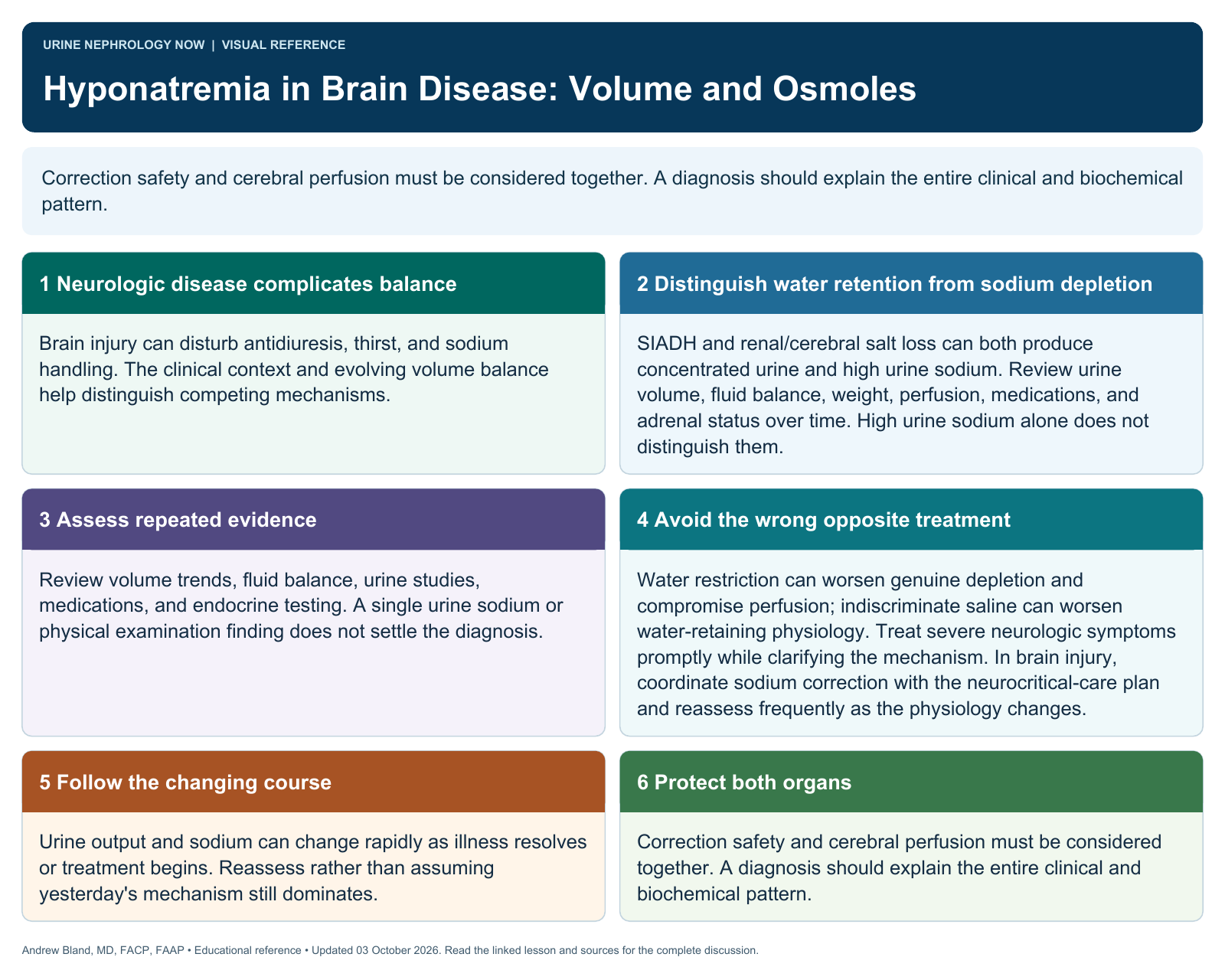
Correction safety and cerebral perfusion must be considered together. A diagnosis should explain the entire clinical and biochemical pattern.
Text version
Neurologic disease complicates balance
Brain injury can disturb antidiuresis, thirst, and sodium handling. The clinical context and evolving volume balance help distinguish competing mechanisms.
Avoid labels from sodium alone
SIADH, sodium loss, adrenal dysfunction, medication effects, and inadequate intake have different treatment implications.
Assess repeated evidence
Review volume trends, fluid balance, urine studies, medications, and endocrine testing. A single urine sodium or physical examination finding does not settle the diagnosis.
Match replacement to loss
Treat severe neurologic symptoms urgently and address the underlying mechanism. A water-restricted patient with genuine depletion can worsen.
Follow the changing course
Urine output and sodium can change rapidly as illness resolves or treatment begins. Reassess rather than assuming yesterday's mechanism still dominates.
Protect both organs
Correction safety and cerebral perfusion must be considered together. A diagnosis should explain the entire clinical and biochemical pattern.
Continue learning
This graphic summarizes a topic. The full educational pages provide the broader discussion and references.