Visual summary
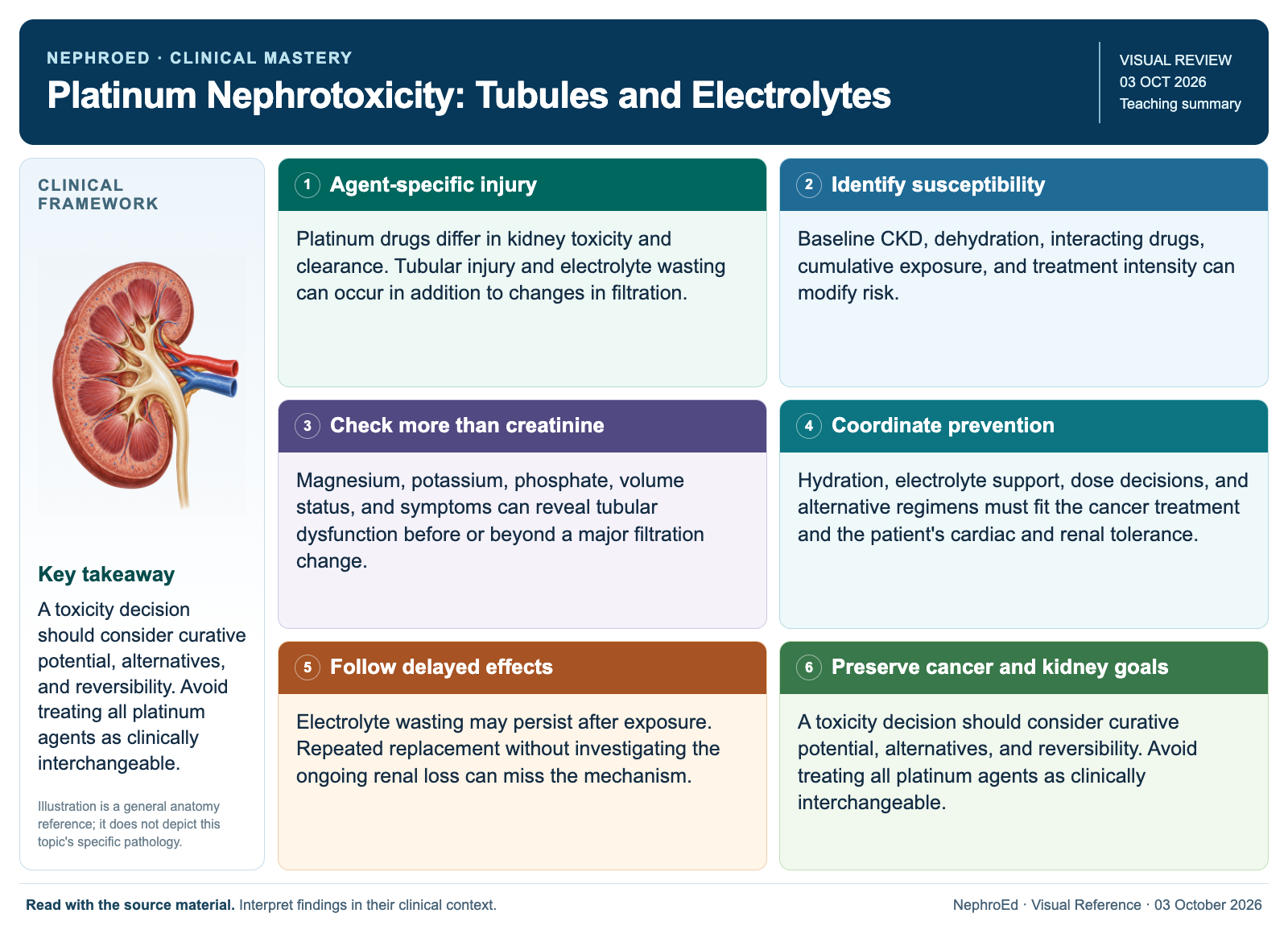
A toxicity decision should consider curative potential, alternatives, and reversibility. Avoid treating all platinum agents as clinically interchangeable.
Text version
Agent-specific injury
Platinum drugs differ in kidney toxicity and clearance. Tubular injury and electrolyte wasting can occur in addition to changes in filtration.
Identify susceptibility
Baseline CKD, dehydration, interacting drugs, cumulative exposure, and treatment intensity can modify risk.
Check more than creatinine
Magnesium, potassium, phosphate, volume status, and symptoms can reveal tubular dysfunction before or beyond a major filtration change.
Coordinate prevention
Hydration, electrolyte support, dose decisions, and alternative regimens must fit the cancer treatment and the patient's cardiac and renal tolerance.
Follow delayed effects
Electrolyte wasting may persist after exposure. Repeated replacement without investigating the ongoing renal loss can miss the mechanism.
Preserve cancer and kidney goals
A toxicity decision should consider curative potential, alternatives, and reversibility. Avoid treating all platinum agents as clinically interchangeable.
Continue learning
This graphic summarizes a topic. The full educational pages provide the broader discussion and references.