Visual summary
A toxicity decision should consider curative potential, alternatives, and reversibility. Avoid treating all platinum agents as clinically interchangeable.
Text version
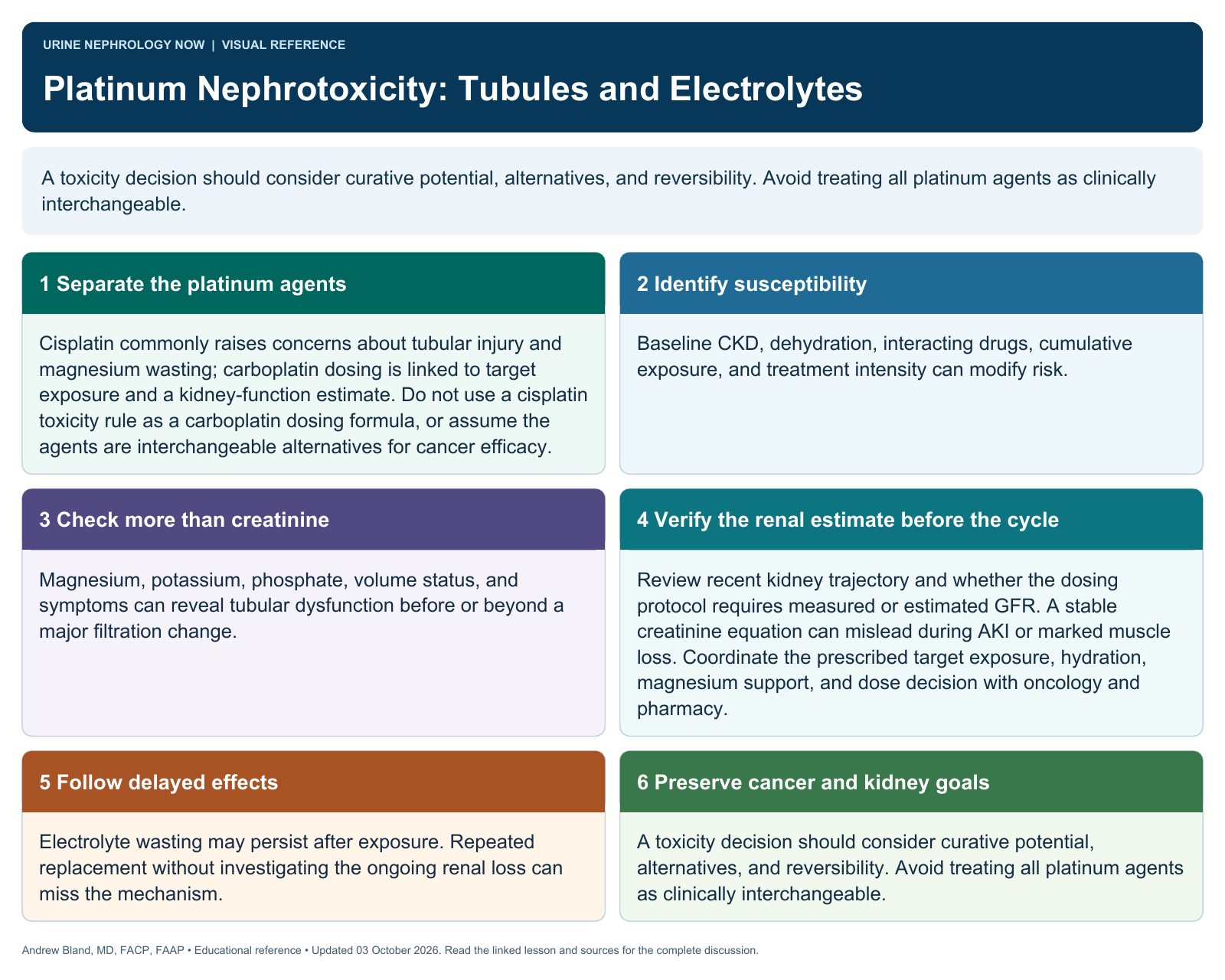
Separate the platinum agents
Cisplatin commonly raises concerns about tubular injury and magnesium wasting; carboplatin dosing is linked to target exposure and a kidney-function estimate. Do not use a cisplatin toxicity rule as a carboplatin dosing formula, or assume the agents are interchangeable alternatives for cancer efficacy.
Identify susceptibility
Baseline CKD, dehydration, interacting drugs, cumulative exposure, and treatment intensity can modify risk.
Check more than creatinine
Magnesium, potassium, phosphate, volume status, and symptoms can reveal tubular dysfunction before or beyond a major filtration change.
Verify the renal estimate before the cycle
Review recent kidney trajectory and whether the dosing protocol requires measured or estimated GFR. A stable creatinine equation can mislead during AKI or marked muscle loss. Coordinate the prescribed target exposure, hydration, magnesium support, and dose decision with oncology and pharmacy.
Follow delayed effects
Electrolyte wasting may persist after exposure. Repeated replacement without investigating the ongoing renal loss can miss the mechanism.
Preserve cancer and kidney goals
A toxicity decision should consider curative potential, alternatives, and reversibility. Avoid treating all platinum agents as clinically interchangeable.