Visual summary
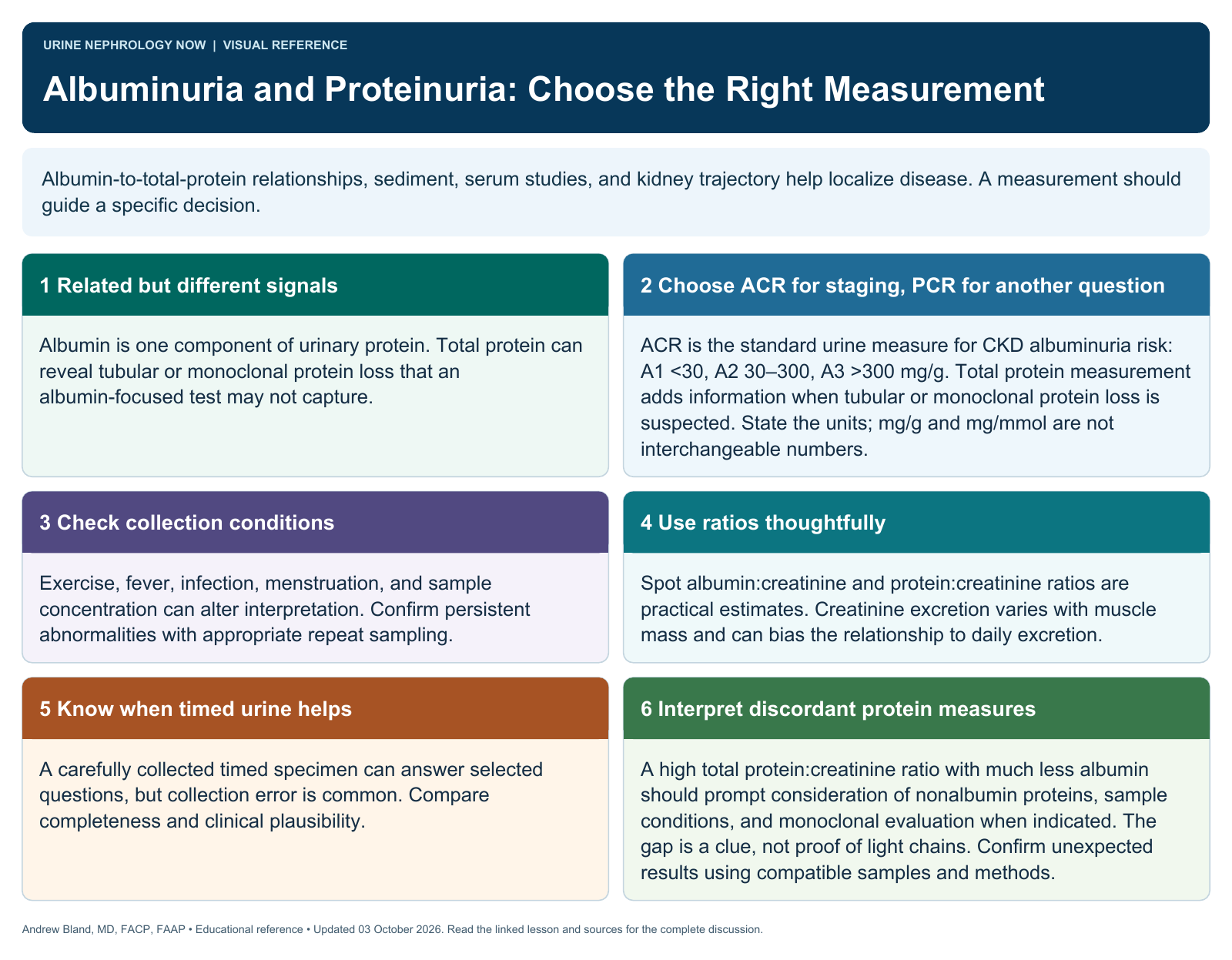
Albumin-to-total-protein relationships, sediment, serum studies, and kidney trajectory help localize disease. A measurement should guide a specific decision.
Text version
Related but different signals
Albumin is one component of urinary protein. Total protein can reveal tubular or monoclonal protein loss that an albumin-focused test may not capture.
Choose ACR for staging, PCR for another question
ACR is the standard urine measure for CKD albuminuria risk: A1 <30, A2 30–300, A3 >300 mg/g. Total protein measurement adds information when tubular or monoclonal protein loss is suspected. State the units; mg/g and mg/mmol are not interchangeable numbers.
Check collection conditions
Exercise, fever, infection, menstruation, and sample concentration can alter interpretation. Confirm persistent abnormalities with appropriate repeat sampling.
Use ratios thoughtfully
Spot albumin:creatinine and protein:creatinine ratios are practical estimates. Creatinine excretion varies with muscle mass and can bias the relationship to daily excretion.
Know when timed urine helps
A carefully collected timed specimen can answer selected questions, but collection error is common. Compare completeness and clinical plausibility.
Interpret discordant protein measures
A high total protein:creatinine ratio with much less albumin should prompt consideration of nonalbumin proteins, sample conditions, and monoclonal evaluation when indicated. The gap is a clue, not proof of light chains. Confirm unexpected results using compatible samples and methods.