Visual summary
Follow growth in children, bone health, nephrolithiasis, potassium, and bicarbonate. A diagnostic label should explain the patient's chemistry and clinical trajectory.
Text version
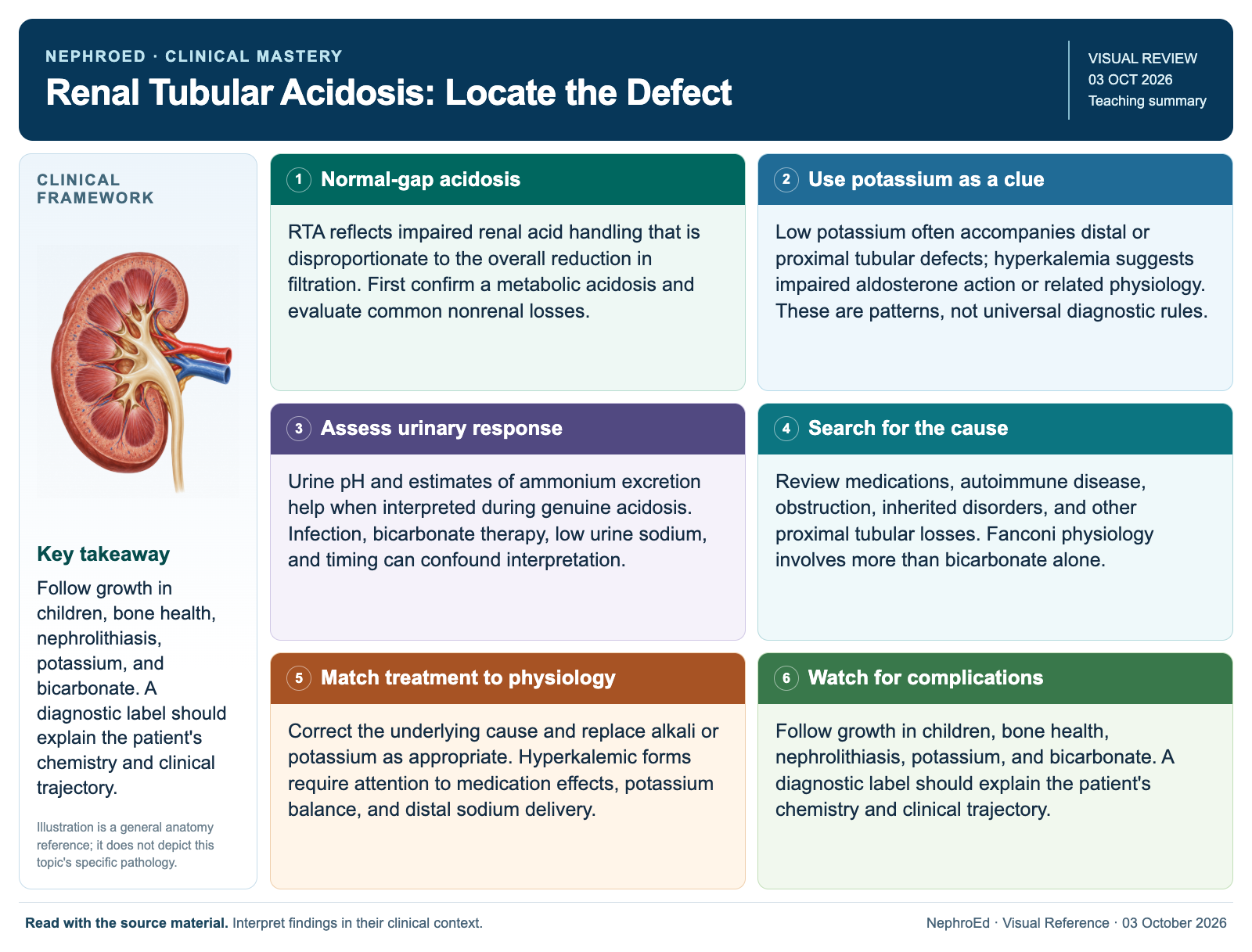
Normal-gap acidosis
RTA reflects impaired renal acid handling that is disproportionate to the overall reduction in filtration. First confirm a metabolic acidosis and evaluate common nonrenal losses.
Use potassium as a clue
Low potassium often accompanies distal or proximal tubular defects; hyperkalemia suggests impaired aldosterone action or related physiology. These are patterns, not universal diagnostic rules.
Assess urinary response
Urine pH and estimates of ammonium excretion help when interpreted during genuine acidosis. Infection, bicarbonate therapy, low urine sodium, and timing can confound interpretation.
Search for the cause
Review medications, autoimmune disease, obstruction, inherited disorders, and other proximal tubular losses. Fanconi physiology involves more than bicarbonate alone.
Match treatment to physiology
Correct the underlying cause and replace alkali or potassium as appropriate. Hyperkalemic forms require attention to medication effects, potassium balance, and distal sodium delivery.
Watch for complications
Follow growth in children, bone health, nephrolithiasis, potassium, and bicarbonate. A diagnostic label should explain the patient's chemistry and clinical trajectory.
Continue learning
This graphic summarizes a topic. The full educational pages provide the broader discussion and references.