Visual summary
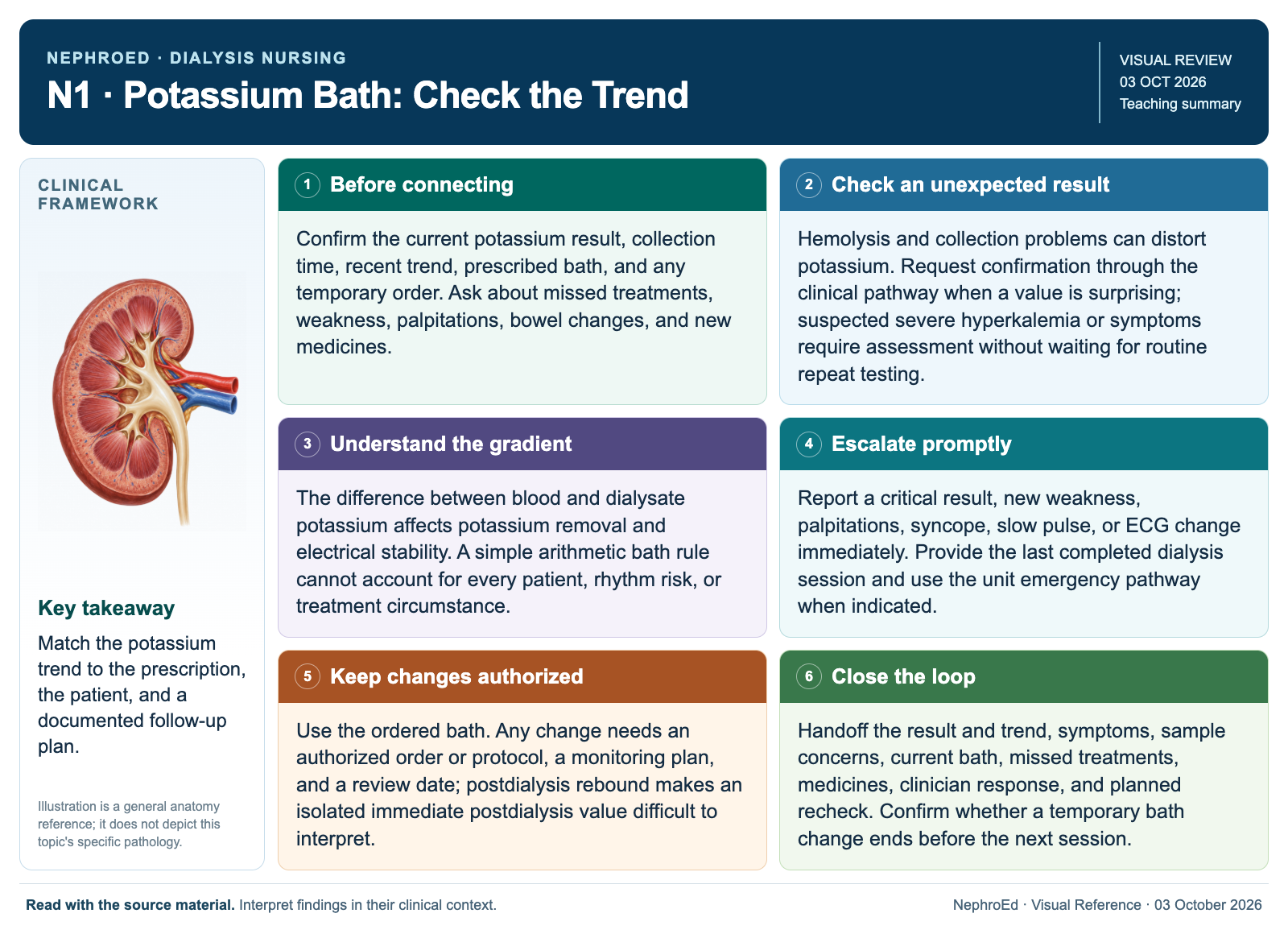
Match the potassium trend to the prescription, the patient, and a documented follow-up plan.
Text version
Before connecting
Confirm the current potassium result, collection time, recent trend, prescribed bath, and any temporary order. Ask about missed treatments, weakness, palpitations, bowel changes, and new medicines.
Check an unexpected result
Hemolysis and collection problems can distort potassium. Request confirmation through the clinical pathway when a value is surprising; suspected severe hyperkalemia or symptoms require assessment without waiting for routine repeat testing.
Understand the gradient
The difference between blood and dialysate potassium affects potassium removal and electrical stability. A simple arithmetic bath rule cannot account for every patient, rhythm risk, or treatment circumstance.
Escalate promptly
Report a critical result, new weakness, palpitations, syncope, slow pulse, or ECG change immediately. Provide the last completed dialysis session and use the unit emergency pathway when indicated.
Keep changes authorized
Use the ordered bath. Any change needs an authorized order or protocol, a monitoring plan, and a review date; postdialysis rebound makes an isolated immediate postdialysis value difficult to interpret.
Close the loop
Handoff the result and trend, symptoms, sample concerns, current bath, missed treatments, medicines, clinician response, and planned recheck. Confirm whether a temporary bath change ends before the next session.
Continue learning
This graphic summarizes a topic. The full educational pages provide the broader discussion and references.