Visual summary
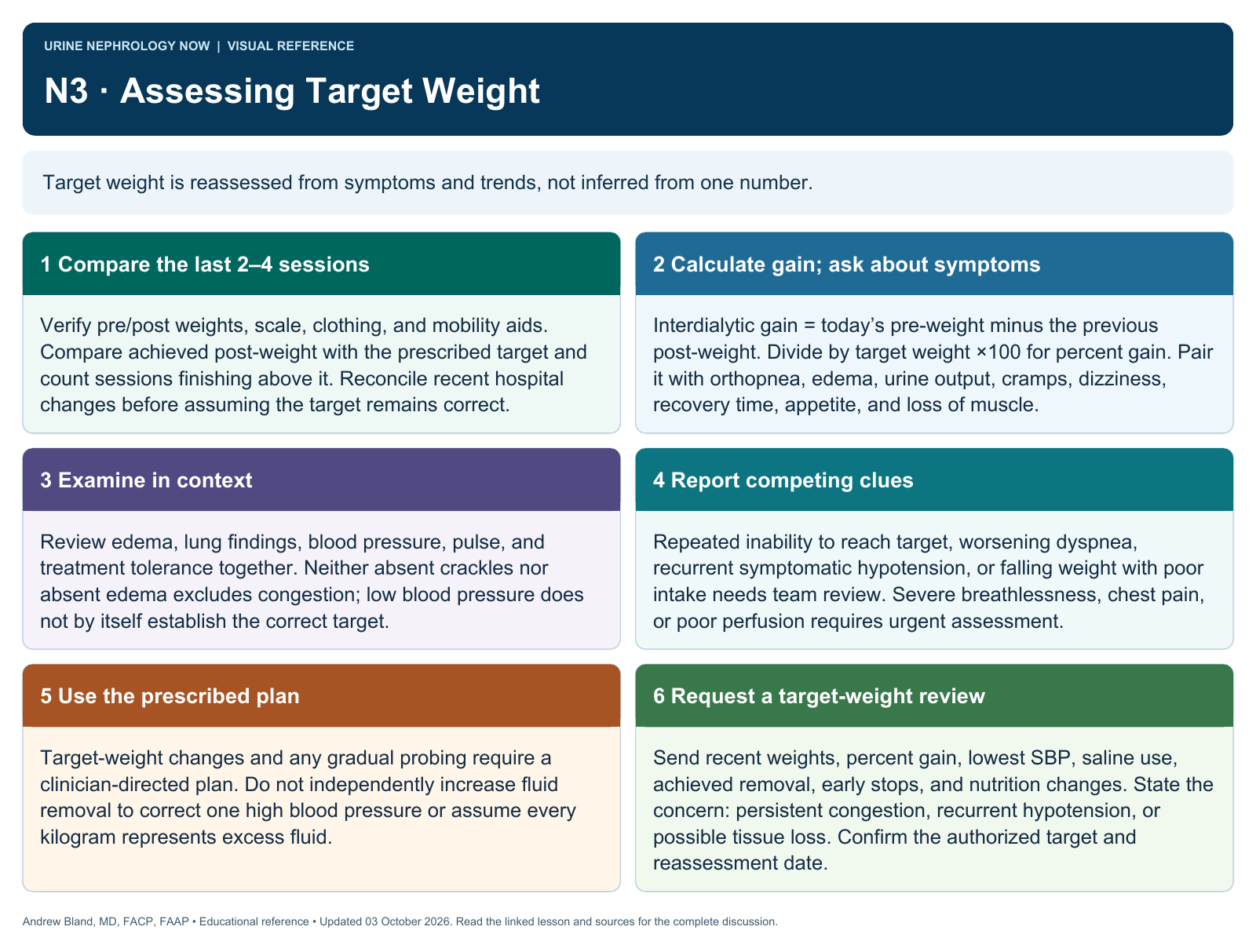
Target weight is reassessed from symptoms and trends, not inferred from one number.
Text version
Start with the pattern
Compare reliable pre- and postdialysis weights with the prescribed target across recent sessions. Check the scale, clothing, mobility aids, and recent admissions before interpreting an apparent change in weight.
Ask about daily life
Assess breathlessness, orthopnea, swelling, thirst, urine output, cramps, dizziness, falls, and recovery time. Ask whether appetite, muscle mass, mobility, or food intake has changed since the target was set.
Examine in context
Review edema, lung findings, blood pressure, pulse, and treatment tolerance together. Neither absent crackles nor absent edema excludes congestion; low blood pressure does not by itself establish the correct target.
Report competing clues
Repeated inability to reach target, worsening dyspnea, recurrent symptomatic hypotension, or falling weight with poor intake needs team review. Severe breathlessness, chest pain, or poor perfusion requires urgent assessment.
Use the prescribed plan
Target-weight changes and any gradual probing require a clinician-directed plan. Do not independently increase fluid removal to correct one high blood pressure or assume every kilogram represents excess fluid.
Make the review useful
Send weight and BP trends, achieved fluid removal, symptoms, saline use, early terminations, urine changes, and nutrition concerns. Name the decision needed and the date for reassessment after a target change.
Continue learning
This graphic summarizes a topic. The full educational pages provide the broader discussion and references.