Visual summary
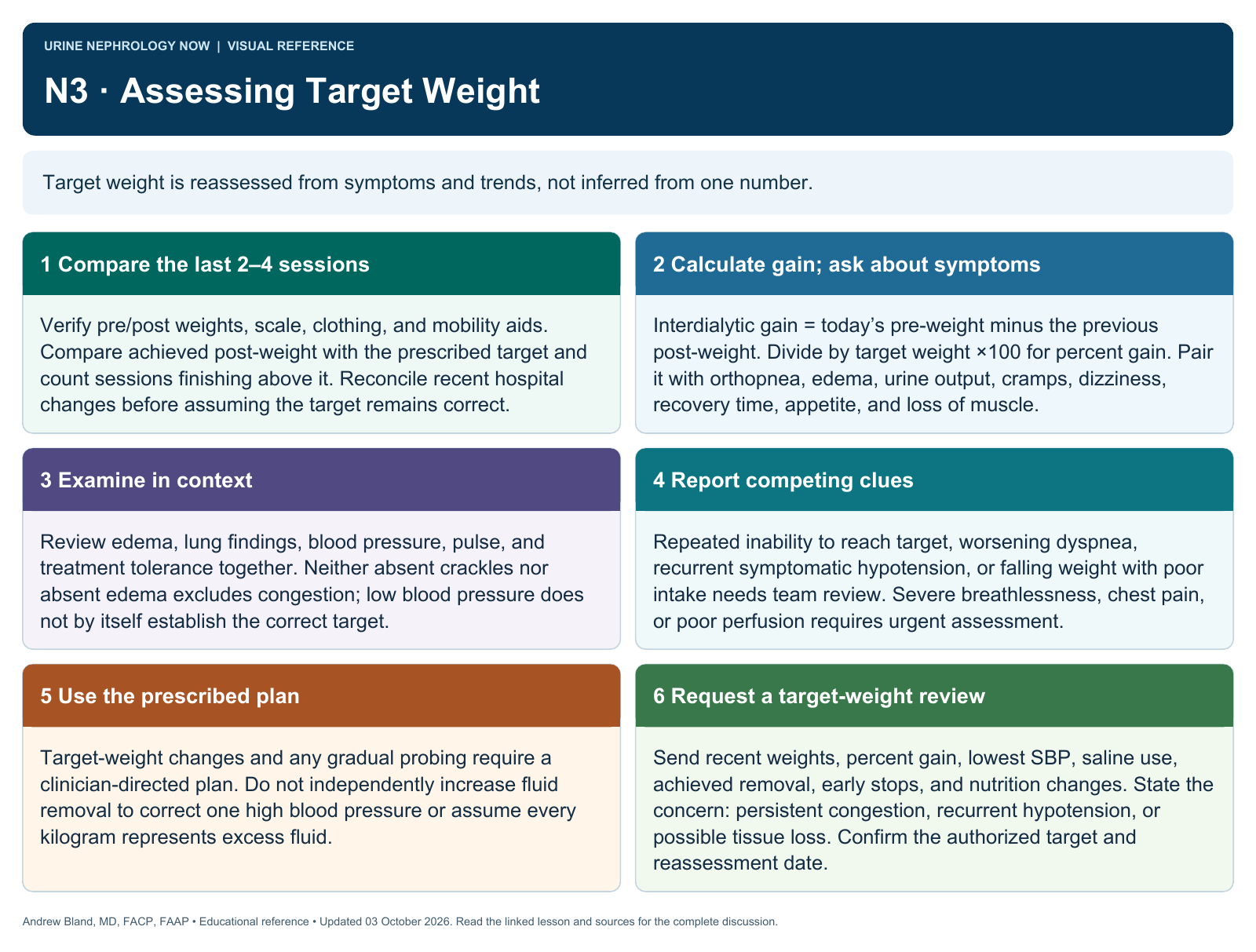
Target weight is reassessed from symptoms and trends, not inferred from one number.
Text version
Compare the last 2–4 sessions
Verify pre/post weights, scale, clothing, and mobility aids. Compare achieved post-weight with the prescribed target and count sessions finishing above it. Reconcile recent hospital changes before assuming the target remains correct.
Calculate gain; ask about symptoms
Interdialytic gain = today’s pre-weight minus the previous post-weight. Divide by target weight ×100 for percent gain. Pair it with orthopnea, edema, urine output, cramps, dizziness, recovery time, appetite, and loss of muscle.
Examine in context
Review edema, lung findings, blood pressure, pulse, and treatment tolerance together. Neither absent crackles nor absent edema excludes congestion; low blood pressure does not by itself establish the correct target.
Report competing clues
Repeated inability to reach target, worsening dyspnea, recurrent symptomatic hypotension, or falling weight with poor intake needs team review. Severe breathlessness, chest pain, or poor perfusion requires urgent assessment.
Use the prescribed plan
Target-weight changes and any gradual probing require a clinician-directed plan. Do not independently increase fluid removal to correct one high blood pressure or assume every kilogram represents excess fluid.
Request a target-weight review
Send recent weights, percent gain, lowest SBP, saline use, achieved removal, early stops, and nutrition changes. State the concern: persistent congestion, recurrent hypotension, or possible tissue loss. Confirm the authorized target and reassessment date.