Visual summary
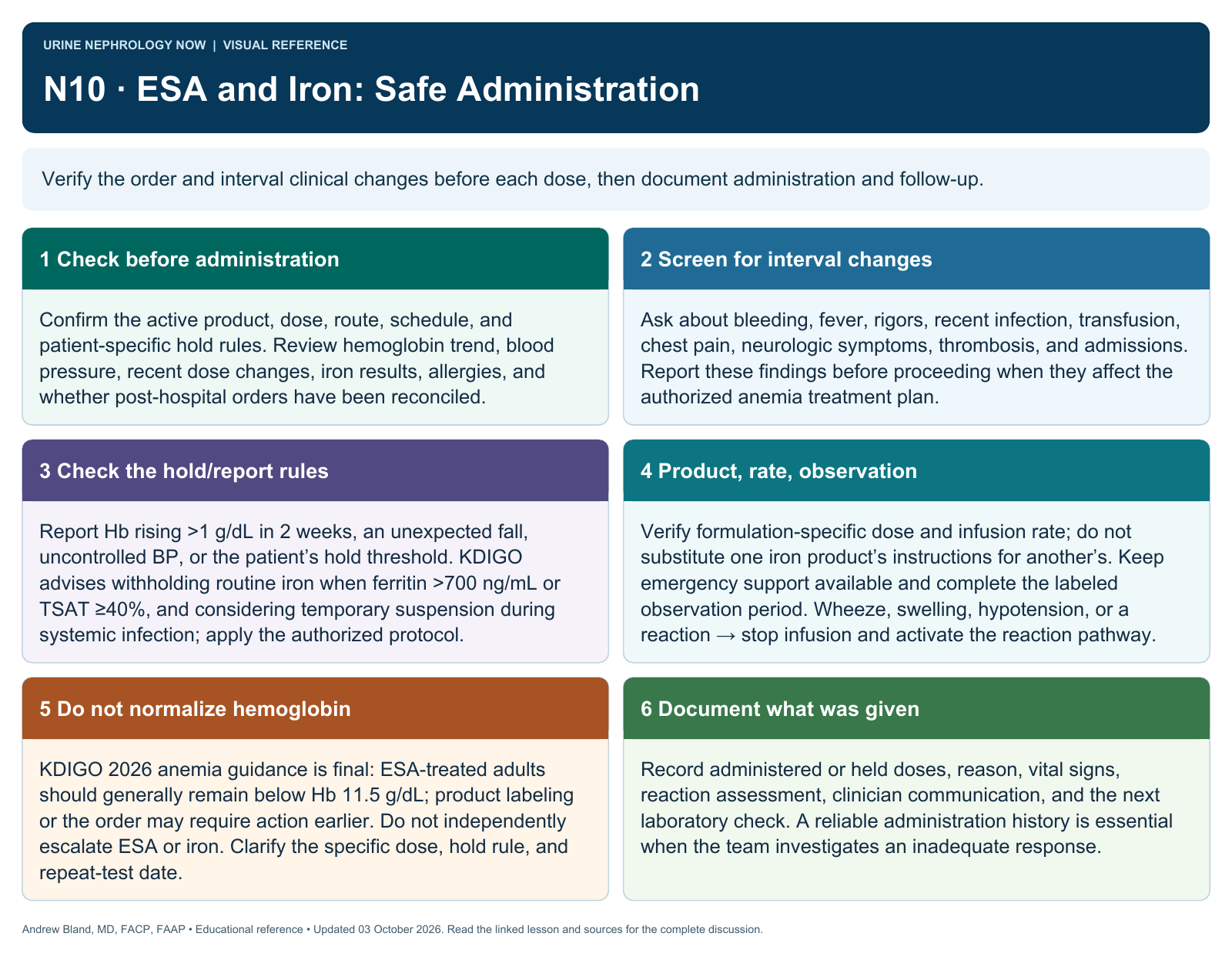
Verify the order and interval clinical changes before each dose, then document administration and follow-up.
Text version
Check before administration
Confirm the active product, dose, route, schedule, and patient-specific hold rules. Review hemoglobin trend, blood pressure, recent dose changes, iron results, allergies, and whether post-hospital orders have been reconciled.
Screen for interval changes
Ask about bleeding, fever, rigors, recent infection, transfusion, chest pain, neurologic symptoms, thrombosis, and admissions. Report these findings before proceeding when they affect the authorized anemia treatment plan.
Check the hold/report rules
Report Hb rising >1 g/dL in 2 weeks, an unexpected fall, uncontrolled BP, or the patient’s hold threshold. KDIGO advises withholding routine iron when ferritin >700 ng/mL or TSAT ≥40%, and considering temporary suspension during systemic infection; apply the authorized protocol.
Product, rate, observation
Verify formulation-specific dose and infusion rate; do not substitute one iron product’s instructions for another’s. Keep emergency support available and complete the labeled observation period. Wheeze, swelling, hypotension, or a reaction → stop infusion and activate the reaction pathway.
Do not normalize hemoglobin
KDIGO 2026 anemia guidance is final: ESA-treated adults should generally remain below Hb 11.5 g/dL; product labeling or the order may require action earlier. Do not independently escalate ESA or iron. Clarify the specific dose, hold rule, and repeat-test date.
Document what was given
Record administered or held doses, reason, vital signs, reaction assessment, clinician communication, and the next laboratory check. A reliable administration history is essential when the team investigates an inadequate response.