Visual summary
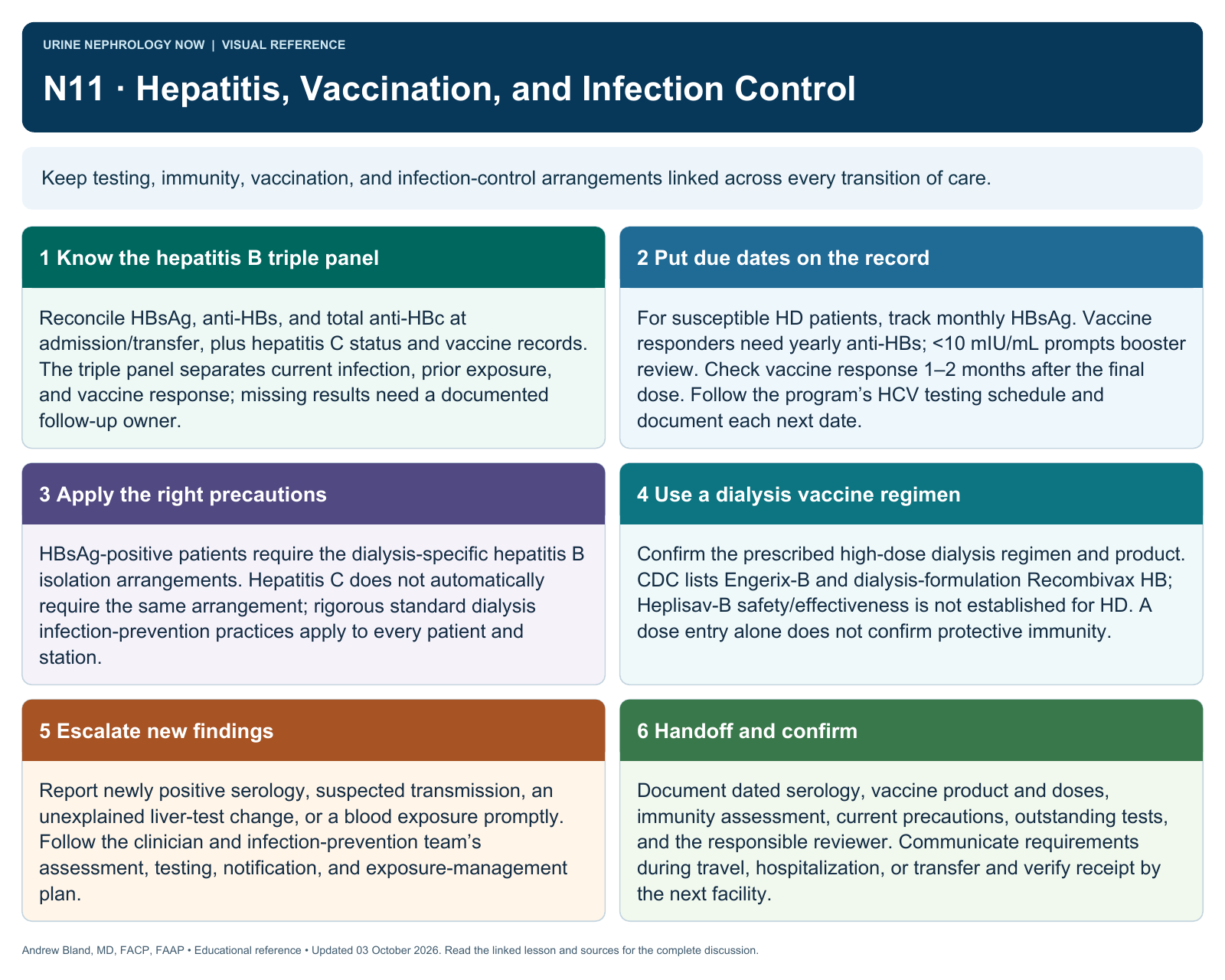
Keep testing, immunity, vaccination, and infection-control arrangements linked across every transition of care.
Text version
Know the incoming status
At admission or transfer, reconcile hepatitis B and C results, vaccination history, and prior infection-control requirements. Clarify missing or discordant results through the unit pathway before assigning care arrangements.
Maintain ongoing surveillance
Track tests and vaccine follow-up at the interval appropriate to susceptibility, immunity, infection history, and the current program. Record results where staff can identify the next required action without relying on memory.
Apply the right precautions
HBsAg-positive patients require the dialysis-specific hepatitis B isolation arrangements. Hepatitis C does not automatically require the same arrangement; rigorous standard dialysis infection-prevention practices apply to every patient and station.
Plan vaccination deliberately
Use the current dialysis-appropriate vaccine schedule and product instructions. Check completion and postvaccination response when indicated; a recorded dose does not necessarily establish protective immunity in a patient receiving hemodialysis.
Escalate new findings
Report newly positive serology, suspected transmission, an unexplained liver-test change, or a blood exposure promptly. Follow the clinician and infection-prevention team’s assessment, testing, notification, and exposure-management plan.
Handoff and confirm
Document dated serology, vaccine product and doses, immunity assessment, current precautions, outstanding tests, and the responsible reviewer. Communicate requirements during travel, hospitalization, or transfer and verify receipt by the next facility.
Continue learning
This graphic summarizes a topic. The full educational pages provide the broader discussion and references.